
Selective Cytopheretic Device Advances Clinical and Commercial Milestones Amid Financing Constraints at SeaStar Medical
SeaStar Medical progresses pivotal trials and regulatory initiatives for its SCD therapy while confronting critical liquidity and manufacturing scale challenges.
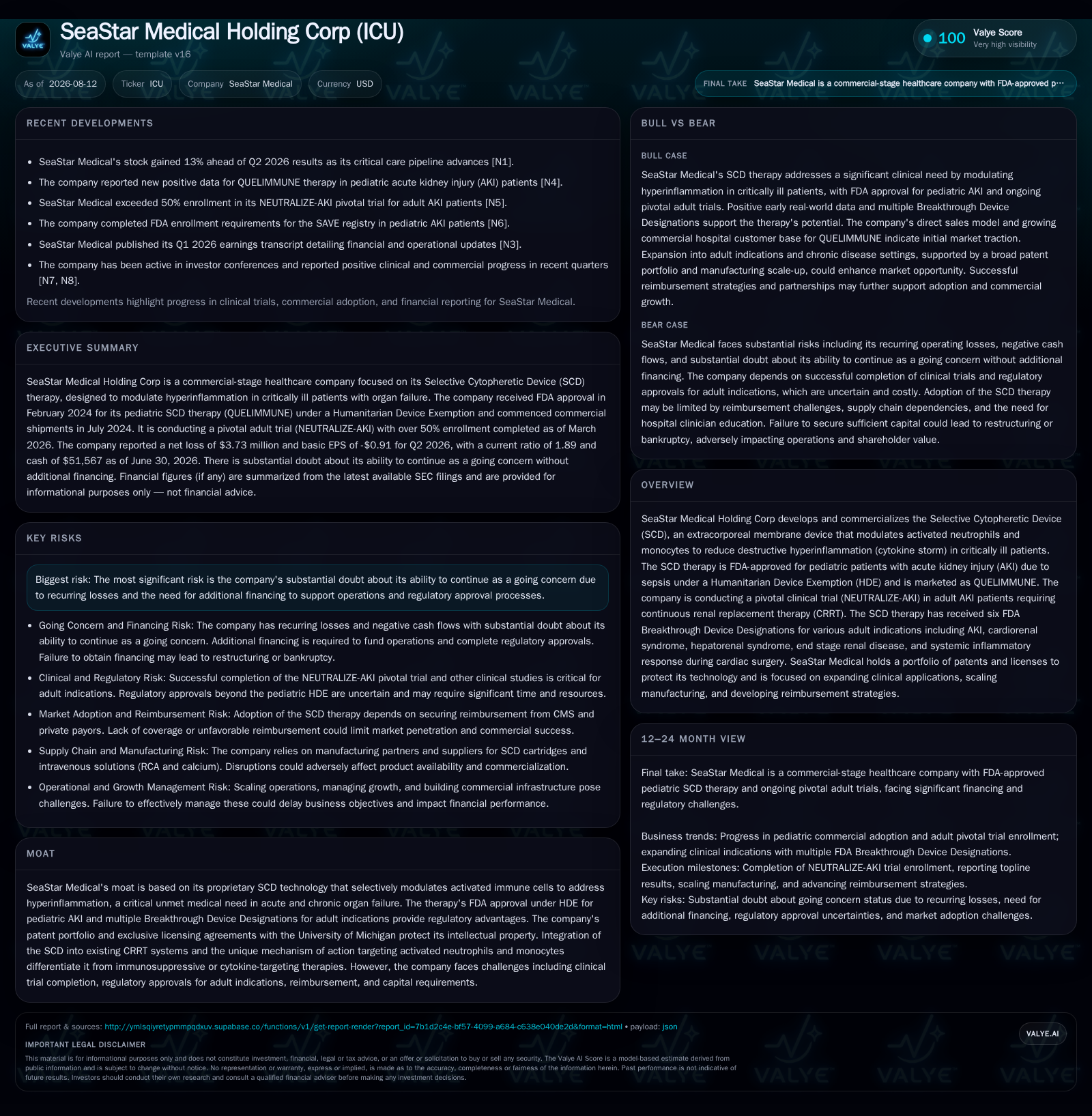
In its August 2026 quarterly update, SeaStar Medical highlights ongoing enrollment in its pivotal NEUTRALIZE-AKI trial targeting adult acute kidney injury patients, supported by six FDA Breakthrough Device Designations that streamline regulatory interactions. The company has commercially launched its pediatric SCD therapy QUELIMMUNE under an FDA Humanitarian Device Exemption since mid-2024, marking initial market entry. Manufacturing scale-up remains a key operational hurdle due to complex device components and supplier negotiations. Despite a differentiated immunomodulatory mechanism protected by patents, SeaStar faces substantial doubt about its ability to continue as a going concern amid recurring losses and modest working capital. Strengthening reimbursement pathways and securing additional financing are essential near-term factors shaping the company’s capacity to advance approvals and broaden adoption.
Pivotal Trial Progress Underpins Expansion Beyond Pediatric Market
SeaStar Medical’s August 12, 2026 quarterly filing confirms active advancement of the NEUTRALIZE-AKI pivotal clinical trial assessing the Selective Cytopheretic Device (SCD) therapy in critically ill adult patients with acute kidney injury (AKI) requiring continuous renal replacement therapy (CRRT) [S2][S1]. This trial is crucial for expanding regulatory approvals beyond the existing pediatric indication granted under the FDA Humanitarian Device Exemption (HDE), which enabled commercial launch of QUELIMMUNE in July 2024 [S1]. The company holds six FDA Breakthrough Device Designations (BDDs) covering multiple adult indications—including cardiorenal syndrome (CRS), hepatorenal syndrome, end-stage renal disease (ESRD), and systemic inflammatory response during cardiac surgery—providing priority review pathways and more frequent FDA interactions [S1]. These designations reflect recognition of unmet needs in managing hyperinflammation-driven organ failure.
SeaStar’s SCD employs a novel mechanism targeting activated neutrophils and monocytes within an extracorporeal circuit integrated into CRRT systems. This targeted immune cell modulation contrasts with competitors focusing on cytokine adsorption filters or broad immunosuppressive approaches [S1]. Progress against enrollment targets and trial endpoints will be key operational indicators validating both clinical efficacy and regulatory trajectory.
Manufacturing Scale-Up Challenges Reflect Typical Early-Stage Device Commercialization Risks
Scaling manufacturing capacity remains a significant challenge as SeaStar negotiates with suppliers of critical components—including cartridges and tubing—to establish redundancies and mitigate supply chain disruptions [S1]. These components are essential for assembling sterile extracorporeal circuits compatible with existing hospital CRRT infrastructure. Complexity in maintaining quality control standards is heightened by patient safety requirements inherent in critical care devices.
Contract manufacturing capacity constraints combined with stringent compliance protocols typical of this sector pose risks of production delays or cost inflation that could compress margins or limit product availability. Monitoring supplier stability and manufacturing throughput will be important KPIs signaling readiness to support commercial growth.
Patent-Protected Differentiation Enhances Competitive Positioning
SeaStar’s SCD leverages an exclusive patent portfolio licensed from the University of Michigan that protects its cell-directed immunomodulatory approach focusing on activated neutrophils and monocytes [S1]. This mechanism offers a distinct competitive moat relative to peers such as NxStage Medical or Baxter International that emphasize renal replacement therapies without targeted immune modulation or those developing cytokine adsorption platforms.
Integration into existing CRRT workflows facilitates clinician adoption by minimizing disruption compared to entirely new modalities [S1]. SeaStar’s medical education initiatives target nephrologists and ICU teams to communicate both biological rationale—mitigating destructive inflammation—and potential economic benefits such as reduced ICU stays or dialysis dependence. This positioning is critical for persuading payors and healthcare providers.
Financial Fragility Amplifies Execution Risks Amid High Cash Burn
At quarter-end June 30, 2026, SeaStar held positive working capital estimated at approximately $3.9 million with current assets totaling about $8.23 million versus current liabilities near $4.35 million [F1]. The company carried total debt close to $525,000 offset by minimal cash reserves resulting in a modest net debt position around $473,000 [F1]. Auditors have emphasized substantial doubt regarding SeaStar’s ability to continue as a going concern absent additional financing [S2]. The company acknowledges that advancing clinical trials and regulatory submissions will increase cash consumption. Failure to secure timely capital raises risks delaying trials, regulatory filings, or manufacturing scale-up—each potentially detrimental to shareholder value.
Reimbursement Dynamics Critical for Commercial Scalability Post-Approval
Beyond regulatory milestones, obtaining favorable reimbursement coverage from third-party payors including Medicare/Medicaid and private insurers is essential for scaling adoption beyond the pediatric segment currently served under HDE [S1][S18]. Adult indications will require robust evidence not only of safety and efficacy but also health economic value relative to standard care.
Variability in reimbursement policies demands strategic negotiation leveraging clinical outcomes data that demonstrate reductions in complications or ICU resource utilization attributable to SCD therapy. Seamless integration into existing hospital billing codes associated with CRRT procedures will influence pricing power. SeaStar must navigate these complexities akin to peers launching immunomodulatory devices.
Risk Factors Heightened by Clinical, Manufacturing, Legal, and Financing Challenges
Key risks include potential delays or failure in completing pivotal clinical trials successfully; such outcomes would jeopardize timelines toward expanded FDA approvals [S4][S8]. Manufacturing challenges may constrain supply for both trials and commercial launches. Product liability risks intrinsic to critical care devices add financial exposure despite insurance coverage efforts.
Capital availability remains paramount; auditors’ going concern emphasis underscores heightened risk if funding is not secured promptly [S2][F1]. Ongoing derivative litigation introduces further uncertainty regarding management focus and potential indemnity costs [S21].
Milestones To Watch: Trial Data Readouts, Regulatory Feedback & Financing Outcomes
Near-term catalysts include:
- Achievement of NEUTRALIZE-AKI enrollment targets followed by interim/final data announcements
- Continued FDA engagement facilitated by Breakthrough Device Designations potentially enabling supplemental approvals
- Expansion of pediatric QUELIMMUNE shipments offering early adoption signals
- Progress updates on CRS feasibility study targeting LVAD patients
- Execution of financing rounds sufficient to fund trials, manufacturing scale-up, regulatory submissions, and commercialization efforts Tracking these KPIs will clarify whether SeaStar can transition from an early-stage developer reliant on external capital toward a sustainable commercial enterprise integrated into critical care treatment paradigms.
SeaStar Medical operates at the intersection of innovation and commercialization challenges—introducing selective immune cell modulation via an extracorporeal membrane device addressing cytokine storm pathologies central to AKI and related syndromes. The company’s multiple FDA Breakthrough Device Designations underscore regulatory recognition yet navigating manufacturing scale-up complexity amidst constrained liquidity amplifies execution risk.
Its ability to secure reimbursement coverage aligned with demonstrated clinical benefit will be essential for broader adoption beyond initial pediatric markets. Investors should monitor trial progress against endpoints, funding developments addressing liquidity constraints, improvements in manufacturing capacity utilization, clinician uptake metrics driven by educational initiatives, and regulatory feedback derived from ongoing breakthrough designation engagements.
Financial Profile Discussion
At quarter-end June 30, 2026, SeaStar held positive working capital estimated at approximately $3.9 million with current assets totaling about $8.23 million versus current liabilities near $4.35 million [F1]. The company carried total debt close to $525,000 offset by minimal cash reserves resulting in a modest net debt position around $473,000 [F1]. Auditors have expressed substantial doubt regarding SeaStar’s ability to continue as a going concern without additional financing [S2]. This constrained liquidity profile necessitates disciplined cash management prioritizing completion of pivotal clinical trials like NEUTRALIZE-AKI, scaling compliant manufacturing operations critical for commercialization readiness, fulfilling regulatory submission requirements under Breakthrough Device pathways, and supporting initial commercial activities focused on the pediatric QUELIMMUNE launch [S1][S2]. Successful capital raises at reasonable terms remain indispensable for operational continuity over the next year and preserving value embedded within SeaStar's innovative therapeutic platform.
This analysis synthesizes information available through August 12, 2026 filings without offering investment advice.
Disclaimer: This is research-only, informational analysis and not investment advice. It may include AI-generated interpretation and general industry context. Always verify important details using primary sources.

Comments