
Kailera Therapeutics' Clinical Momentum and Capital Position Shape its Biotech Trajectory
Kailera advances global clinical trials on licensed Chinese-origin assets with robust liquidity, navigating typical biopharma development risks.
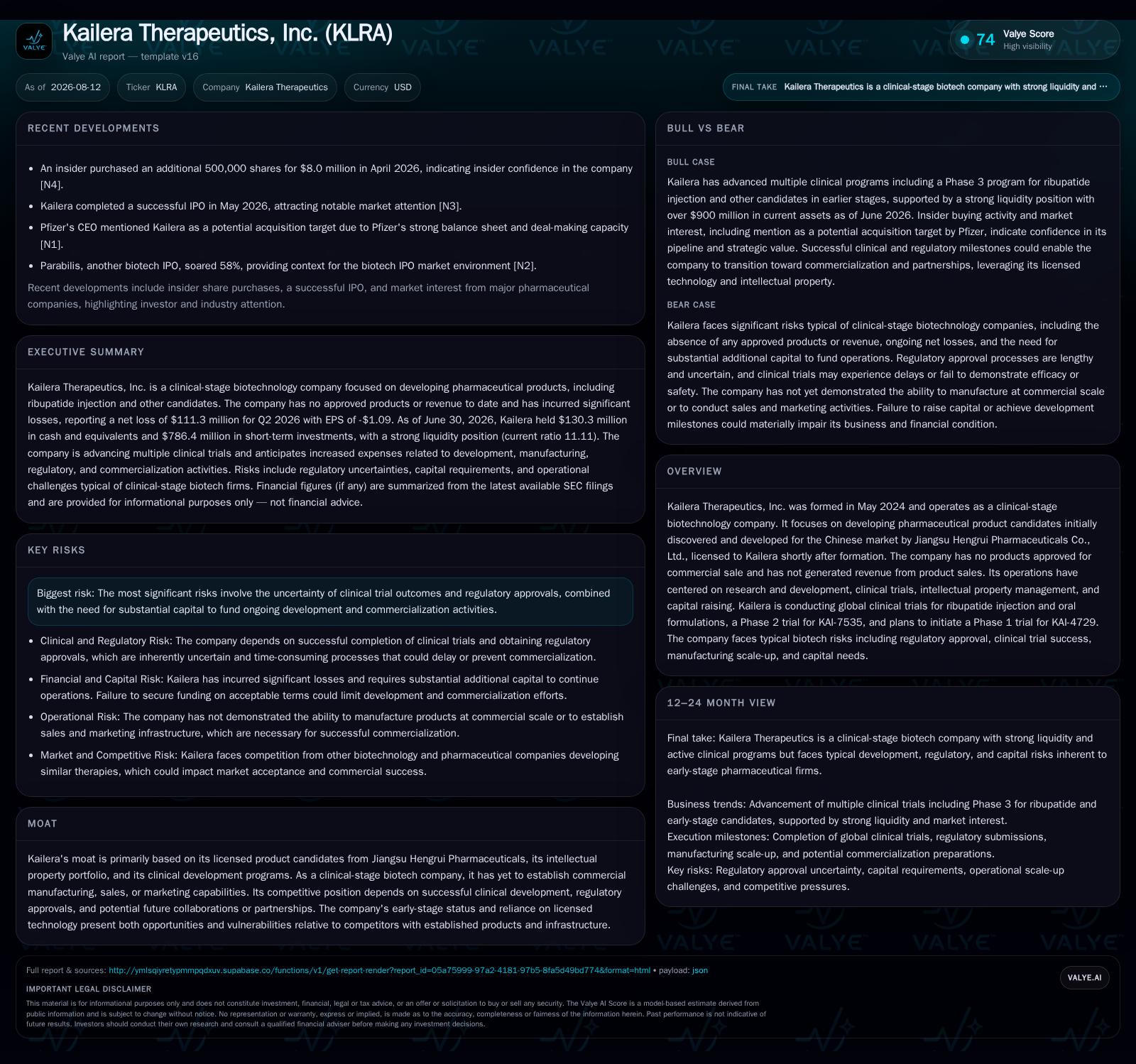
Kailera Therapeutics, a clinical-stage biotech spun out in 2024 with licensed assets from Jiangsu Hengrui Pharmaceuticals, recently reported ongoing progress in its global trials including ribupatide and promising candidates KAI-7535 and KAI-4729. The company's strategy leverages a licensing model focusing on advancing multi-phase clinical programs without current commercial revenues. Kailera's competitive position hinges on successful trial outcomes, intellectual property maintenance, and sustaining access to capital. With $130 million in cash and an 11x current ratio, Kailera maintains a healthy runway to support R&D activities amid the sector's inherent regulatory and execution risks.
Latest Quarterly Developments Signal Pipeline Activity Amidst Clinical-Stage Realities
Kailera Therapeutics’ Q2 2026 SEC filings reveal operational activity focused on advancing multiple clinical programs originating from licensed assets from Jiangsu Hengrui Pharmaceuticals. The company continues global trials for ribupatide in both injectable and oral formulations while progressing a Phase 2 study of KAI-7535. Additionally, plans are underway to commence a Phase 1 trial for KAI-4729 shortly [S2], [S3]. This pipeline stage mix reflects a classical early-to-mid phase biotech profile where multiple candidates are tested simultaneously to spread development risk.
Operating expenses remain heavily skewed toward research and development efforts consistent with early-stage biopharmaceutical firms lacking commercial products. Kailera’s operating loss widened to over $121 million in the quarter ended June 30, reflecting expanded trial operations and associated nonclinical activities [F1]. These losses align with the company’s stated focus on progressing its pipeline rather than generating revenues.
On the liquidity front, Kailera reported cash and equivalents of approximately $130 million at quarter-end alongside a very strong current ratio above 11x, signaling substantial near-term funding availability relative to liabilities [F1]. This sizable cash reserve is critical given the negative cash flows characteristic of the clinical-stage biotech segment where product sales have not commenced. Maintaining liquidity supports uninterrupted R&D execution and underpins upcoming milestones.
Leveraging Early-Stage Licensing Model: R&D Focus and Product Candidate Profiles Shape Growth Potential
Kailera operates primarily as a licensee of late discovery pharmaceutical assets initially developed for the Chinese market by Jiangsu Hengrui Pharmaceuticals shortly before Kailera’s May 2024 formation [S2]. This licensing agreement defines much of Kailera’s business model: it holds rights to develop these candidates globally while relying heavily on intellectual property management inherited from Hengrui
The pipeline composition includes ribupatide—examined in injection and oral forms—plus novel compounds KAI-7535 (in Phase 2) targeting indications supported by underlying biological rationale from prior work in China. The planned Phase 1 trial entry for KAI-4729 adds breadth signaling an intent to expand therapeutic scope systematically [S3]. Such a focused but diversified development program could provide multiple shots at regulatory success.
However, reliance on licensed technology implies milestone payments and royalties will factor heavily into future monetization. Therefore, only upon successful regulatory progress or partnering/licensing agreements will revenue begin materializing. This licensing-based model requires capital-intensive upfront investment without immediate income streams typical of discovery or late-commercialization biotechs owning proprietary pipelines outright.
Competitive Positioning: Intellectual Property Strength and Peer Benchmarking in Clinical Trial Advancement
Within the broader biotechnology ecosystem, Kailera’s competitive position is shaped by its dependence on licensed intellectual property combined with advancing multi-phase clinical trials. Compared to peers developing internally originated molecules or those with established commercialization infrastructure, Kailera must demonstrate efficient clinical progression to validate asset value.
Its substantial R&D burn rate reflects aggressive investment but must translate into meaningful clinical milestones for value capture [F1]. Intellectual property robustness—protected via licensing agreements inherited from Hengrui—is fundamental but vulnerable should patent challenges or enforcement issues arise. These are common concerns for license-dependent biotechs which lack proprietary control over original discovery.
Peers in similar stages often face attrition rates exceeding 70% before approvals; hence timing and success rates around Phase 2/3 transitions are pivotal as proof points. Furthermore, manufacturing scale-up readiness appears premature given no commercial production reported yet, aligning Kailera with peers that will likely need partners or contract manufacturers post-approval.
Growth Pathways Anchored in Multi-Candidate Trial Progression and Regulatory Milestones
Kailera’s growth outlook depends critically on advancing its portfolio through key regulatory inflection points: successful Phase 2 completions enabling pivotal trials, submissions to FDA or other health authorities for marketing approval designation interactions, and validation of product safety-efficacy profiles parallel to competitive benchmarks.
The ongoing global trials for ribupatide and KAI-7535 serve as primary near-term catalysts with the initiation of Phase 1 studies for KAI-4729 indicating further pipeline expansion ambitions [S3]. Positive data readouts would enhance prospects not only for future top-line revenue but also for corollary milestone payments under licensing agreements or attractiveness for strategic partnerships.
Despite these potential growth levers, commercialization scale remains distant. Partnership deals akin to those consummated by other clinical-stage biotechs could materially augment growth trajectories but hinge entirely on demonstration of convincing clinical benefit versus standard therapies.
Risks Around Trial Outcomes, Regulatory Hurdles, and Capital Needs Underpin Valuation Uncertainty
The inherent uncertainties emblematic of clinical-stage biotechnology companies are well articulated in Kailera’s recent filings. Principal risks revolve around potential trial failures or delays that could materially erode development timelines or necessitate costly additional studies. Regulatory hurdles specific to the FDA or international agencies compound this risk given variable approval standards.
Healthcare regulations impose escalating compliance burdens increasing operating costs while reimbursement environments increasingly constrain pricing power post-approval—a challenge described explicitly within filings that could affect eventual profitability. Intellectual property disputes also pose latent threats given license reliance.
Capital requirements remain substantial as costly trials advance; although ample liquidity currently exists ($130M), continued net losses require either further equity issuance or collaboration revenue generation to sustain operations beyond mid-term horizons [F1], [S25]. Market volatility may raise financing costs or delay funding availability further amplifying financial risk.
Upcoming Catalysts: Trial Enrollment Updates, Regulatory Submissions, and Funding Milestones to Watch
Investors evaluating Kailera’s trajectory should monitor key upcoming operational milestones: progress reports on enrollment rates in ongoing ribupatide global trials; initiation timing of Phase 1 study for KAI-4729; interim data releases potentially poised after June quarter close; plus news regarding any impending regulatory submissions that could precipitate valuation uplifts [S2], [S3].
Furthermore, announcements concerning new financing rounds or partnership deals tied to trial successes will serve as barometers of execution discipline amidst prevailing sector headwinds.
Confirming full patient enrollment within planned windows would increase confidence in timeline sustainability whereas recruitment bottlenecks might signal developmental delays requiring reforecasting.
Financial Profile Discussion: Cash Runway Stability Supports R&D Investment but Highlights Capital Dependence
From a financial perspective measured against its operating profile through Q2 2026, Kailera posted a net loss exceeding $111 million reflecting intensive R&D spending aligned with anticipated expansionary investment cycle fundamentals characteristic of license-dependent early-stage biotechs without commercial products [F1]
Liquidity remains sound at approximately $130 million cash & equivalents with current assets substantially outweighing liabilities resulting in an exceptionally strong current ratio above 11x supporting short-to-mid-term operational viability absent major unexpected expenditures or capital flow interruptions [F1]. This robust balance sheet affords flexibility in managing upcoming trial investments while mitigating immediate refinancing risks.
Nonetheless, absent near-term approval-triggered revenues or partnering inflows Kailera faces typical sector dependency on equity capital markets subject to volatility influences. Success hinges critically on navigating complex regulatory pathways through multi-phase trials while preserving intellectual property rights against evolving compliance landscapes. Industry peer benchmarks counsel cautious optimism tempered by recognized high failure rates in analogous early-stage portfolios. Monitoring milestone achievements alongside capital market access forms key windows into sustaining therapeutic pipeline advancement towards eventual commercialization necessity.
Disclaimer: This is research-only, informational analysis and not investment advice. It may include AI-generated interpretation and general industry context. Always verify important details using primary sources.

Comments