
Vine Hill Capital Investment Corp. II’s SPAC Progress Anchored by $230M Trust and Experienced Sponsors
Vine Hill Capital Investment Corp. II remains a classic blank check company holding IPO proceeds in trust while actively pursuing an initial business combination, supported by seasoned management and a $230 million capital base.
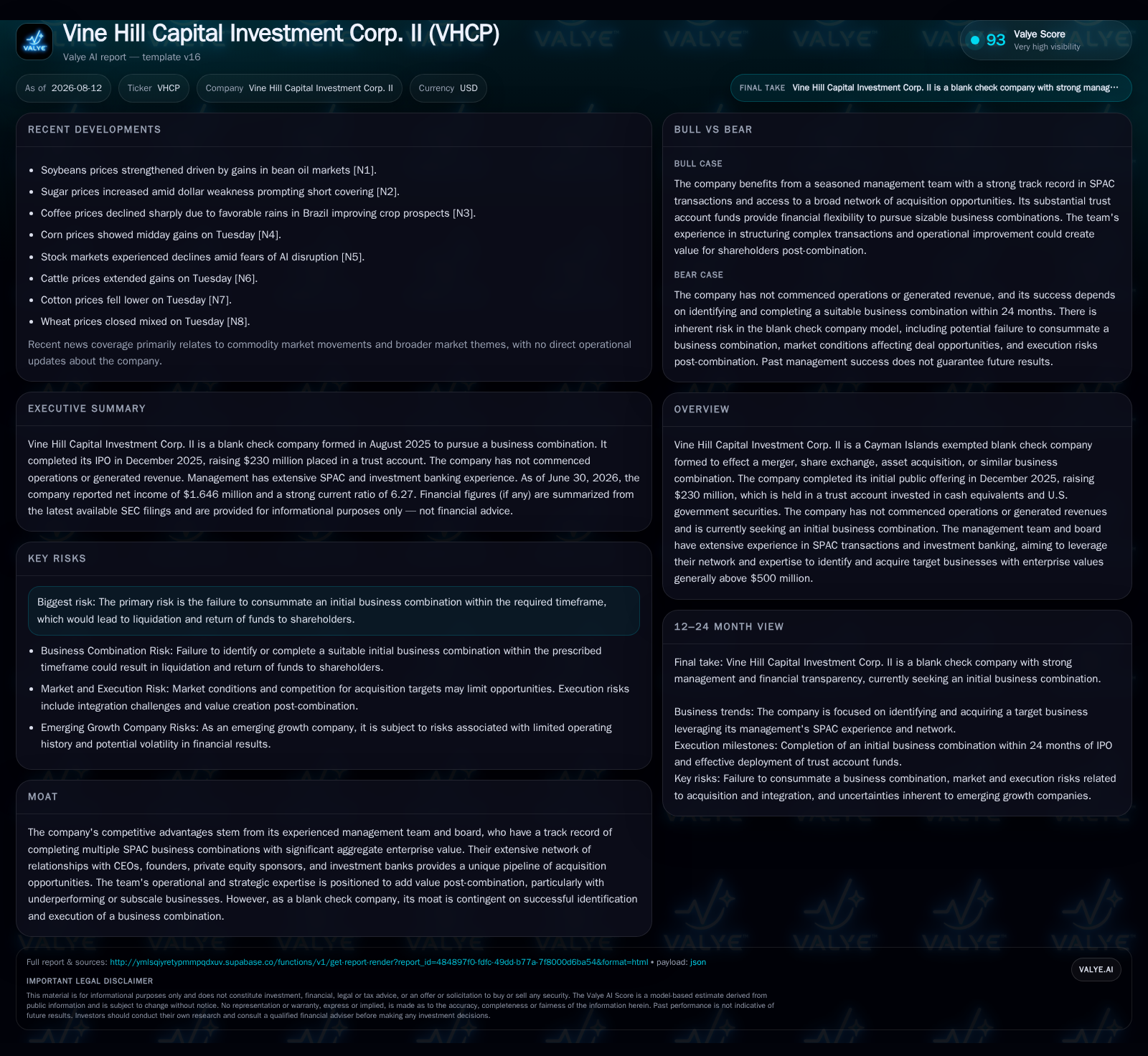
Vine Hill Capital Investment Corp. II completed a $230 million IPO in December 2025 and currently holds these funds in a trust account as it evaluates acquisition targets. The experienced sponsor team leverages extensive networks to identify potential deals with enterprise values typically exceeding $500 million. The company has yet to close any transaction or generate revenue, maintaining limited operating costs during the search phase. Key risks include the potential failure to complete a business combination within the mandated timeframe, shareholder redemption dynamics, evolving directors and officers liability insurance conditions, and regulatory developments affecting SPAC transactions.
Recent Operating Update
Vine Hill Capital Investment Corp. II ("VHCP") filed its latest quarterly report on August 12, 2026, confirming steady progress as a blank check company focused exclusively on identifying an initial business combination target within the typical SPAC timeframe [S2]. As of June 30, 2026, VHCP held approximately $2.28 million in current assets against liabilities of about $364,000, resulting in a robust current ratio of approximately 6.27x [F1]. This strong liquidity position aligns with the conservative cash management approach standard for SPACs prior to consummating a de-SPAC transaction.
No material changes to risk factors or legal proceedings have been reported since the IPO prospectus was filed in December 2025 [S2]. This stability suggests that VHCP continues to navigate common SPAC formation challenges without unexpected operational or regulatory setbacks
Business Model Analysis
VHCP operates as a Special Purpose Acquisition Company (SPAC), raising capital through an initial public offering (IPO) to create a trust account that safeguards investor funds until an acquisition is completed [S1]. The company’s $230 million IPO was executed by issuing 23 million units priced at $10 each, including full exercise of underwriters’ over-allotment options [S1]. These funds are primarily held in cash equivalents and U.S. government securities to preserve capital.
The blank check structure means VHCP has no operational revenues or earnings before completing its initial business combination. Revenue generation depends entirely on acquiring an operating private company through merger or share exchange – the de-SPAC process – which bypasses traditional IPO pathways.
Sponsor Vine Hill Capital Sponsor II LLC owns approximately 7.7 million founder shares acquired at nominal cost ($0.004 per share), representing equity stakes designed to incentivize successful deal completion [S1]. While these founder shares introduce dilution risk for ordinary shareholders post-merger, they align sponsor interests with those of public investors aiming for accretive transactions.
Operating expenses are currently limited to administrative costs such as legal fees, due diligence efforts on prospective targets, insurance premiums including increasingly costly directors and officers liability coverage noted by management, and other preliminary expenses typical of early-stage SPACs [S1].
Industry Structure and Competitive Position
The SPAC landscape features numerous blank check companies competing for attractive mid-to-large scale private companies seeking access to public markets without traditional IPO complexities. VHCP contends with peers like Pershing Square Tontine Holdings (PSTH), Social Capital Hedosophia Holdings series, and Churchill Capital Corp vehicles that vary between generalist approaches and sector-specific focuses.
VHCP’s competitive edge lies in its experienced management team and board members who bring proven track records completing sizable SPAC deals along with strong networks across private equity sponsors, founders, CEOs, and investment banks [S1]. This network depth potentially enhances access to higher-quality acquisition candidates aligned with VHCP’s stated preference for targets generally exceeding $500 million in enterprise value.
However, VHCP operates under common structural constraints facing all SPACs: limited timelines before mandatory liquidation if no deal closes; balancing shareholder redemption rights that can materially reduce available deal capital; securing PIPE financing critical for transaction funding; managing elevated directors & officers insurance premiums; and navigating evolving regulatory requirements that may impact disclosure burdens or governance standards.
Growth Drivers
VHCP’s growth prospects stem from sustained investor demand for alternative public listing routes fueled by receptive capital markets favoring pre-vetted growth companies outside traditional IPO channels. Its substantial trust account positions it well relative to smaller competitors lacking scale.
Experienced management’s access to proprietary deal flow enhances the likelihood of sourcing differentiated acquisition opportunities structured to satisfy both sponsor economics and public shareholder interests.
Regulatory frameworks currently permit streamlined disclosures compared to traditional IPO processes, though evolving regulations require ongoing vigilance.
Availability of PIPE financing alongside market acceptance of de-SPAC transactions supports pathways toward successful deal execution when credible valuation narratives are supported by rigorous due diligence performed by VHCP’s team.
Risks and Watchpoints
VHCP faces several risks typical of the SPAC model:
- Failure to complete an initial business combination within required timeframes could trigger liquidation events returning funds net of expenses but erasing equity upside beyond trust interest accruals [S1].
- Shareholder redemption behavior: Elevated redemptions following deal announcements reduce available capital for closing transactions, potentially forcing renegotiations or downsizing deals that impair sponsor returns.
- Directors & Officers (D&O) insurance challenges: Rising premiums and reduced market capacity increase transaction completion costs or deter qualified director/officer participation post-business combination—factors explicitly highlighted by management [S1].
- Regulatory uncertainty: Amendments in SEC rules governing disclosures or governance could increase compliance burdens or delay transaction timelines.
- Conflicts of interest: Sponsor holdings of founder shares and warrants may create tensions during valuation negotiations impacting shareholder vote outcomes.
- PIPE financing dependencies: Securing sufficient backstop funding partners is critical amid volatile market sentiment affecting investor confidence. These areas warrant close monitoring ahead of any potential merger announcement or shareholder voting event.
What To Watch Next
Key upcoming milestones for VHCP include:
- Announcement timing of one or more acquisition targets consistent with stated enterprise value thresholds [S1].
- Shareholder approval processes if legally required or voluntarily pursued to ensure transaction legitimacy.
- Redemption rates following deal announcements signaling investor confidence impacting liquidity for closing financings.
- Engagement levels with underwriters or placement agents supporting supplemental PIPE rounds vital for finalizing transaction structures [S1].
- Developments in D&O insurance market pricing/availability influencing transaction feasibility [S1].
- Regulatory rule changes affecting disclosure or governance requirements during merger consummation phases. While no specific targets have been disclosed reflecting typical SPAC confidentiality until formal agreements are executed, VHCP’s filings will provide updates on timeline progress and shareholder communications referencing these critical factors.
Financial Profile Discussion
As expected for a pre-combination SPAC entity, VHCP reported operating losses primarily from administrative expenses totaling roughly $230,000 through year-end December 2025 reflective of formation-related costs [F1]. Conversely, net income was positive at approximately $1.65 million as of June 30, 2026 driven chiefly by interest income earned on conservatively invested trust account balances post-IPO proceeds placement [F1].
The balance sheet exhibits minimal leverage with total debt near $25,000 as last reported September 2025 representing accrued liabilities rather than financing obligations [F1]. Strong liquidity is evidenced by current assets significantly exceeding current liabilities supporting transactional obligations such as deferred underwriting fees payable upon merger completion plus ongoing due diligence expenses ahead of potential deals [F1].
Sponsor founder shares constitute about one-third of total equity issued at nominal cost ($0.004 per share). These shares align sponsor incentives toward successful de-SPAC execution but introduce dilution risk depending on final transaction terms including warrant mechanics detailed in offering documents [S1].
Underwriting fees follow standard industry practice wherein commissions are deferred until closing incentivizing alignment across sponsors and underwriters who often provide advisory support during M&A negotiations—a relationship requiring transparency given potential conflicts of interest [S1].
In summary, VHCP’s financial profile reflects textbook SPAC characteristics demonstrating sound capital preservation strategies while awaiting timely execution on acquisition opportunities that ultimately will determine value creation potential.
Disclaimer: This analysis is based solely on publicly available SEC filings without speculative assumptions regarding future acquisitions or valuations. It does not constitute investment advice.
Disclaimer: This is research-only, informational analysis and not investment advice. It may include AI-generated interpretation and general industry context. Always verify important details using primary sources.

Comments