
Arbutus Biopharma Advances RNAi and LNP Platform Amid Key Patent Litigations and Clinical Progress
Arbutus Biopharma’s latest quarter highlights clinical advances in chronic hepatitis B therapies alongside ongoing patent litigation over its lipid nanoparticle technology that underpins mRNA delivery.
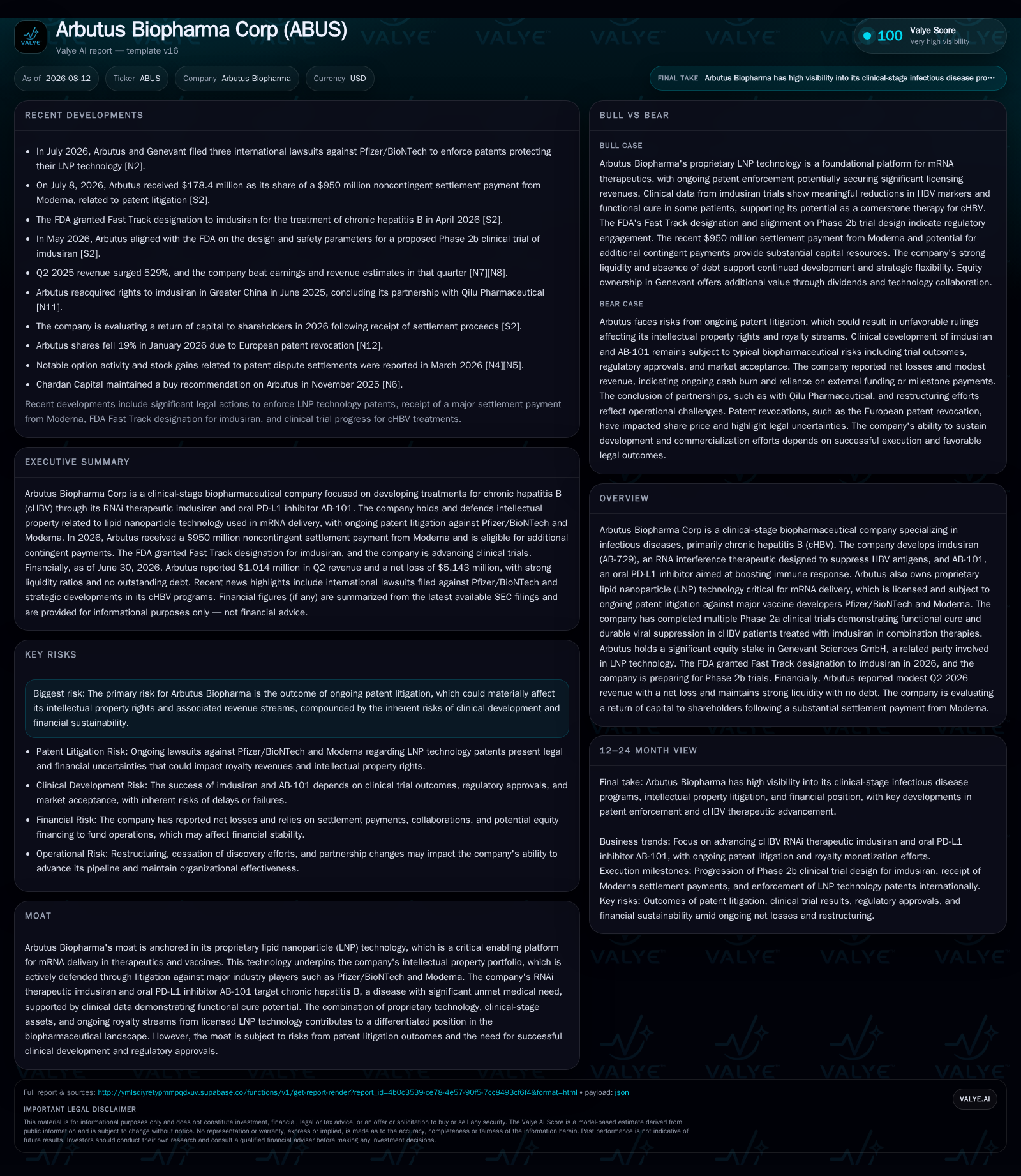
In its Q2 2026 filing, Arbutus Biopharma reported progress advancing imdusiran’s Phase 2b clinical trial for chronic hepatitis B with FDA alignment on trial design. The company remains focused on defending its proprietary lipid nanoparticle (LNP) platform through active patent litigations against Pfizer/BioNTech and recent settlements with Moderna, which underpin potential milestone and royalty revenues. While the RNA interference (RNAi) therapeutic imdusiran shows promise toward functional cure, execution risks from litigation outcomes and clinical development remain. Arbutus’s strong balance sheet with $19 million cash and no debt supports ongoing R&D and legal activities.
Recent Operating Update
Arbutus Biopharma’s Q2 2026 filing underscores focused advancement of its lead RNA interference therapeutic imdusiran (AB-729) for chronic hepatitis B (cHBV), alongside vigorous defense of its foundational lipid nanoparticle (LNP) platform intellectual property. Crucially, the FDA has aligned with Arbutus on the Phase 2b trial design for imdusiran, marking an important regulatory milestone that enhances confidence in the clinical development pathway [S2]. This follows promising early-phase data suggesting that targeted antigen suppression via RNAi could achieve durable viral control—a functional cure approach distinct from current therapies.
Concurrently, Arbutus pursues active patent infringement litigation against Pfizer/BioNTech concerning their use of the company’s patented LNP technology integral to COVID-19 mRNA vaccines. A favorable claim construction ruling issued in September 2025 strengthens Arbutus's position, complemented by three international lawsuits filed in July 2026 to broaden enforcement [S2]. Earlier in March 2026, Arbutus settled related patent disputes with Moderna, securing upfront payments plus contingent milestone payments tied to appellate outcomes—highlighting the material financial stakes linked to IP protection [S2].
The August 12, 2026 Form 8-K incorporated Q2 results alongside management commentary emphasizing sustained R&D investment balanced with efforts to monetize intellectual property through licensing and litigation [S3]. This dual focus illustrates how Arbutus leverages its proprietary delivery platform as both a technological moat and a revenue driver.
Business Model Overview
Arbutus operates as a clinical-stage biopharmaceutical company specializing in RNA interference therapeutics coupled with proprietary drug delivery technology. Its revenue model centers on milestone payments triggered by clinical or regulatory achievements, royalties derived from licensed LNP technology embedded in partner products, and eventual product sales contingent upon successful commercialization.
The core asset is imdusiran (AB-729), a GalNAc-conjugated RNAi candidate administered subcutaneously to suppress HBV antigen expression—a key factor in viral persistence. Complementing this is AB-101, an oral PD-L1 inhibitor designed to restore immune responses dampened by chronic infection. Both candidates address critical unmet needs where existing antivirals fail to achieve functional cures.
Ownership of the LNP delivery platform is a strategic advantage enabling technology licensing agreements with multiple biotech partners including vaccine developers like Moderna and Pfizer/BioNTech. These partnerships generate potential double-digit royalty streams based on product sales [S1]. Protecting this platform through rigorous patent enforcement is vital for sustaining long-term recurring revenues.
Operating expenses are predominantly driven by R&D costs supporting clinical trials and platform development. General & administrative costs reflect legal fees associated with ongoing IP litigation and corporate functions. Recent organizational restructuring has reduced early-stage discovery efforts to prioritize late-stage clinical programs [S1].
Industry Structure and Competitive Landscape
The biotechnology sector focusing on RNAi therapeutics and nanoparticle delivery platforms is characterized by rapid innovation alongside intense intellectual property disputes. Peers such as Alnylam Pharmaceuticals have established commercial RNAi products setting efficacy benchmarks.
Meanwhile, mRNA vaccine innovators Moderna and BioNTech rely heavily on LNP technologies pivotal to vaccine efficacy but now face infringement claims from Arbutus asserting proprietary rights over key formulations. Control over such delivery technologies constitutes a significant competitive moat impacting partnership dynamics across the biopharma ecosystem.
Chronic hepatitis B remains a challenging indication with limited options delivering functional cure; Arbutus’s combined approach of RNAi-mediated antigen knockdown plus immune checkpoint inhibition positions it competitively versus other gene-silencing or immuno-oncology pipelines.
Barriers include high capital intensity for clinical advancement, regulatory complexities, and protracted timelines typical of biotech development. Licensing revenues provide interim valuation support while pivotal trial outcomes unfold [S1]
Growth Drivers
Key growth catalysts include:
- Progression into pivotal Phase 2b trials for imdusiran under FDA guidance increases probability of demonstrating meaningful clinical endpoints necessary for late-stage development or partnering opportunities [S2].
- Fast Track designation accelerates regulatory interactions potentially shortening time to approval if positive data continue.
- Expansion of international patent enforcement actions enhances global leverage over competitors using LNP technology, potentially unlocking multi-jurisdictional royalties.
- Strategic equity stake in licensee Genevant Sciences GmbH fosters collaborative innovation around LNP chemistry improvements supporting future pipeline expansion.
- Early clinical signals indicating potential for functional cure could redefine HBV treatment paradigms attracting collaborations or acquisition interest [S1].
Technology licensing agreements producing milestone payments offer near-term revenue independent of direct product commercialization risk—a common monetization path for platform-centric biotechs.
Risks / Watchpoints / Growth Constraints
Challenges include:
- Legal outcomes remain uncertain; adverse rulings could materially impact royalty income streams essential for funding ongoing R&D activities [S1]. Appeals introduce timeline ambiguity affecting near-term valuation visibility.
- Revenue volatility due to reliance on milestone payments linked to clinical progress; delays or failures may compress cash inflows.
- Significant cash burn driven by costly trials and legal expenses; while liquidity stands at $19 million cash versus minimal liabilities at Q2 end providing runway near term, further financing may be required depending on litigation or trial scaling [F1], [S2].
- Competition from established RNAi developers like Alnylam or emerging gene editing technologies may threaten technological relevance if superior efficacy or safety profiles emerge.
- Regulatory hurdles beyond Fast Track designation encompass demonstrating long-term safety/efficacy needed for market access post-launch.
- Dependency on partnerships such as Genevant entails governance risks and shared IP management complexities.
Monitoring upcoming court decisions expected within the next year will be critical for assessing IP moat durability [S1], [S2]. Clinical data timelines also serve as key valuation inflection points.
What To Watch Next
Analysts should focus on:
- Data readouts from imdusiran’s Phase 2b trial validating dosing regimens, biomarker responses, and safety consistent with functional cure hypotheses [N2], [S2].
- Patent litigation developments including dispositive motions or appellate rulings against Pfizer/BioNTech anticipated within the next year impacting royalty prospects [S2].
- Updates on royalty receipts or milestone recognitions stemming from the Moderna settlement agreement providing financial visibility [S1].
- Pipeline expansion initiatives involving AB-101 or new partnerships broadening infectious disease coverage.
- Cash burn trajectories relative to expense management reflecting strategic prioritization or workforce adjustments influencing financial sustainability [S3], [F1].
Financial Profile Discussion
As of June 30, 2026, Arbutus held $19.17 million in cash equivalents against nominal current liabilities of approximately $3.36 million resulting in a robust current ratio exceeding 81—reflective of substantial current assets relative to liabilities without leverage constraints [F1]. The company reports zero debt enhancing financial flexibility amid ongoing R&D and legal expenditures.
The balance sheet strength buffers short-term operational continuity but sustained profitability depends heavily on favorable litigation outcomes securing royalty flows alongside successful clinical progression enabling partnership or launch opportunities.
Disclaimer
This analysis reflects information available up to August 12, 2026. It is provided solely for informational purposes without constituting investment advice regarding Arbutus Biopharma Corp securities. Readers should perform independent due diligence considering individual risk tolerance.
Disclaimer: This is research-only, informational analysis and not investment advice. It may include AI-generated interpretation and general industry context. Always verify important details using primary sources.

Comments