
Capital-Fueled Advances and Leadership Transition Shape Livengood Gold Project Development
International Tower Hill Mines Ltd. progresses its Livengood Gold Project with robust financing but faces execution and regulatory risks.
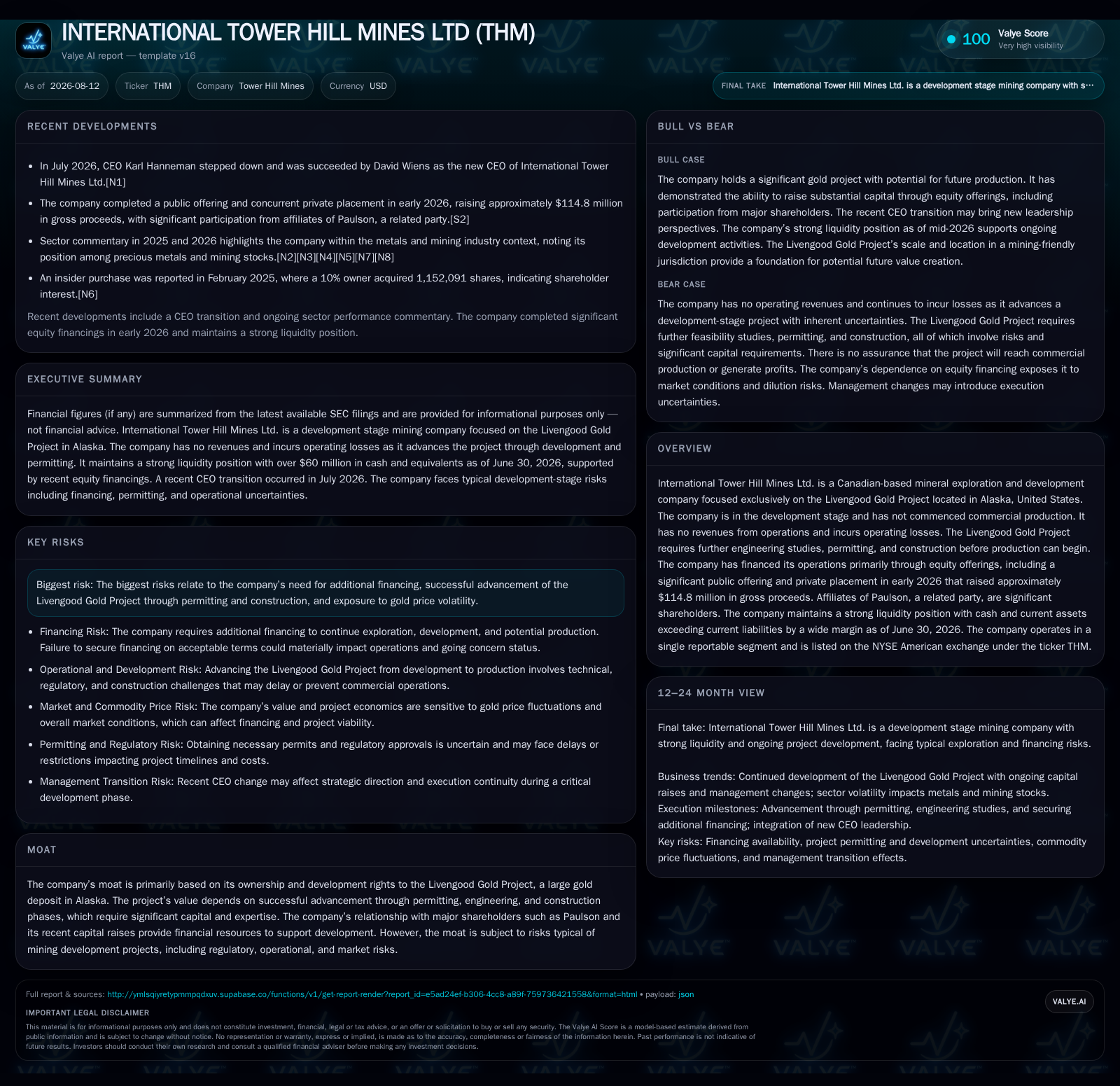
International Tower Hill Mines Ltd. remains in the development phase with its sole asset, the Livengood Gold Project in Alaska, relying heavily on recent equity financings totaling approximately $115 million to fund ongoing engineering, permitting, and operational expenses. The company reported increased operating expenses and net loss in Q2 2026 amid substantial liquidity, evidenced by a current ratio above 7, supporting near-term activities. Leadership changed with a new CEO in July 2026, potentially signaling strategic shifts. The company continues to face inherent mining development risks, including securing future capital, completing permitting, and navigating fluctuating gold prices.
Recent Operating Update
International Tower Hill Mines Ltd. (THM) advanced its operational footing as of Q2 2026 following substantial equity financings completed earlier in the year. The company's 10-Q filed August 12, 2026 reveals that through the combination of a public share offering and a private placement with affiliates of Paulson — a major shareholder — it raised aggregated gross proceeds of approximately $114.8 million [S2][S8]. This sizable infusion is critical given THM's status as a pre-production mining development company focused exclusively on the Livengood Gold Project in Alaska.
Operating expenditures escalated materially in Q2 2026 to nearly $7 million versus $1.76 million recorded year-to-date one year prior [S15]. This growth largely reflects increased engineering workstreams, permitting efforts, and the scaling of administrative functions consistent with preparing the project for potential construction. Despite no revenues — typical for exploration-stage miners — the company reported a net loss of approximately $3.38 million in Q2 alone [S15]. The widening loss underscores the capital-intensive nature of development-stage mining and an expanding cost base as milestones are pursued.
As of June 30, 2026, cash and cash equivalents reached roughly $60.4 million while total current assets approximated $112.6 million against only about $15.1 million in current liabilities [F1]. The resulting current ratio of about 7.46 evidences ample short-term financial flexibility to cover anticipated expenditures on advancing Livengood through further feasibility studies and regulatory permitting [F1]. Maintaining sufficient liquidity is particularly salient given industry norms where project timelines can extend for several years before transitioning into production.
An important governance event occurred shortly before this filing window: former CEO Karl Hanneman stepped down on July 27, 2026, replaced by David Wiens who was granted time-based restricted stock units (RSUs) valued at $1.65 million that vest over three years subject to continued service [S3][N1]. Such leadership transition combined with equity incentive grants often reflect a strategic recalibration or renewed management focus aligning executive interests with developmental milestones.
Business Model
THM’s business model exemplifies an upstream mining exploration and development archetype, concentrating resources almost exclusively on proving economic viability for the Livengood Gold Project prior to any extraction or revenue generation [S1]. The company does not generate income from operations; instead it funds advancement through capital markets primarily via equity issuance — a strategy reinforced by its recent January 2026 Public Offering and private placements involving institutional shareholders like Paulson [S2][S8].
Monetization depends entirely on post-development commercial production of gold ore extracted from Livengood once permitting hurdles are cleared and construction phases commence successfully.
The revenues later would come from sales under market-based commodity pricing mechanisms dependent on gold spot prices. At present, THM’s value proposition hinges on measured and indicated mineral resource estimates establishing sufficient size and grade amenable to cost-effective mining economics [S1]. Ongoing engineering work targets optimization of strip ratios (waste/ore volumes) and recovery technologies to improve mine design feasibility while adhering to environmental compliance frameworks.
Industry Structure and Competitive Position
Mining exploration firms like THM occupy the upstream segment of the mineral value chain focused on discovery, resource delineation drilling programs, and feasibility evaluation prior to capital-intensive mine construction undertaken by more mature producers such as Barrick Gold or Newmont Corporation. These majors benefit from cash flow generation that provides internal funding advantages absent for pure explorers.
THM’s competitive moat derives mainly from full ownership rights to one of Alaska’s sizeable gold deposits acquired decades ago combined with progress through technical studies demonstrating economic feasibility at given gold price points (~$1,680/oz highlighted in pre-feasibility insights) [S1]. However, compared with larger diversified producers that operate across multiple mines globally offering portfolio risk diversification, THM is exposed solely to single-asset risks requiring timely achievement of permits amid economical commissioning.
Engagement with experienced institutional investors such as Paulson lends credibility and potential pathway access for future financing rounds necessary for costly project construction faced by mid-tier development miners like Kinross Gold or Alamos Gold who demonstrate similar upstream capital intensity challenges.
Growth Drivers
Fundamental drivers underpinning THM growth prospects stem first from rising or sustained strong gold prices which favorably influence project net present values (NPVs) prompting financing willingness among stakeholders. Resource expansion via continued geological drilling programs could potentially increase mineral reserves or improve grade profiles enhancing long-term economics.
Completion of key permitting milestones with relevant federal and state authorities marks critical de-risking events enabling transition into construction phase expenditures (CapEx). Each successfully passed engineering study iteration—moving from pre-feasibility toward definitive feasibility study—heightens investor confidence by tightening cost uncertainty assumptions.
Strategic alliances or joint ventures remain plausible growth accelerants reducing dilution risk while sharing substantial capex burdens common among isolated development projects requiring multi-hundred-million-dollar investments before production returns commence.
Finally technological advances supporting improved extraction or ore processing efficiencies could lower operating expenses thereby making previously marginal zones economically viable additions during mine life extensions.
Risks and Watchpoints
Prominent risks mirror typical industry hazards inherent within precious metals development but are acute here due to THM’s early stage profile. Chiefly among these is reliance on achieving further capital raises; continuation hinges on favorable equity market conditions and investor appetite for exploration risk which can be volatile amidst macroeconomic uncertainty [S1][S10].
Permitting constitutes another major vulnerability given regulatory complexities in Alaska encompassing environmental impact assessments alongside potential indigenous community consultations which can cause costly timeline delays or required project design modifications impacting budgets.
Commodity price fluctuations represent unpredictable yet material risk affecting projected economics – sustained weakness below feasibility thresholds could delay or indefinitely postpone construction decisions minimizing shareholder returns.
Execution risk also arises during planned engineering optimizations where cost overruns or geotechnical surprises may necessitate revised capex allocations impacting financial forecasts laid out during feasibility phase disclosures.
Leadership changes injecting new management perspectives could serve as opportunity catalysts but also introduce transitional uncertainty over strategic priorities or operational focus consistency affecting investor sentiment until demonstrated progress matches guidance assumptions.
What to Watch Next
Key near-term markers include:
- Updates on completion status for definitive feasibility studies incorporating optimization insights announced by management possibly impacting mine plan scale,
- Regulatory milestone announcements regarding environmental permit approvals crucial for construction authorization,
- Quarterly burn rate trends vis-à-vis cash reserves providing signals on sustainability without further dilution,
- Continued engagement by major shareholders notably Paulson through participation in financing rounds that could confirm ongoing support,
- Management commentary clarity following CEO transition emphasizing timeline visibility towards production decisions,
- Macro trends in gold prices influencing project valuation sensitivity analyses disclosed publicly.
Monitoring these developments will help contextualize THM’s trajectory relative to peers progressing through similar upstream mining stages who face analogous execution challenges but may differ materially on resource scale or geographic risk profiles.
Financial Profile Discussion
From a financial standpoint as of June 30, 2026, International Tower Hill Mines holds cash & equivalents totaling approximately $60.4 million supported by total current assets of about $112.6 million against liabilities near $15.1 million yielding a strong liquidity cushion exemplified by a current ratio above seven times coverage [F1]. Operating losses continue reflecting elevated expenditures tied principally to project advancement rather than commercial activity.
The absence of debt reduces leverage-related pressures typical among more mature miners although it increases dependency solely upon equity markets for capital inflows required throughout prolonged development phases [F1]. Net losses are expected over several fiscal periods until production ramp-up when revenue commencement reverses cash flow dynamics.
Recent substantial equity raises undertaken in Q1 through public offering alongside strategic private placements both at prices around C$3.33 per share support medium-term funding needs but highlight dilution considerations affecting existing shareholders’ stakes [S8]. Going forward managing dilution while efficiently deploying capital towards value-accretive technical milestones will be required to sustain investor confidence amid sector cyclicality typical within junior-to-mid-tier mining development companies.
This analysis synthesizes publicly filed SEC disclosures along with contextual industry knowledge relevant for valuation reframing focused exclusively on International Tower Hill Mines Ltd.’s operational progression as anchored by its latest quarterly report dated August 12, 2026. It aims to provide internal insight regarding strategic positioning without issuing investment advice.
Disclaimer: This is research-only, informational analysis and not investment advice. It may include AI-generated interpretation and general industry context. Always verify important details using primary sources.

Comments