
Cartesian Growth Corp IV’s SPAC Capital Structure and Early Positioning Post-IPO
Newly public Cartesian Growth Corp IV completed its $275 million IPO with a standard SPAC trust account setup, positioning for a business combination within the prescribed timeframe.
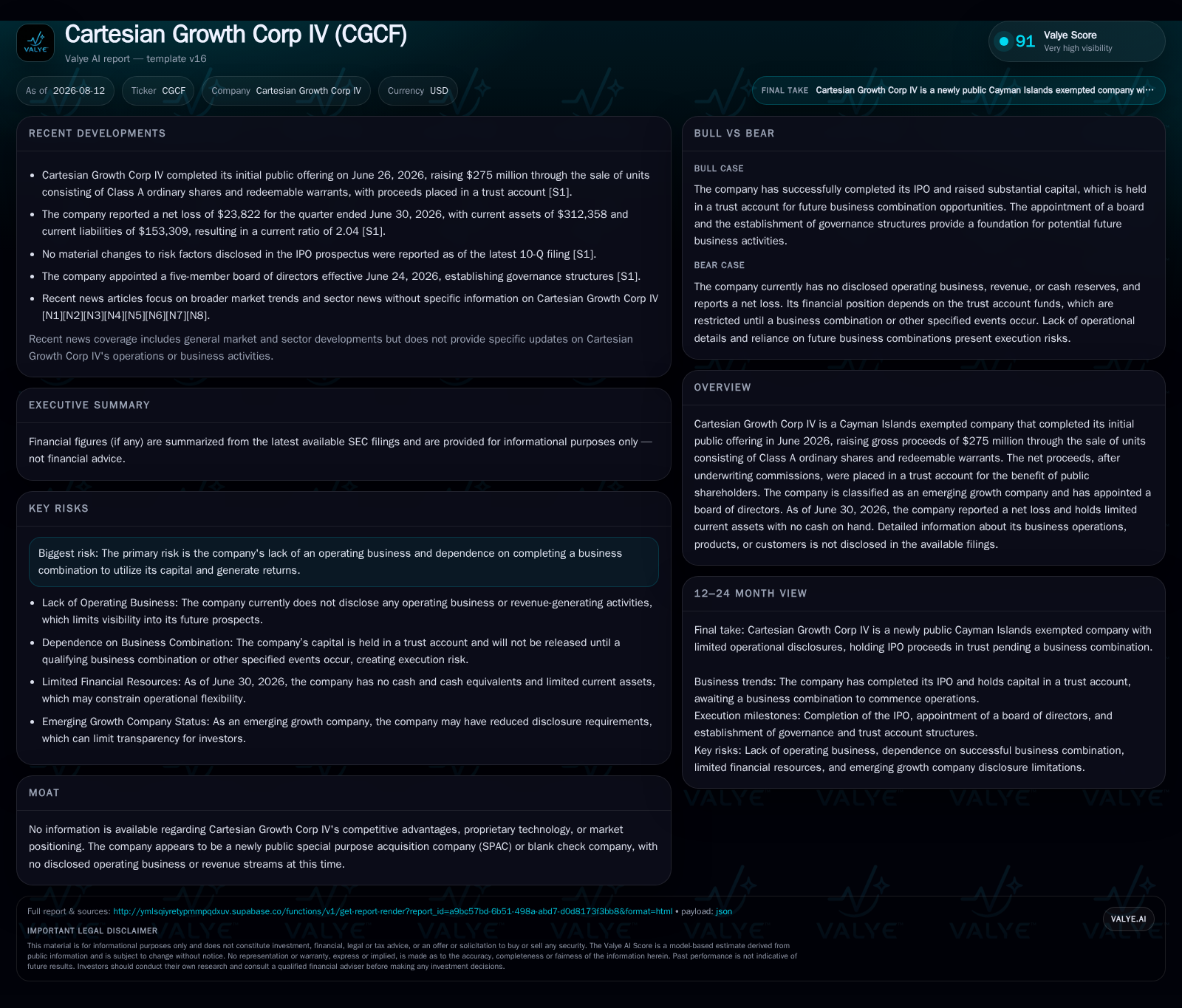
Cartesian Growth Corp IV is a Cayman Islands exempted company that successfully raised $275 million in June 2026 through a SPAC initial public offering, issuing units consisting of Class A ordinary shares and redeemable warrants. The proceeds were placed into a trust account pending the completion of a business combination, marking the company’s status as a blank check entity without operating revenues. Its board was constituted at IPO, and it currently holds minimal working capital outside the trust. Key risks remain tied to completing a business combination timely and managing shareholder redemption rights. The company’s early financial position is typical for SPACs, with no operations or cash on hand aside from trust assets earmarked for acquisition purposes.
Recent Operating Update
Cartesian Growth Corporation IV (CGCF) completed its initial public offering (IPO) on June 26, 2026, raising gross proceeds of $275 million through the sale of 27.5 million units priced at $10 each [S3]. Each unit consists of one Class A ordinary share and one-third of a redeemable warrant exercisable at $11.50 per share. The net proceeds after underwriting commissions—including $11.5 million in deferred underwriting fees—were deposited into a trust account managed by Continental Stock Transfer & Trust Company for the benefit of public shareholders [S6][S13]. This arrangement aligns with standard Special Purpose Acquisition Company (SPAC) structures intended to safeguard investor capital until the completion of an approved business combination.
No operating revenue or commercial activity has been disclosed since inception; consequently, Cartesian Growth Corp IV remains a blank check company focused exclusively on identifying suitable target companies for merger or acquisition within its specified timeframe [S2]. The Company reported operating losses amounting to approximately $77,949 USD and a net loss near $23,822 USD as of June 30, 2026—figures consistent with limited operational activity dominated by administrative overhead typical of newly formed SPAC entities [F1].
Business Model
Cartesian Growth Corp IV employs the archetypal SPAC business model: it raises capital through an IPO by selling units comprising common shares paired with warrant instruments granting holders rights to purchase further stock at a preset strike price ($11.50). This monetization approach generates immediate cash inflows while aligning incentive structures between sponsors and public shareholders.
The core economic mechanic revolves around the trust account into which IPO proceeds are legally segregated. These funds cannot be accessed directly by management unless an initial business combination (commonly termed “de-SPAC transaction”) is consummated or if liquidation/redemption events occur. Investors retain redemption rights allowing them to reclaim their pro rata investment when they disapprove or opt out of proposed mergers.
In addition to public warrants issued per unit sold, Cartesian Growth Corp IV has private placement warrants granted to its sponsors and underwriter affiliates under lock-up provisions that restrict exercise or transfer until after business combination completion [S14]. These features produce structured capitalization that balances sponsor upside potential against downside protections for early investors.
The company currently maintains nominal working capital (~$312k in current assets vs ~$153k liabilities), reflecting pre-operating administrative expenses unrelated to substantive business operations [F1]. This modest liquidity level supports organizational functions like compliance and governance but underscores the absence of operational cash flows.
Industry Structure and Competitive Position
SPACs such as Cartesian Growth Corp IV fulfill an intermediary role within financial markets: they offer private companies an alternative route to public markets compared with traditional IPOs by facilitating reverse mergers or acquisitions. This placement upstream from private firms seeking liquidity contrasts them downstream from institutional investors participating in IPO financing rounds.
This industry is characterized by several persistent dynamics: regulatory oversight demands transparency and procedural compliance; shareholder redemption rights limit financing certainty; sponsor expertise critically drives deal sourcing efficiency; and temporal constraints necessitate prompt transaction execution—typically within two years post-IPO.
While Cartesian Growth Corp IV operates without any disclosed sector focus or proprietary competitive advantages at this stage [S2], its ability to attract favorable target companies depends heavily on sponsor reputation and experience—factors not detailed explicitly in filings but critical in peer contexts like Churchill Capital or Pershing Square’s SPAC vehicles.
Growth Drivers
Growth prospects hinge on executing a successful de-SPAC transaction that creates shareholder value beyond trust account liquidation amounts.
Key drivers include:
- Availability of attractive private candidates seeking alternatives to traditional listings amid fluctuating capital markets.
- Sponsor deal sourcing networks which can uncover differentiated targets providing scalable growth opportunities.
- Investor appetite sustaining liquidity in units and warrants during pre-merger phases helps maintain trading activity supporting valuation stability.
- Regulatory clarity around SPAC transactions encourages more efficient deal closure timelines minimizing uncertainty risks.
A successful merger consummation unlocks access to publicly listed cash flows absent until then while validating market confidence in management’s strategic execution.
Risks and Watchpoints
The predominant risks stem from:
- Failure to complete a timely business combination, potentially forcing liquidation where investors only recover pro rata trust balances less expenses.
- Redemption rights exercised en masse, which could reduce available acquisition funding and complicate deal structuring.
- Market volatility affecting stock price performance incentivizing redemptions despite underlying deal merits.
- Regulatory changes impacting SPAC governance frameworks possibly increasing transaction complexity or costs.
- Sponsor-investor conflicts, where incentives may diverge regarding deal terms or timing decisions.
- Exposure to reputational risks if deals announced disappoint on strategic fit or growth potential assessments.
Monitoring redemption rates leading up to proposed mergers alongside public shareholder voting outcomes provides critical markers for assessing transaction viability.
What To Watch Next
Investors and analysts should focus on:
- Announcement of prospective acquisition targets: While none has been disclosed so far post-IPO, signals about sectors pursued or specific deals advance clarity on growth prospects.
- Shareholder vote schedules pertaining to merger approvals or amendments adjusting redemption terms provide insight into stakeholder sentiment dynamics.
- Redemption statistics following deal disclosures that directly influence available capital deployment capacity.
- Management commentary during earnings or SEC filings explaining pipeline quality and execution milestones help gauge timeline optimism versus risk exposures.
These developments fundamentally alter the business profile from speculative shell toward operational entity reliant on transaction success metrics.
Financial Profile Discussion
Disclaimer: This is research-only, informational analysis and not investment advice. It may include AI-generated interpretation and general industry context. Always verify important details using primary sources.

Comments