
BayFirst Financial Corp. Implements Asset Resolution Amid Loan Portfolio Challenges
BayFirst shifts focus to core community banking in Tampa Bay while addressing legacy SBA loan issues.
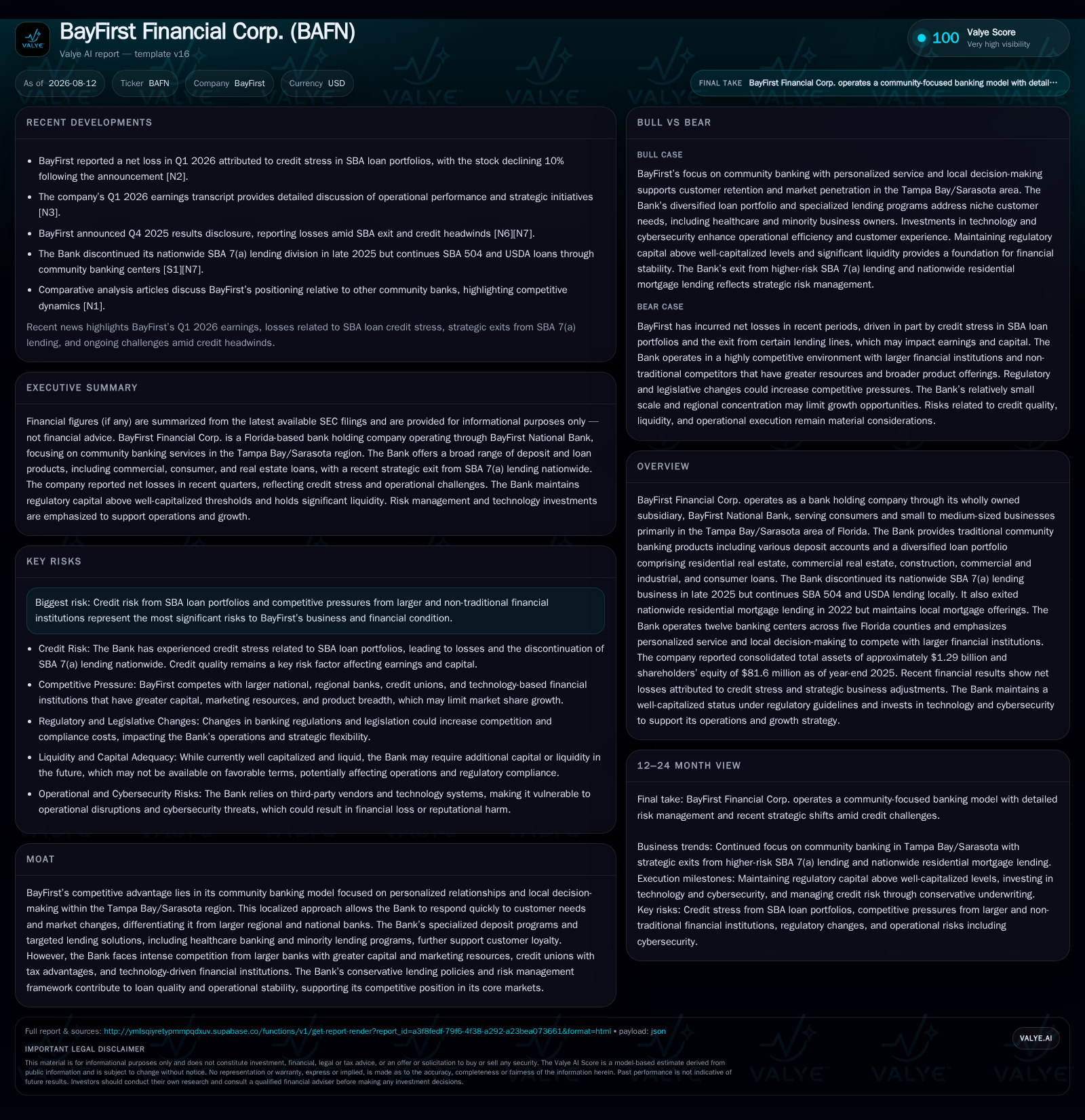
BayFirst Financial Corp.'s latest filings reveal a strategic recalibration focused on its Tampa Bay community banking franchise, highlighted by exit from nationwide SBA 7(a) lending and residential mortgage business. The company is facing material financial restatements related to its SBA 7(a) portfolio, prompting an asset resolution plan impacting Q2 2026 results. Despite liquidity and capital headwinds, BayFirst maintains localized deposit and loan growth strategies with specialized programs targeting regional customers. Credit risk tied to government-backed loan portfolios and competitive pressures remain key operational challenges.
Recent Operating Update
BayFirst Financial Corp.'s latest quarterly filing dated May 12, 2026, highlights a continuation of strategic initiatives originally set in late 2025 with the discontinuation of its nationwide SBA 7(a) lending business. This move refocuses the bank on servicing SBA 504 and USDA guaranteed loan segments locally through its community banking centers across Tampa Bay/Sarasota [S1]. Notably, BayFirst had exited its nationwide residential mortgage lending arm by Q3 2022 but maintains selective local mortgage offerings aligned with its community bank model.
Meanwhile, the company disclosed implementation of an asset resolution plan during mid-2026 aimed at addressing credit quality issues within the government-guaranteed loan portfolio. This plan includes writedowns and valuation adjustments exceeding $37 million related primarily to over 7,000 small balance SBA 7(a) loans no longer under origination after exit from that segment at year-end 2025 [S17]. Accompanying impairment charges include a $1.5 million non-marketable equity investment write-down linked to a former partner in the SBA program along with $1.6 million related to purchased USDA guaranteed loan premiums exposed to early repayment or default risk.
Those developments have necessitated material restatements of previously reported financials spanning from full year 2024 through Q1 2026 due to understatements in provision expense and overstated net interest income linked to these legacy loans [S15]. Consequently, investors should regard prior earnings releases as no longer reliable until amended filings are completed by August 12, 2026 [S15,S23].
The operational implications signal a period of credit remediation coupled with tightened liquidity management during regulatory scrutiny [S21]. As of March end-2026, BayFirst held approximately $134.5 million in cash and equivalents bolstering its funding position despite reported net losses over prior periods [F1,S24]. Furthermore, the bank is pursuing incremental capital measures including preferred stock issuances pending shareholder approvals designed to reinforce regulatory capital adequacy given reduced retained earnings caused by losses
Business Model Overview
BayFirst operates primarily as a community bank through its wholly owned national bank subsidiary serving individual consumers and small-to-medium sized businesses concentrated within five Florida counties centered on Tampa Bay and Sarasota. The company's value proposition lies heavily in localized decision-making authority that empowers rapid responsiveness to borrower needs while fostering deep customer relationships unmatched by larger regional or national competitors [S1].
Revenue is derived predominantly from net interest income generated by a diversified loan portfolio comprising commercial real estate lending (a vital sector in Florida's economy), construction loans supporting regional development projects, commercial & industrial loans tailored for small businesses, consumer loans including signature lines and secured products, plus residential mortgages offered locally following nationwide exit [S1]. Complementing interest revenues are fee-based income streams from deposit accounts featuring specialized products like Essential Checking—aimed at helping customers rebuild banking access—TrendSetters Club targeting older demographics with bespoke benefits, and Cash Kids' Club fostering financial literacy among youth via interactive digital tools [S1].
The company's branch network spans twelve community banking centers offering comprehensive retail banking services alongside online capabilities such as internet banking, remote deposit capture, cash management services for businesses including lock box and merchant processing solutions—all integral to maintaining deposit base stability which funds loan originations [S1]
Industry Structure & Competitive Context
Community banks like BayFirst occupy the critical intermediary role between large financial institutions and underserved regional markets. In highly fragmented local markets such as Tampa Bay/Sarasota, banks compete based on personalized service models contrasted against scaled operations of larger players such as Regions Financial or Synovus Financial serving broader geographies. Additionally, competition arises from tax-advantaged credit unions popular among residents seeking lower fees as well as fintech lenders who vie through enhanced digital platforms offering faster loan approvals.
BayFirst’s competitive moat is anchored in localized underwriting expertise with swift credit decisions enabling it to extend tailored financing solutions especially in segments like healthcare-related lending programs or minority-owned business initiatives that larger banks may overlook due to scale inefficiencies or risk frameworks less adapted for small ticket volumes [N1,S1]. However, these advantages are tempered by limited capital scale restricting risk appetite versus larger peers able to absorb bigger credit losses or invest aggressively into technology stacks enhancing client experience.
Growth Drivers
BayFirst’s growth trajectory depends chiefly on several factors: resurgent local economic activity fueling demand for commercial real estate financing; expansion of small business sectors requiring tailored commercial & industrial credits; agribusiness financing opportunities supported by USDA guarantees potentially stimulating rural business lending; expanding deposit relationships driven by differentiated banking products; plus cross-selling ancillary fee services such as treasury management or merchant processing improving non-interest income mix [S1,S17]
The continuation of selective SBA lending programs locally (SBA 504) helps preserve a government-guaranteed credit component mitigating credit risk while USDA B&I loans offer competitively priced options enhancing borrower affordability especially important amidst rising interest rate environments experienced industry-wide.
Furthermore, demographic trends favoring community banks' relational approach among mature population segments align well with offerings such as TrendSetters Club account products that build loyalty beyond typical transactional banking relationships.
Risks & Constraints
The most immediate risk factor identified is credit quality erosion within legacy government-guaranteed portfolios notably the exited SBA 7(a) segment that triggered material asset impairments uncovering weaknesses possibly linked to historically underpriced risk or origination lapses. Management’s ongoing asset resolution plan effectiveness will be pivotal in containing further losses [S17,S15,N2].
Increasing competition from regional banks benefitting from scale efficiencies alongside growing fintech disruption threatens margin pressure requiring technology investments which may strain BayFirst’s currently constrained capital resources.
Regulatory compliance remains critical with potential enforcement actions looming if capital ratios decline below mandated thresholds. BayFirst's recent moves toward preferred stock issuance underscore efforts to address this but shareholder approval delays or market reception could impact timing and cost of capital access negatively [S21,S24]. Liquidity management also warrants attention given reliance on deposit gathering which could fluctuate with market interest rates affecting depositor behavior.
Additionally, rapid technological changes necessitate continual upgrades in digital platforms lest customer expectations erode favor towards more agile competitors.
What To Watch Next
Key upcoming milestones include filing amendments for prior years’ restatements by August 12, 2026; second quarter earnings release expected shortly after market close on August 13; followed by a management webcast providing clarity on asset resolution progress embodied by reductions in non-performing loan ratios or provisioning trends reflective of stabilized credit loss trajectory [S3,S23]
Monitoring shifts in total loans held for investment particularly within SBA504/USDA segments alongside deposit growth rates will inform about core franchise momentum post restructuring efforts. Changes in net interest margin reflecting pricing power amid interest rate volatility also merit scrutiny.
Shareholder votes regarding preferred stock issuance scheduled for later this year will provide insight into BayFirst’s capitalization path forward critical for funding strategic investments including technology enhancements.
Financial Profile Discussion
The Company’s total shareholder equity has decreased from prior years reflecting these losses impacting retained earnings, though preferred stock issuances subject to shareholder approval are intended to strengthen capital buffers and support regulatory capital adequacy [S21,S24,S29]
Access to Federal Home Loan Bank advances provides an additional liquidity backstop as part of its overall liquidity management strategy.
In conclusion, BayFirst Financial Corp.'s near-term narrative centers on navigating challenges born out of exit decisions in federal guaranteed lending domains while endeavoring to stabilize its balance sheet through an active asset resolution plan paired with localized community banking strengths leveraging personalized customer relationships within Florida’s Tampa Bay region. The execution efficacy of loan portfolio remediation alongside capital augmentation efforts will decisively shape whether sustainable profitability can resume against an increasingly competitive banking landscape accentuated by regulatory imperatives and technological evolution.
This analysis reflects only publicly available information as sourced from SEC filings referenced herein. It does not constitute investment advice but aims to provide an informed perspective on BayFirst Financial Corp.’s operating context and industry positioning.
Disclaimer: This is research-only, informational analysis and not investment advice. It may include AI-generated interpretation and general industry context. Always verify important details using primary sources.

Comments