
White Pearl Acquisition Corp. Stakes IPO Trust and Liquidity in Early SPAC Trajectory
The August 2026 quarterly filing highlights White Pearl Acquisition Corp.'s solid liquidity position post-IPO, underscoring the challenges of navigating SPAC transaction timelines amid market uncertainties.
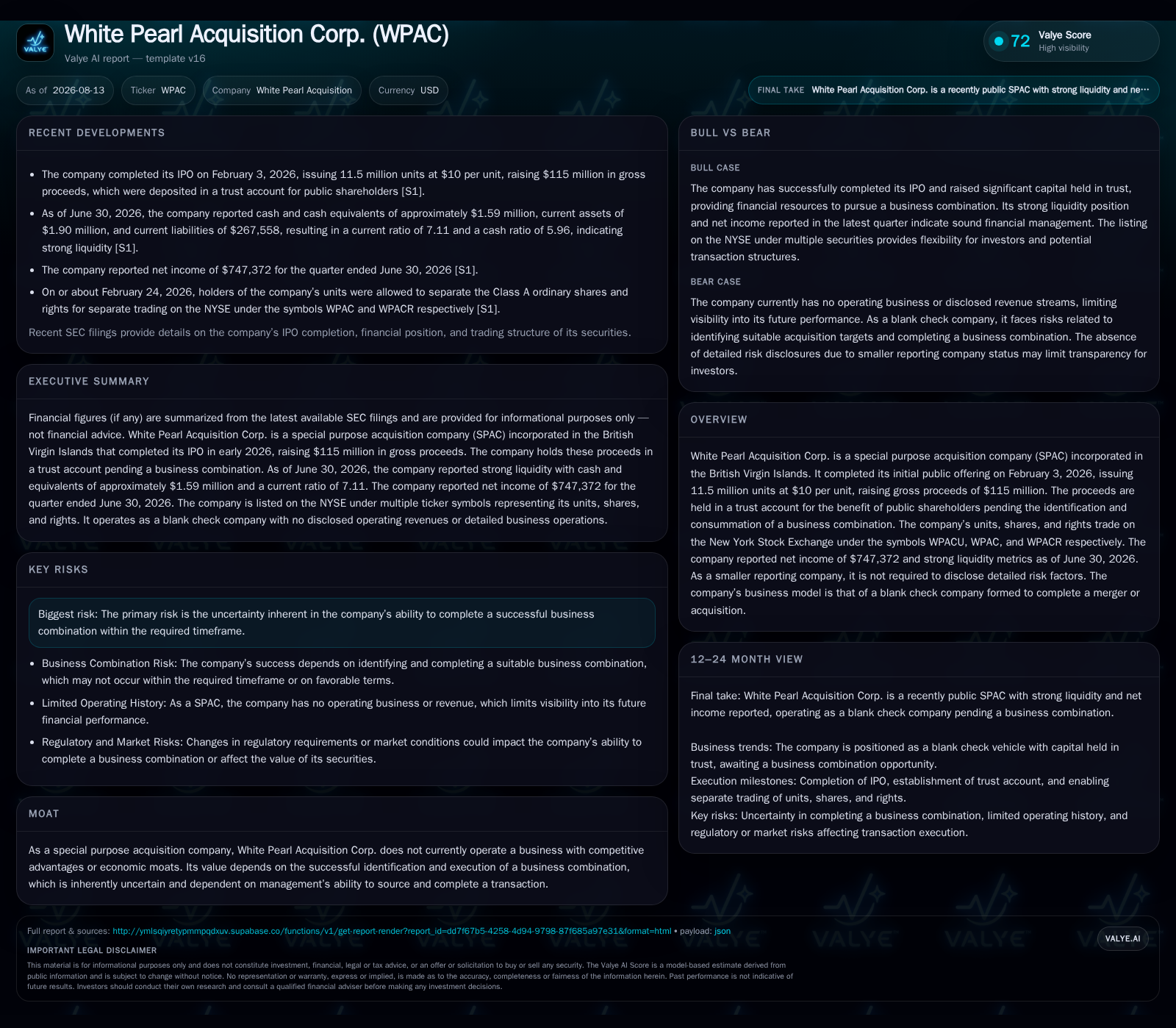
White Pearl Acquisition Corp. (WPAC) completed its IPO in early 2026, raising $115 million held in a trust account pending a business combination. The latest quarterly report as of June 30, 2026, shows a strong liquidity profile with cash and equivalents of approximately $1.59 million against limited liabilities, and nominal net income reflecting pre-combination operational status. As a blank check company, WPAC’s value depends on its ability to identify and complete an acquisition within regulatory timeframes. Compared with larger peers, WPAC’s smaller capital base heightens typical SPAC risks such as redemption impact and deal execution uncertainty.
The company completed its IPO on February 3, 2026, raising gross proceeds of $115 million from selling 11.5 million units at $10 each [S3][F1]. Each unit consists of one Class A ordinary share plus one right to receive one-fifth of an additional share contingent on completing a qualifying business combination.
At June 30, 2026, WPAC held approximately $1.59 million in cash and equivalents alongside total debt near $170 thousand [F1]. Current assets were about $1.9 million versus current liabilities around $268 thousand yielding a current ratio above 7 — signaling ample liquidity coverage for administrative expenses during the pre-combination phase [F1]. This financial robustness is typical for SPACs that maintain trust accounts to protect investor capital until deployment or return.
Net income registered roughly $747 thousand pre-combination reflecting nominal activity rather than operational profitability [F1]. This aligns with the blank check company model where earnings primarily reflect accounting adjustments or minimal expenses rather than commercial revenue generation.
Business Model Overview: Typical SPAC Structure With Sponsor-Aligned Capital
WPAC exemplifies the archetype of a blank check company formed solely to raise capital through an IPO by issuing units combining equity shares and rights exercisable post-business combination [S3][S4]. Unlike traditional IPOs tied directly to operating companies’ performance metrics, WPAC’s value derives from successfully identifying and merging with a private entity that gains public market access via the de-SPAC process.
Proceeds from the IPO are segregated into a trust account safeguarding investor funds pending transaction completion or liquidation within regulatory deadlines—typically around two years from IPO [S2]. Sponsor contributions via private placements totaling approximately $2.9 million align incentives but also introduce dilution risk when founder shares convert after merger closure [S13]. Underwriting agreements formalize these arrangements balancing capital formation with governance controls.
Investor redemption rights add complexity by allowing public shareholders to redeem shares before closing deals. This can reduce available acquisition funds and necessitates careful deal structuring to accommodate fluctuating capital levels.
Competitive Context: Smaller Scale Amid Established SPAC Players
Within the broader SPAC landscape featuring high-profile vehicles like Pershing Square Tontine Holdings (PSTH), WPAC’s $115 million gross proceeds position it as a smaller player focused on more targeted acquisition opportunities. While large SPACs benefit from expansive sponsor networks and broad deal pipelines, WPAC faces typical challenges around sourcing accretive targets and managing redemption risks that can materially affect transaction feasibility.
Sponsor involvement through private placements demonstrates aligned interests but also underlines potential dilution effects post-merger—a common dynamic across SPACs requiring investor attention.
Outlook: Crucial Milestones Ahead Amid Execution Risks
The paramount challenge for WPAC remains completing an initial business combination within the regulatory timeframe or facing liquidation. No merger announcements have been made as of mid-2026 filings [S2], emphasizing the importance of monitoring forthcoming disclosures including merger agreements and shareholder vote schedules.
Redemption rates will be key indicators of public shareholder confidence impacting available acquisition capital. Additional PIPE financing may bolster transaction viability by supplementing trust account proceeds if utilized.
Managing timing pressures amid volatile market conditions will test management’s ability to secure favorable terms without compromising shareholder value.
Risks: Redemption Impact, Deadline Pressures, Dilution, and Valuation Uncertainty
WPAC faces standard industry risks including:
- Redemption Risk: Exercised redemption rights shrink acquisition funding potentially forcing smaller or less attractive deals.
- Time Constraints: Regulatory deadlines impose urgency that may pressure sponsors toward suboptimal transactions if pipeline visibility is limited.
- Dilution: Warrants and founder shares issued at IPO can dilute post-merger ownership stakes affecting returns.
- Valuation Ambiguity: Absence of announced targets leaves valuation assumptions speculative increasing investment risk profiles.
- Regulatory Scrutiny: Heightened SEC oversight on de-SPAC disclosures may increase compliance burdens affecting transaction cadence.
These factors collectively influence investor sentiment throughout the pre-deal period.[S2]
Financial Profile Discussion: Balance Sheet Robustness Supports Near-Term Operations
As of June 30, 2026, WPAC holds approximately $1.59 million in cash against total debt near $170 thousand resulting in negative net debt close to -$1.42 million [F1]. The current ratio of about 7.11 underscores very strong short-term liquidity consistent with typical pre-combination SPAC profiles reliant on trust account funds rather than operating cash flow.[F1]
Operating losses near $292 thousand reflect expected administrative costs maintaining compliance without substantive revenue streams.[F1] The modestly positive net income likely stems from nonoperating items or accounting adjustments rather than core business activity.[F1]
In summary, WPAC’s financial condition provides sufficient runway ahead of its de-SPAC event while transactional execution remains the pivotal driver of future shareholder value realization.
This analysis is based exclusively on publicly filed information from White Pearl Acquisition Corp. as of August 2026 and aims to contextualize its standing within the special purpose acquisition company industry framework.
Disclaimer: This is research-only, informational analysis and not investment advice. It may include AI-generated interpretation and general industry context. Always verify important details using primary sources.

Comments