
Central Plains Bancshares Advances Repurchase Program Amid Regional Banking Dynamics
Central Plains Bancshares updates operating results and capital strategy, leveraging its localized banking model amid evolving regional market and regulatory conditions.
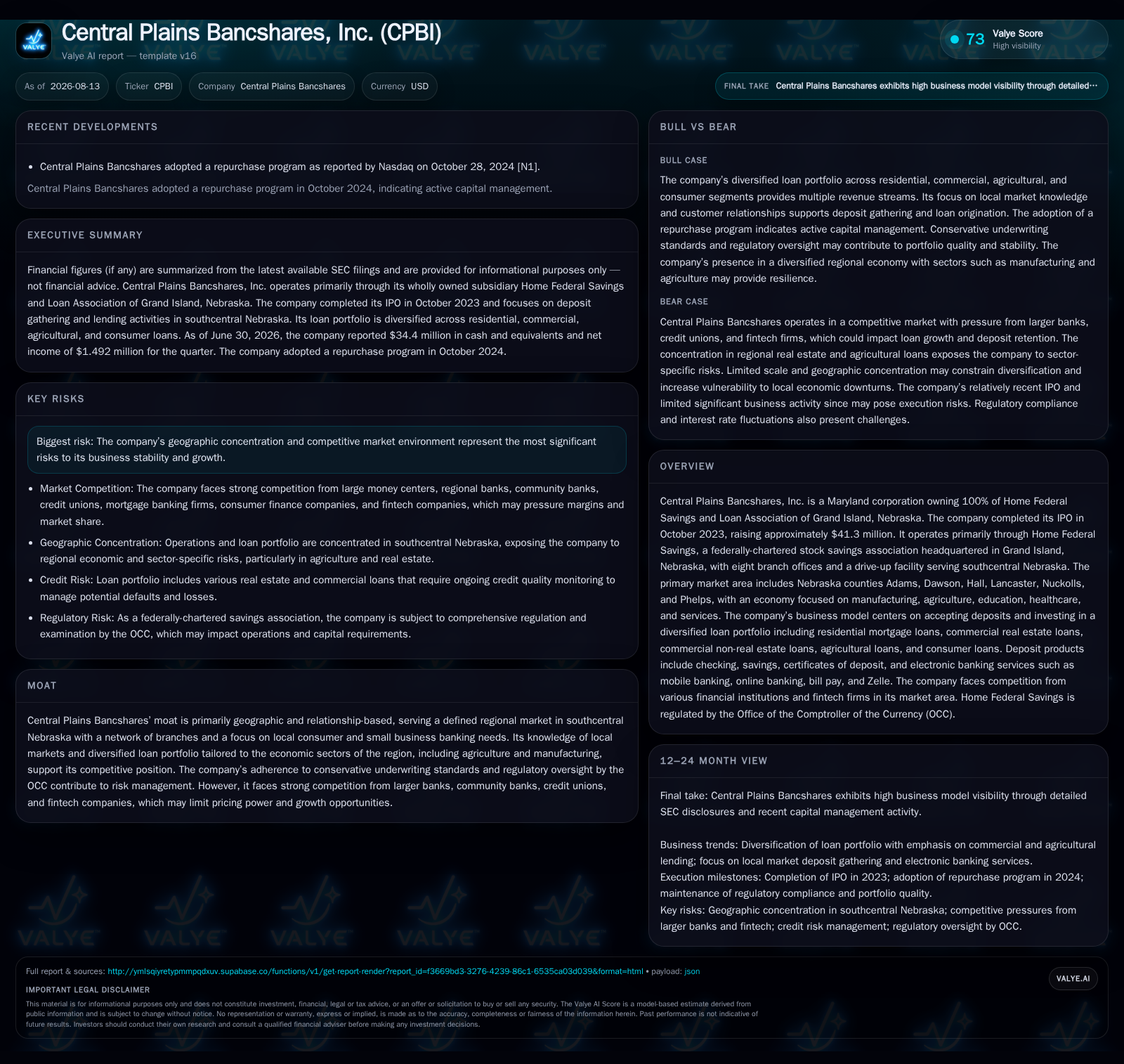
In its latest quarterly filing, Central Plains Bancshares reported stable loan growth and a solid deposit base supporting continued regional banking operations in southcentral Nebraska. The company's board approved a new stock repurchase program, reflecting confidence in capital adequacy and shareholder value management. Its business model centers on a diversified loan portfolio tailored to the local economy’s manufacturing, agriculture, and service sectors, with conservative underwriting sustaining credit quality. Competitive pressure on deposit pricing and the geographic concentration of the bank pose ongoing risks, while capital deployment decisions will be key to monitoring execution success going forward.
Q2 Operating Update Highlights and Implications for Capital Strategy
This solid operational progress underpinned the board’s July 2026 approval for submission to regulators of a new stock repurchase program, signaling confidence in both capital position and shareholder value initiatives during a well-capitalized posture maintained through prudent capital management practices [S3], [S2]. Cash and cash equivalents stood at $34.4 million at quarter end June 30, reinforcing liquidity strength for balance sheet growth or opportunistic capital deployment [F1]. This repurchase plan refresh follows previous buybacks executed earlier in fiscal 2026 totaling several thousand shares at an average price near $17.50 per share, balancing capital returns with operational needs [S4].
Building Competitive Resilience Through Localized Banking and Product Diversification
Central Plains Bancshares operates exclusively through Home Federal Savings & Loan Association based in Grand Island, Nebraska. The Company emphasizes relationship banking via a network of eight branches plus a drive-up facility primarily serving six Nebraska counties: Adams, Dawson, Hall, Lancaster, Nuckolls, and Phelps [S1]. This localized focus creates a geographic moat allowing access to loyal retail customers and small businesses familiar with Home Federal's community-oriented service model.
The loan portfolio reflects this regionally-tailored approach with sizable concentrations in residential mortgage loans—anchored by one- to four-family properties—and expanding commercial real estate loans targeting owner-occupied buildings and investment properties typical of local economic activity [S1],[S22]. Agricultural loans also constitute a meaningful segment given the area's historical farming base supplemented by manufacturing and healthcare services underpinning economic diversity. Consumer loans and commercial non-real estate lending supplement this mix but remain smaller components relative to real estate exposures. This product spread aligns loan risk concentrations with key local industry sectors while providing some variance against cyclical downturns specific to individual categories.
Regional Banking Economics: Loan Mix, Deposit Dynamics, and Pricing Power Considerations
The interplay between loan yields and deposit funding costs underpins Central Plains’ net interest margin dynamics. Despite upward pressure on deposit pricing observed broadly across regional banks competing for retail funds—including community banks and credit unions—the Company has leveraged its entrenched branch presence to maintain deposit stability while judiciously managing certificate of deposit rates especially those maturing within one year which totaled $89 million at March 31, 2026 [S10],[S25].
Brokered deposits introduced during fiscal 2026 have helped ameliorate funding volatility risks created by competitive pressures yet represent a cost element that management likely monitors closely given margin sensitivity [S10]. On the asset side, residential mortgages provide relatively stable yields albeit subject to prepayment risk while commercial non-real estate loans witnessed strong growth (+51%) supporting higher-yielding opportunities reflecting small business demand trends locally tied to economic development efforts [S10]. Sustained net interest margin above peers sized similarly signals effective repricing capabilities despite competitive headwinds—a factor supportive of durable net interest income generation if cost controls hold.
Balancing Credit Quality and Growth: Underwriting Discipline in Agriculture-Driven Markets
Provision for credit losses rose slightly to $306 thousand for Q2 versus prior periods but remains consistent with historical provisioning patterns indicative of sound credit risk management [S28],[S2]. Conservative underwriting permeates portfolio maintenance; commercial real estate loans are generally capped at loan-to-value ratios near or below 75%, reflecting cautious valuation disciplines aligned with OCC supervisory expectations under the federal savings association charter regime governing Home Federal Savings [S1],[S21].
Agricultural exposures face inherent cyclicality tied to commodity prices and weather conditions yet diversification within agricultural real estate versus operating loans may dampen episodic impacts on delinquencies or charge-offs.
Regulatory Context and the Strategic Rationale Behind the Latest Share Repurchase Program
Capital adequacy constitutes a central determinant shaping Central Plains’ capital return initiatives. The bank meets all applicable regulatory minimums comfortably across common equity Tier 1 (CET1), Tier 1 leverage ratios, and total risk-weighted capital ratios required under OCC regulations governing federally-chartered stock savings associations like Home Federal Savings [S18],[S2].
The July board approval to seek regulatory consent for a refreshed share repurchase plan follows prior buybacks managed carefully within prudential limits designed not to compromise capital buffers essential for safe operation amidst evolving macro-financial conditions [S3],[S4]. This progression indicates management’s strategy balancing shareholder returns against maintaining robust financial flexibility necessary for addressing organic growth via loan originations or potential strategic acquisitions should opportunities arise.
'What to Watch': Milestones in Loan Expansion, Deposit Retention, and Capital Management Ahead
Upcoming quarterly disclosures will be critical checkpoints to monitor deposit retention rates particularly on certificates of deposit where $89 million matures within one year as of Q2-end—and renewals at current yield environments will affect future funding cost trajectory profoundly [S10],[S2]. Loan origination volume trends—especially sustained expansion in higher yielding commercial non-real estate loans—will provide further visibility into demand pull from small-to-medium businesses operating within Central Plains’ market footprint.
Additionally, investors should track regulatory responses related to the repurchase program pending approval since timing or conditions imposed could influence capital allocation pacing or magnitude impacting near-term earnings per share dynamics.
Risks From Geographic Concentration and Competitive Pressures on Deposit Costs
Concentration risks inherent from focusing operations solely within six contiguous Nebraska counties expose Central Plains Bancshares primarily to regional economic cycles heavily influenced by agriculture production variability alongside manufacturing shifts impacting employment levels locally—a scenario that can amplify credit performance volatility relative to more geographically diversified institutions [S5],[S1].
This narrow operating footprint combined with intensifying competition from community banks offering tailored products as well as growing fintech alternatives exert pressure on deposit pricing dynamics limiting full pass-through potential within lending yields thereby challenging net interest margin expansion sustainably over multiple rate cycles without collateral efficiency gains or expense discipline enhancements.
Financial Profile Discussion
This liquidity strength supports ongoing balance sheet expansion ambitions evidenced by double-digit deposits growth this fiscal year while preserving regulatory capital adequacy intact permitting measured share repurchases aimed at enhancing per-share economics without undermining prudential safeguards stipulated by OCC oversight regimes governing federally chartered institutions such as Home Federal Savings acting through Central Plains Bancshares.
This analysis is based solely on publicly available information from Central Plains Bancshares’ SEC filings up to August 2026 without any speculative projections or assumptions beyond documented disclosures provided therein.
Disclaimer: This is research-only, informational analysis and not investment advice. It may include AI-generated interpretation and general industry context. Always verify important details using primary sources.

Comments