
Oaktree Acquisition Corp. III Life Sciences Navigates SPAC Lifecycle with Capital and Management Focus
As a SPAC targeting life sciences, OACC maintains liquidity readiness while progressing toward a business combination amid industry-wide execution risks.
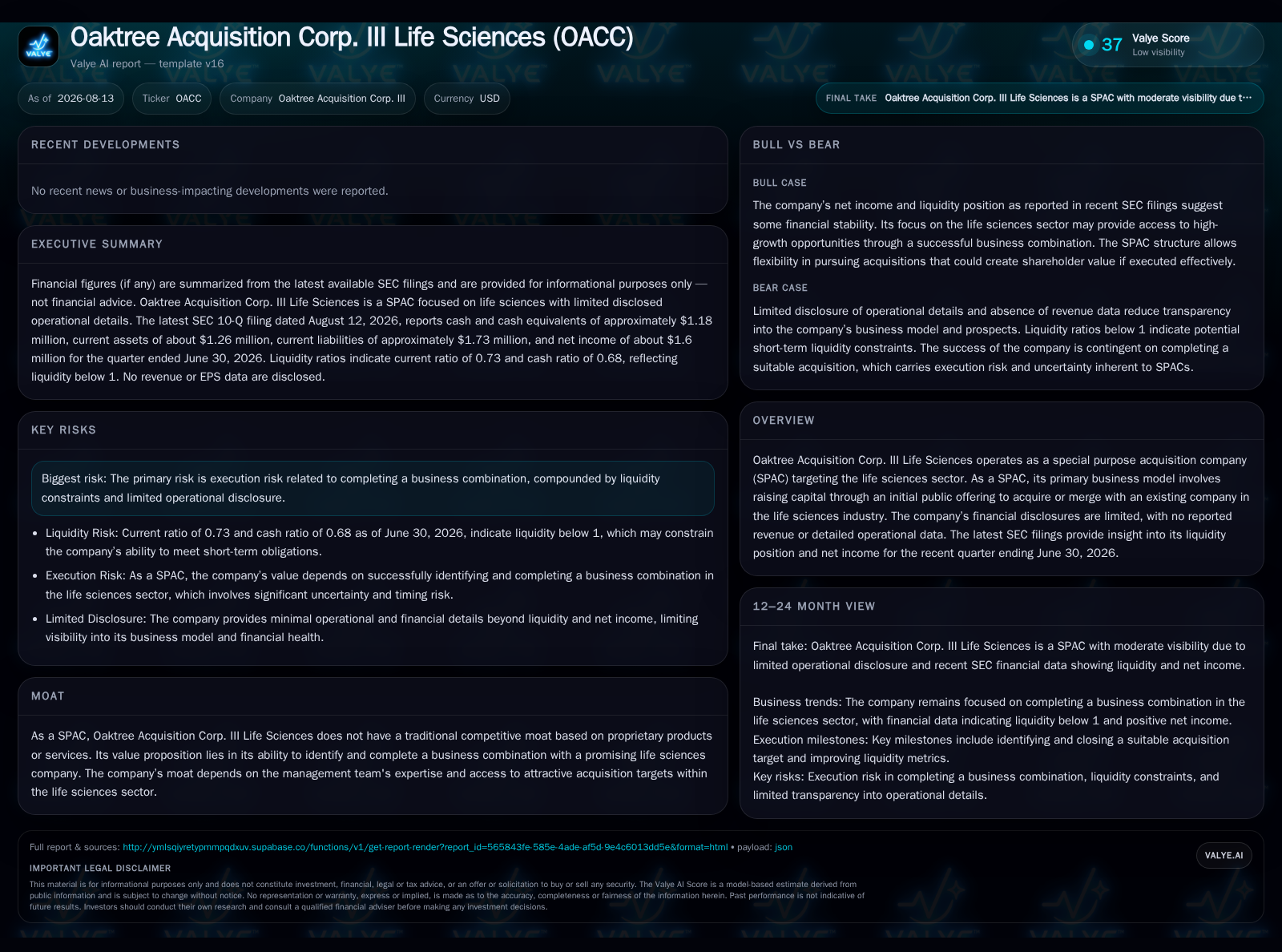
Oaktree Acquisition Corp. III Life Sciences (OACC) operates as a special purpose acquisition company raising public capital to acquire a private life sciences firm and take it public via merger. The latest quarterly filing reflects the typical SPAC financial profile of minimal operating income, sizeable cash reserves held in trust, low debt, and ongoing administrative expenses. The company’s value proposition hinges on management’s ability to source and close a suitable life sciences target within the mandated timeframe, an inherently uncertain process with significant execution risk. Liquidity metrics remain adequate but highlight challenges related to current liabilities exceeding current assets, underscoring reliance on timely deal completion or shareholder approvals to unlock value. OACC’s evolving leadership team includes experienced directors with deep sector expertise, aligning with common SPAC best practices for governance continuity prior to transaction close.
Recent Operating Update: Quarterly Context Reflects Pre-Combination Status
Oaktree Acquisition Corp. III Life Sciences (ticker: OACC) filed its latest quarterly report on August 12, 2026 ([S2]). As expected from a special purpose acquisition company (SPAC) still seeking a business combination within the life sciences sector, the filing discloses no operational revenue or commercial activities but details liquidity status and corporate governance developments. The balance sheet as of June 30, 2026 shows cash and equivalents totaling approximately $1.18 million against negligible total debt of about $11,800 yielding a net cash position near $1.17 million ([F1]). Current assets of $1.26 million compared with $1.73 million in current liabilities produce a sub-1 current ratio (0.73), reflecting short-term liabilities primarily comprising accrued expenses and administrative obligations that precede transaction closure milestones ([F1]).
This financial snapshot is typical of SPACs in their capital preservation phase post initial public offering (IPO) but pre-merger execution — capital chiefly resides in trust accounts reserved for the eventual acquisition while administrative costs persist.
Business Model: SPAC Framework Anchored on Life Sciences Sector Targeting
Distinct from traditional operating companies, OACC's core business model revolves around raising funds through its IPO by selling units consisting of Class A ordinary shares coupled with warrants ([S1]). Capital raised is held largely intact in trust pending identification and consummation of a merger partner aligned with its life sciences investment mandate. Revenue generation prior to this event is essentially nonexistent; returns to investors derive from successful completion of a so-called "business combination" wherein a private life sciences entity merges into the publicly listed shell created by OACC.
Value creation depends heavily on management's ability to source promising biotech or healthcare startups undergoing growth or needing public market access without the time-consuming traditional IPO process ([S1]). Unlike active biotech firms deploying R&D pipelines or healthcare providers delivering services, OACC operates purely as a financial intermediary facilitating liquidity events for target companies.
Key monetization levers include negotiating favorable merger terms ensuring accretive valuation for shareholders after accounting for dilution from warrants, founder shares, or PIPE (private investment in public equity) financing introduced concomitantly ([S1],[S9]).
Industry Structure and Competitive Position: Navigating SPAC Dynamics Amid Life Sciences Focus
Within the broader category of SPACs focused on biotechnology and healthcare sectors, OACC competes primarily on deal sourcing acumen and sponsor credibility rather than product differentiation or market share. The space includes peers such as Churchill Capital Corp (various series), Social Capital Hedosophia holdings targeting innovation-driven companies, and others which transact via similar trust-bucket financing vehicles backed by institutional capital.
The life sciences vertical itself is characterized by long development cycles, stringent regulatory approvals (FDA et al.), high capital intensity for drug development or medical devices, and volatility tied to clinical trial outcomes or approval milestones. This adds complexity and elevated due diligence demands for any prospective SPAC acquisition.
OACC benefits from sponsorship by Oaktree Capital Management professionals whose background includes finance operations expertise and relationships crucial for deal flow generation ([S7],[S16]). Additionally, board appointments like Dr. David A. Berry — an experienced biotech executive with prior CEO roles — enhance credibility and guidance specific to navigating this sector’s nuances ([S15]).
Growth Drivers: Capitalizing on Alternative Public Market Access Demand
Growing investor appetite for alternative routes into high-growth sectors fuels demand for vehicles like OACC that streamline access to private life sciences companies seeking public funding without traditional IPO friction.
Regulatory environments have recently stabilized favoring clear disclosure rules around warrants exercisability and redemption rights which enhances investor confidence in SPAC structures overall ([S9],[S1]). Moreover, innovations in deal structuring — including simultaneous PIPE commitments during merger announcements — supplement capital resources ensuring robustness against shareholder redemptions reducing available funds ([S1]).
Sector-specific tailwinds derive from continued biomedical innovation trends driving robust pipelines suitable for SPAC acquisitions — areas including gene editing, novel therapeutics modalities, diagnostics advancements — all requiring capital-intensive scaling supported by liquidity events facilitated by entities like OACC.
Risks and Watchpoints: Execution Challenges Central Amid Liquidity Constraints
The most critical risk inherent in OACC's business model is execution risk tied to identifying an eligible life sciences acquisition target aligned with valuation expectations within the mandated timeframe set forth post-IPO ([S9]). Failure triggers liquidation scenarios detrimental to shareholders’ invested capital.
Financial liquidity metrics flag potential short-term pressure demonstrated by the current ratio below 1.00 at June 2026 quarter-end ([F1]). While indicative mainly of routine expenses ahead of merger close rather than distress, it underscores dependency on completing transactions promptly.
Additional risks relate to warrant exercise limitations—public holders might face forced cashless exercises diminishing share upside while sponsors retain privileges enhancing potential conflicts ([S1]). Regulatory scrutiny over disclosure transparency and timing continues evolving impacting document filings.
Shareholder redemptions also represent variability factors potentially reducing available proceeds needed for targeted acquisitions or creating adverse negotiation leverage against prospective targets.
What To Watch Next: Milestones Critical For Transitioning Beyond Shell Status
Key near-term catalysts include:
- Announcement of specific target companies under agreement or letter-of-intent phases within the life sciences arena;
- Outcomes from shareholder votes on proposed mergers which validate investor support;
- Levels of redemptions exercised by public shareholders affecting available deal financing;
- Amendments concerning warrant terms especially regarding redemption rights or cashless exercise mandates impacting future equity distribution;
- Any extension requests filed regarding statutory deadlines governing business combination consummation;
- Additional appointments or changes among executives or independent directors signaling governance evolution.
Investors monitoring OACC should prioritize SEC filings disclosing tangible progress markers beyond routine risk factor updates or administrative staffing changes.
Financial Profile Discussion
As per the latest June-end balance sheet data sourced from companyfacts ([F1]), Oaktree Acquisition Corp.
Operating income remained negative consistent with standard administrative expense run rates (-$1.19 million annualized last reported period) while net income previously registered positive but stems chiefly from interest revenues earned on cash balances rather than operational profitability ([F1]).
Taken together these figures illustrate typical financial positioning for an early-stage SPAC whereby preserving liquidity integrity is paramount alongside controlling overhead while progressing toward transaction finalization.
This analysis intends solely to explicate business and financial fundamentals grounded in publicly available SEC filings without extending any explicit investment research view concerning securities discussed herein.
Disclaimer: This is research-only, informational analysis and not investment advice. It may include AI-generated interpretation and general industry context. Always verify important details using primary sources.

Comments