
Lucid Diagnostics Advances Noninvasive Esophageal Cancer Screening Amid Ongoing Commercial and Financial Challenges
The latest quarterly report highlights incremental revenue progress from patented DNA methylation testing combined with continued investment in commercialization and reimbursement expansion.
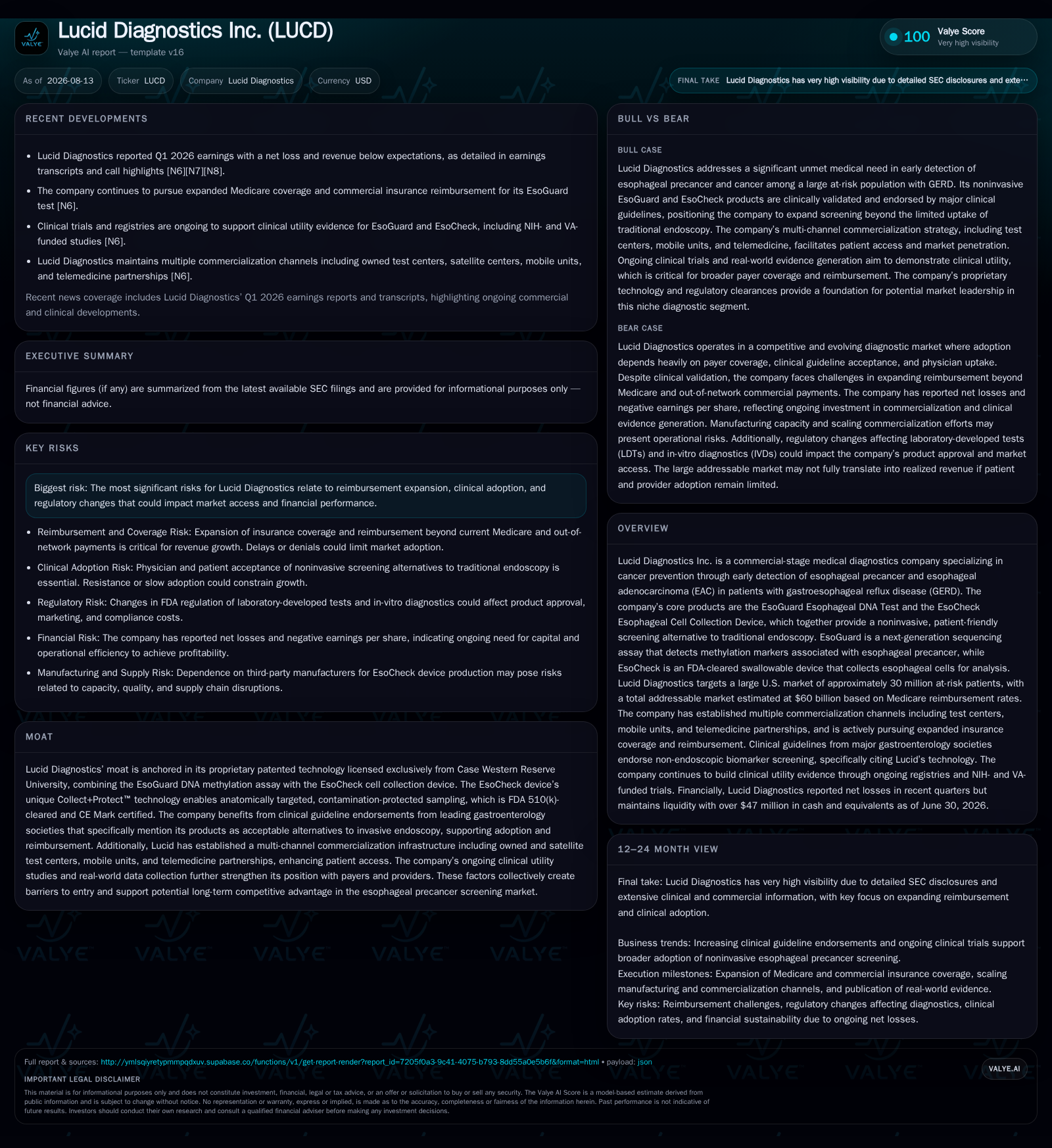
Lucid Diagnostics Inc. focuses on early detection of esophageal adenocarcinoma through its EsoGuard methylation assay and FDA-cleared EsoCheck cell collection device, targeting a large at-risk GERD patient population. The recent quarter shows modest revenue growth alongside sustained operating losses and liquidity management challenges. Lucid’s proprietary sample collection technology and clinical validation underpin its competitive positioning in a developing molecular diagnostics niche, but scaling commercialization depends critically on expanding reimbursement coverage, accelerating physician adoption, and increasing manufacturing and laboratory capacity.
Recent Operating Update
In Q2 2026, Lucid Diagnostics reported approximately $1.5 million in revenue related to EsoGuard testing services, marking incremental commercial progress in deploying its noninvasive esophageal cancer screening solution [S2]. This revenue growth signals initial physician adoption but remains modest relative to operational expenditures. The company continues to invest heavily in research and development, clinical validation studies, regulatory activities, marketing infrastructure, and manufacturing scale-up — typical for early-stage diagnostic companies transitioning from development to commercialization. Funding continues primarily through equity issuances complemented by convertible securities and debt instruments subject to restrictive covenants that affect liquidity management [S2]. These dynamics highlight the balance Lucid must strike between advancing market penetration while securing sufficient capital to sustain operations.
Business Model Overview
Lucid operates in the molecular diagnostics sector with a focus on noninvasive early detection of esophageal adenocarcinoma (EAC) precursors among patients suffering from gastroesophageal reflux disease (GERD). Revenue is generated mainly by selling the EsoCheck sample collection device alongside laboratory analysis using the EsoGuard methylation assay. EsoGuard applies bisulfite-converted targeted next-generation sequencing (NGS) technology to quantify methylation at 31 specific sites on genes linked to Barrett’s esophagus (BE) and EAC from cells collected via EsoCheck’s patented Collect+Protect™ mechanism [S1]. This integrated approach aims to offer clinicians a less invasive alternative to endoscopy for screening high-risk patients.
Payors include Medicare and private insurers reimbursing healthcare providers who order tests for at-risk populations. Lucid’s monetization leverages direct laboratory services supported by owned or partnered test centers managing sample processing throughput — key levers impacting revenue scalability and margin potential [S1]. Proprietary intellectual property covering both the molecular targets in the assay and the unique cell capture technology embedded in EsoCheck supports differentiation and potential pricing leverage compared to competing diagnostics
Industry Context and Competitive Positioning
The medical diagnostics industry increasingly prioritizes noninvasive early cancer detection tools that combine high analytical sensitivity/specificity with patient-friendly procedures. Lucid’s focus on EAC prevention via methylation biomarker assays places it alongside peers like Exact Sciences (colorectal screening) or Guardant Health (liquid biopsy), which also integrate advanced molecular assays with streamlined specimen collection methods. Lucid distinguishes itself by targeting esophageal cancer precursors with clinically validated biomarkers not easily detected by symptom-based or imaging approaches.
Critical success factors include regulatory clearance (achieved FDA 510(k) status for EsoCheck), robust clinical validation demonstrating ~97% sensitivity and ~95% specificity, plus securing reimbursement acceptance essential for payor funding [S1]. Endorsements in clinical practice guidelines elevating these tests as viable alternatives to invasive endoscopy provide a competitive moat facilitating physician uptake.
Emerging competition from blood-based liquid biopsies offering broader oncologic screening presents medium-term risks requiring ongoing innovation investment. Additionally, license dependency on Case Western Reserve University’s patents introduces counterparty risk should agreements be compromised.
Growth Drivers
Lucid targets an estimated U.S. population of approximately 30 million adults with GERD at elevated risk for EAC progression, representing a sizable addressable market valued near $60 billion based on Medicare reimbursement rates [S1]. Increasing emphasis on early detection in gastroenterology practice guidelines drives demand alongside growing clinician awareness facilitated by published clinical utility data.
Advances in NGS technology enable cost-efficient methylation profiling supporting scalable assay throughput without sacrificing diagnostic accuracy — critical as test volumes increase. Strategic partnerships expanding telemedicine-enabled screening programs further extend reach beyond traditional specialty centers.
Manufacturing capacity through Coastline International currently supports annual production of up to 25,000 EsoCheck devices with planned expansions aimed at meeting anticipated volume growth [S1]. Efficient logistics managed by Diagnostic Support Services optimize supply chain reliability.
Ongoing real-world evidence generation from post-market studies is expected to reinforce payer confidence by demonstrating health-economic benefits that support broader coverage policies critical for sustainable recurring revenues beyond early adopters.
Risks and Watchpoints
Execution risks primarily revolve around achieving broad reimbursement coverage beyond Medicare into commercial payors; slow physician adoption could constrain volume ramp-up projections. Regulatory shifts affecting device classification or reporting requirements could increase compliance costs or delay approvals [S1], [S17].
Dependency on licensing agreements with Case Western Reserve University poses intellectual property continuity risks impacting commercialization rights. Competition from evolving liquid biopsy technologies or alternative biomarker platforms necessitates continuous innovation investment.
Financially, sustaining operations depends on timely access to capital markets amid dilution risks inherent in outstanding convertible securities; failure to secure funding would threaten operational runway given persistent losses [S2].
Manufacturing or laboratory processing bottlenecks could limit growth if capacity expansions lag demand increases.
Potential legal liabilities including product liability claims remain possible though no material litigation is currently disclosed [S17]
What to Watch Next
Key indicators include expansion of reimbursement coverage among commercial insurers complementing existing Medicare acceptance. Monitoring test order volumes will provide insight into adoption momentum.
Results from ongoing clinical utility studies assessing real-world effectiveness have potential to influence payer negotiations positively if outcomes align with prior high predictive value findings.
Operational metrics such as increased manufacturing output from Coastline International capacity upgrades or enhanced lab throughput will reflect execution capability underpinning future growth.
Announcements regarding new intellectual property filings or strategic collaborations—particularly telehealth integration—would signal strengthening competitive positioning.
Liquidity updates following financing events will clarify balance sheet strength supporting continued R&D investment necessary for assay enhancements or pipeline diversification.
Financial Profile Discussion
As of September 30, 2025, Lucid held approximately $47.3 million in cash and equivalents [F1]. Current assets stood at $36.6 million versus current liabilities of $27.5 million as of June 30, 2026, yielding a current ratio of about 1.33 indicative of adequate short-term liquidity management [F1].
Quarterly cash burn remains significant due to expenses associated with marketing expansion, R&D activities, regulatory compliance costs, manufacturing scale-up efforts, and infrastructure development required to support expected increases in test volume [S2]
SEC disclosures acknowledge substantial doubt regarding going concern status driven primarily by recurring negative cash flows absent accelerated revenue scale-up combined with reliance on equity raises including convertible notes highlighting financial sustainability risks if capital access tightens [S2]
Balancing accelerated adoption generating recurring revenues against dilution effects requires vigilant monitoring alongside margin improvement strategies focused on efficient assay processing and supply chain optimization essential for approaching profitability.
Disclaimer: This is research-only, informational analysis and not investment advice. It may include AI-generated interpretation and general industry context. Always verify important details using primary sources.

Comments