
Linkhome Holdings Builds AI-Driven Real Estate Platform with Fintech Innovation
Linkhome’s August 2026 quarterly update highlights operational progress in integrating advanced AI and fintech capabilities to reshape residential real estate transactions.
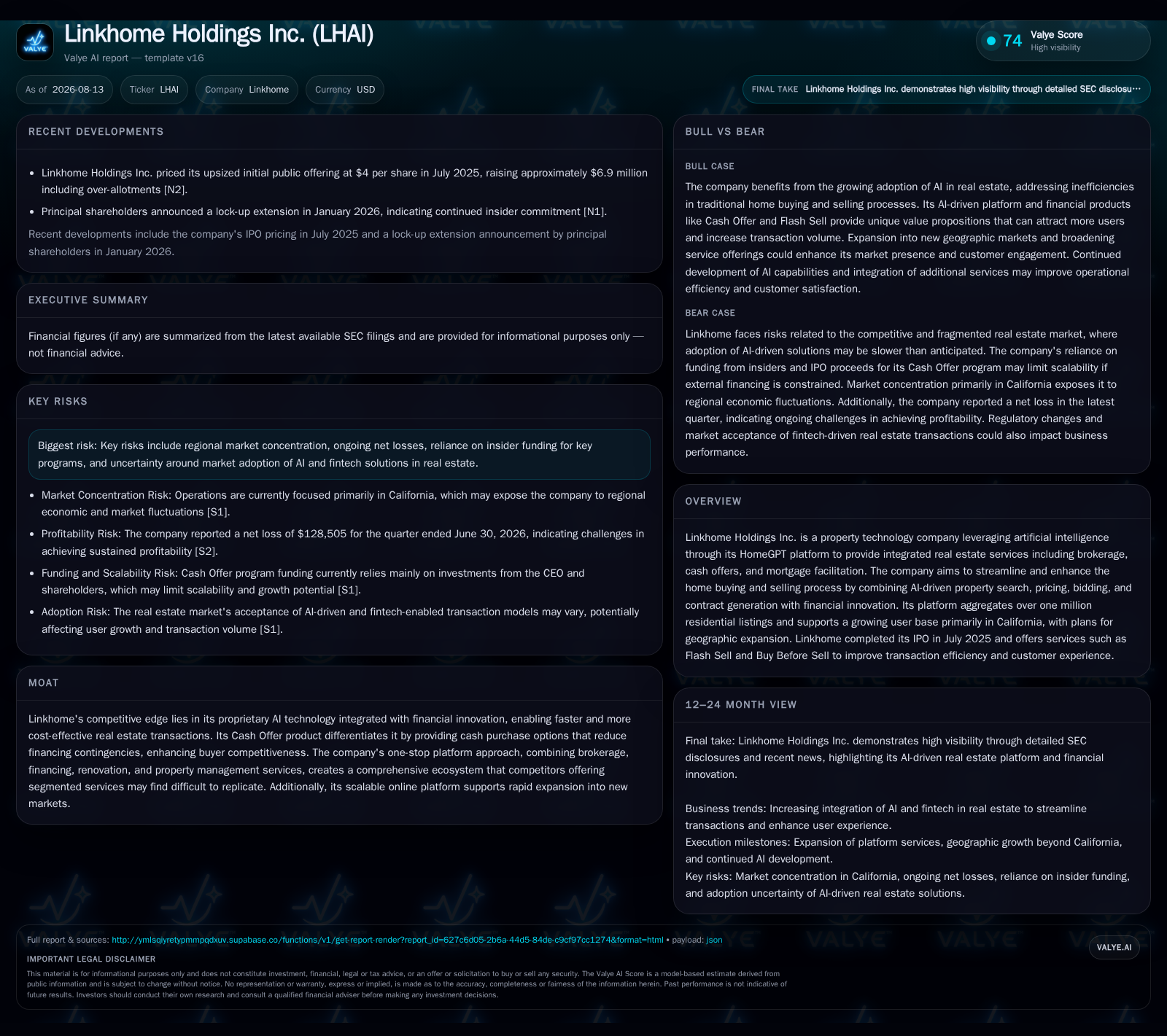
In its latest filing, Linkhome Holdings Inc. demonstrated early signs of traction in deploying its HomeGPT AI platform integrated with fintech solutions such as Cash Offer and mortgage facilitation, aiming to streamline home buying and selling. The company reported a robust liquidity position with over $5 million in cash and minimal debt while advancing strategic efforts including its recent acquisition of Mortgage One Group to bolster financing services. Despite the concentrated California market focus and ongoing challenges in achieving consistent profitability, Linkhome’s multi-service platform model positions it for scalable growth amid increasing consumer adoption of digital real estate tools.
Latest Quarterly Developments: Operational Signal or Noise?
Linkhome Holdings Inc.'s Q2 2026 filing signals incremental progress toward business maturation after its mid-2025 IPO. The company reported no material operational setbacks but highlighted ongoing initiatives enhancing its platform's transactional throughput. Notably, stockholders authorized amendments enabling reverse stock splits within a range of 1-for-5 to 1-for-20 shares to maintain Nasdaq listing standards compliance—a move indicating capital structure flexibility amid share price pressures [S2][S3]. Such governance actions underline management’s responsiveness to public market dynamics while the company scales its technology-driven ecosystem.
Although specific quarterly transaction volumes remain confidential, Linkhome’s announcement of completing the acquisition of Mortgage One Group evidences strategic expansion in mortgage facilitation capabilities—a crucial vertical in its integrated offering spectrum [S3]. This acquisition complements the HomeGPT platform by adding backend mortgage financing functions designed to accelerate deal closure speeds and improve conversion metrics. These developments affirm that Linkhome is transitioning from foundational R&D and user acquisition phases toward deeper integration of real estate brokerage and fintech lending services.
Integrating AI and Fintech: The Mechanics Behind Linkhome’s Platform
At its core, Linkhome leverages HomeGPT—an AI engine developed internally—that ingests extensive residential property data aggregated from MLS feeds encompassing over one million active listings [S1]. The AI algorithm improves property valuation accuracy and buyer-seller matching relevance by analyzing market trends, buyer preferences, and pricing dynamics. This capability reduces search friction typically encountered in conventional home buying processes.
Beyond search enhancement, Linkhome's Cash Offer product integrates fintech solutions enabling buyers to submit competitive cash offers which bypass typical financing contingencies that often delay or derail transactions [S1][S3]. This innovation reduces risk for sellers and improves buyers’ offer success rates by providing transaction certainty. Combined with mortgage facilitation services post-Mortgage One Group acquisition—which brings potential recurring revenue streams from loan origination fees—this multi-pronged approach diversifies revenue beyond traditional brokerage commission models relating solely to deal closings
Customer acquisition is boosted via an AI-driven multi-channel marketing strategy that targets segments with tailored messaging based on refined audience segmentation. This lowers customer acquisition cost (CAC) relative to untargeted campaigns—an important efficiency consideration given intense competition among PropTech firms for digital engagement [S1]. As these components coalesce within a unified platform infrastructure, Linkhome aims for operating leverage through transactional volume growth and incremental fintech service penetration.
Competitive Positioning Within a Crowded PropTech Ecosystem
The PropTech landscape is composed of diverse players covering marketplaces (e.g., Zillow), integrated brokerages (Redfin), iBuyers offering instant cash sales (Opendoor), and dedicated fintech mortgage lenders (Better.com). Linkhome occupies a hybrid niche that blends AI-powered search brokerage with embedded financial products designed to speed up closing times and provide capital solutions directly from the platform.
While Zillow primarily generates revenue through advertising and leads with partial iBuyer involvement; Redfin integrates technology into a full-service brokerage; Opendoor focuses exclusively on instant home buying; Better.com concentrates on the digital mortgage segment. Linkhome attempts to bridge these gaps by delivering end-to-end services within one ecosystem — from discovery via HomeGPT through cash offers to financing origination — intending to build switching costs via customer convenience and data integration.
However, the company's current geographical concentration mainly in California limits network effects scale compared to national incumbents like Zillow or Redfin. Furthermore, the absence of explicit market share disclosures suggests early-stage penetration requiring sustained investment before notable competitive positioning gains can be evidenced.
Expanding Demand Drivers: Geographic Reach and Product Innovation
Expanding beyond California represents a significant growth lever for Linkhome—filings note plans to launch the platform across additional cities within upcoming years alongside expanded service offerings such as Buy Before Sell programs that allow customers to purchase new homes prior to selling their existing ones without typical financing contingencies [S1][S3]
Such product innovations tap into buyer pain points related to timing mismatches during home transitions. Improvements in HomeGPT’s AI algorithms also promise superior property valuation tools that could enhance conversion rates from listing viewerships to sales closures—a critical KPI for brokerage profitability.
Partnering with financial institutions and integrating Mortgage One Group’s origination capacity provide mechanical levers for scaling loan volumes that directly increase fee-based income streams distinct from commission dependency. Optimizing customer acquisition cost through targeted marketing enhances growth unit economics as transaction volume scales.
Risks: Market Concentration, Profitability Challenges, and Execution Risks
Linkhome’s primary risk factor stems from its heavy reliance on California's housing market—a region subject to pronounced cyclicality influenced by interest rate shifts, regulatory changes such as mortgage underwriting standards adjustments, housing inventory volatility, and local economic factors affecting affordability [S1]. A downturn or adverse regulatory change could materially impair transaction volume.
Despite increasing revenues supported by a growing listing base exceeding one million properties as of end-2025, consistent profitability remains elusive due to substantial investments in technology development, marketing campaigns aimed at scaling users efficiently via AI-driven methods, plus costs related to the recent acquisition integration process. Continued dependence on insider funding for cash offer financing introduces liquidity risk as public markets demand confidence in sustainable capital structures.
Moreover, uncertainties around consumer adoption timing for AI-powered homebuying platforms combined with evolving federal/state regulations governing fintech mortgage operations pose additional execution risks common across emerging PropTech firms striving for rapid scale with innovative offerings.
Monitoring Points: What Next Quarters Could Reveal About Growth Trajectory
Investors assessing Linkhome should monitor quantitative indicators like rising closed transaction counts correlated with increased Cash Offer usage rates—both signaling acceptance of fintech-enabled purchase acceleration.
Mortgage origination volume trends following Mortgage One Group's integration will reveal incremental fee income stability beyond commission revenue. Efficiency improvements reflected in lowered CAC via precision-targeted advertising would demonstrate marketing effectiveness complementary to user engagement metrics on the HomeGPT platform.
Additionally, outcomes related to reverse stock split authorizations will be key for gauging management’s ability to maintain Nasdaq listing eligibility which impacts institutional investor accessibility.
Finally, geographic expansion progress benchmarks measured by new city launches relative to planned timelines will indicate whether scalability ambitions translate into tangible growth beyond current core markets.
Financial Profile Discussion: Liquidity Strength Amid Scaling Investments
As of June 30, 2026, Linkhome held approximately $5.1 million in cash and equivalents against nominal total debt near $19 thousand—yielding a large net cash position that supports runway extension during capital-intensive scaling phases [F1]
This financial strength enables Linkhome to invest in expanding its ecosystem integration capabilities—including further enhancements of AI algorithms within HomeGPT—and financing infrastructure improvements brought by acquired subsidiaries without excessive dilution or reliance on costly external funding sources at this juncture.
This analysis summarizes publicly available filings combined with industry context; it does not constitute investment advice or endorsement.
Disclaimer: This is research-only, informational analysis and not investment advice. It may include AI-generated interpretation and general industry context. Always verify important details using primary sources.

Comments