
Vivos Inc. Advances Yttrium-90 Radionuclide Therapy Amid Regulatory and Funding Challenges
Recent quarterly filings highlight Vivos Inc.'s progress in veterinary oncology commercialization while navigating critical capital and regulatory hurdles for human therapy.
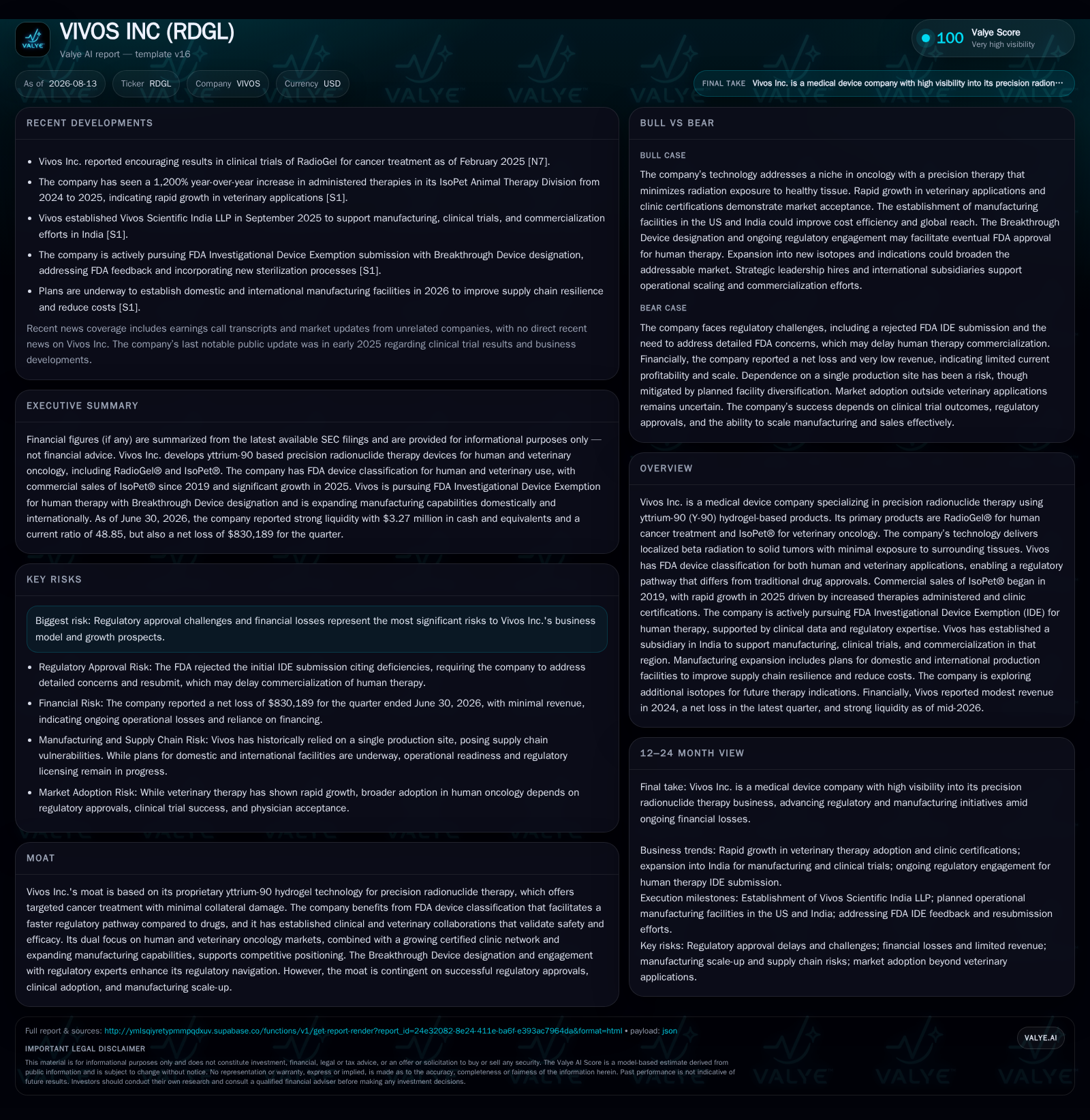
Vivos Inc. specializes in yttrium-90 precision radionuclide therapy devices targeting solid tumors in both humans and animals. Its veterinary product, IsoPet®, has grown through increased therapies administered and clinic certifications, aiming to become a standalone business. However, the company continues to face significant challenges securing regulatory approvals for human applications and requires additional capital estimated at $9 million over three years to sustain operations and advance clinical trials. The company's proprietary hydrogel technology and FDA device classification provide differentiation, but financial constraints and regulatory risk remain substantial near-term headwinds. Operational focus remains on expanding veterinary sales while progressing Investigational Device Exemption (IDE) efforts for human treatment.
Recent Operating Update
Vivos Inc.'s latest quarterly filing dated August 12, 2026, reveals persistent financial discipline challenges despite operational progress in its Precision Radionuclide Therapy™ product line. The company explicitly states it requires approximately $3.0 million per year to maintain current activities and anticipates needing about $9.0 million over the next three years to finance critical milestones including the FDA approval process for its human therapeutic products under an Investigational Device Exemption (IDE) [S2]. Such funding is crucial given Vivos's accumulated deficits exceeding $88 million through year-end 2025 and recurring operating losses [S1]. This replenishment need underpins the company's strategic intent to leverage diverse capital sources comprising licensing deals, partnerships, Regulation A+ offerings, and revenue streams from its veterinary IsoPet® division [S2].
Of note, IsoPet®, Vivos's yttrium-90 hydrogel-based device tailored for veterinary oncology applications—specifically treating solid tumors in animals—has achieved faster commercial traction. Starting in 2019 with product launch, recent years have brought accelerated adoption driven by increased numbers of therapies administered as well as a growing clinic certification network. For instance, beginning in 2025 the company shifted from absorbing clinic certification costs to charging fees for these services, indicating scaling market demand sufficient to enable positive contribution margins within the animal health segment [S1]. This pivot toward “volume pricing” aims to expand clinic participation and smooth pathway to profitability in this standalone business unit [S2].
Business Model: Revenue Mechanics and Strategic Strengths
Vivos's revenue model derives predominantly from direct product sales of its RadioGel®/IsoPet® yttrium-90 precision radionuclide hydrogel devices to medically certified veterinary clinics and eventual human oncology healthcare providers subject to FDA approval pathways [S1]. The company monetizes through sales of the radioactive hydrogel kits along with fees for clinic certification—a process ensuring safe and effective administration aligned with regulatory standards—which supports wider adoption beyond initial pilot users. The veterinary market benefits from an FDA Center for Veterinary Medicine determination categorizing IsoPet® as a medical device rather than a drug; this pivotal classification exempts it from premarket approval (e.g., PMA or 510(k)) requirements facilitating faster access to commercial distribution upon demonstrating safety compliance
Conversely, human therapeutic commercialization depends heavily on securing an Investigational Device Exemption followed by eventual premarket submissions leveraging FDA’s medical device pathway—a notable advantage relative to conventional drug development timelines but still subject to rigorous clinical scrutiny. Vivos’s proprietary yttrium-90 hydrogel polymer platform represents a key technological moat by enabling localized beta radiation delivery directly into solid tumors with minimal off-target exposure. This precision reduces common collateral damage associated with systemic radiotherapies or external beam radiation and is validated by collaboration with leading radiochemists and research institutions [S1].
Sales channels involve direct engagement with veterinary clinics initially and later specialized cancer treatment centers post-human approvals; these channels require clinic certifications that serve as both quality stamps and revenue contributors as scale increases. The company also supplies specialized polymers (PLGA-g-PEG) used in its PrecisionGel™ platform enabling extended drug delivery applications, although these constitute supplementary product lines.
Industry Context and Competitive Position
Within the medical devices radiation oncology sector, companies focus on delivering isotopes like yttrium-90 via innovative modalities to treat solid tumors effectively while limiting toxicity profiles compared to traditional chemotherapy or surgical approaches. Vivos occupies a niche between established radiation oncology device manufacturers such as Varian Medical Systems or Elekta AB—which primarily supply external beam systems—and radiopharmaceutical firms focusing on systemic treatments.
By straddling human and veterinary markets with differentiated regulatory frameworks—facilitated by FDA device classifications—the company enjoys mitigated single-market concentration risk while addressing two distinct segments with growing demand for minimally invasive cancer therapies. Veterinary oncology provides an accelerated commercial testbed due to lower regulatory barriers and an expanding pet cancer care market. Scaling clinic certifications acts as structural lever for adoption rates across regions.
While peers deploy various isotopes or radiation delivery methodologies (e.g., BTG International’s interventional devices), Vivos’s use of a hydrogel polymer matrix as an implant carrier for yttrium-90 offers competitive differentiation via controlled release kinetics and enhanced locoregional retention in tumor beds.
Growth Drivers
Demand tailwinds include increasing global incidence of solid tumor cancers coupled with greater acceptance of targeted radionuclide therapies offering improved safety-benefit profiles relative to legacy treatments. Furthermore, FDA’s medical device classification affords faster regulatory pathways compared to drug approvals which typically entail lengthier trials.
The expansion of certified veterinary clinics administering IsoPet® signals validating market traction aiding unit volume growth—an important revenue growth driver given that therapy counts correlate directly with product sales and ancillary certification fees. Additionally, successful advancement through human clinical trial stages aiming at IDE authorization will unlock significant new TAM expansion high-value revenue opportunities.
Manufacturing scale-up investments underway aim at enhancing capacity utilization critical to margin improvements as per-unit production economics benefit from higher output volumes.
Risks and Constraints
Foremost risks hinge on regulatory approvals for human therapy indications which remain uncertain despite existing FDA device classifications; delays or failures could materially impede timeline and capital requirement projections. The company’s long history of operating losses combined with high cash burn intensifies funding needs raising concerns about dilutionary financing rounds which may impose restrictive covenants or adverse terms impacting operational flexibility [S1], [S2].
Manufacturing scale-up entails technical execution risk that could undermine supply consistency affecting customer confidence during commercialization ramp phases. Clinic certification uptake relies on veterinarians’ or oncologists’ acceptance predicated on emerging clinical evidence; slow adoption would constrain therapy administrations and revenue growth.
Competitive pressures exist from alternative therapeutic modalities including external beam radiation vendors expanding indications as well as evolving pharmacologic agents benefiting from larger marketing budgets.
What To Watch Next
Key milestones include progress reports from ongoing clinical trials relevant to IDE submissions particularly evidencing safety/efficacy metrics that underpin FDA clearance decisions.
Tracking the number of newly certified veterinary clinics alongside reported therapy volumes will provide timely indicators of commercial momentum widening IsoPet® penetration domestically and abroad.
Monitoring capital raising activities is essential since approximately $9 million over three years is anticipated for sustained operations; success or delay here influences execution capability dramatically.
Manufacturing scale-up benchmarks assessing throughput efficiency will offer insight into potential margin expansions crucial for achieving eventual profitability thresholds.
Subsequent signaling around Breakthrough Device designation updates or partnership/licensing agreements can accelerate market access or de-risk capital intensity.
Financial Profile Discussion
As of June 30, 2026, Vivos exhibited a strong liquidity position relative to immediate payables highlighted by $2.44 million current assets against approximately $49 thousand current liabilities yielding an unusually high current ratio near 48.85 [F1], [S2]. This imbalance primarily reflects cautious balance sheet management but also points toward modest near-term obligations against limited tangible working capital deployment amid ongoing R&D.
Operating results continue depressed illustrating net losses exceeding $3 million annually reflecting high fixed costs linked to R&D expense ratios intrinsic to novel medical device innovation cycles coupled with limited commercial revenues so far confined mainly within veterinary applications generating nominal top-line turnover ($4,995 at end-2024) [F1], [S1].
Overall, financial footing indicates critical dependency on future fundraising success aligned tightly with hitting clinical milestones that catalyze licensing revenues or expanded direct sales.
Disclaimer: This analysis presents factual information supported by SEC filings and industry context without providing investment advice or price forecasts.
Disclaimer: This is research-only, informational analysis and not investment advice. It may include AI-generated interpretation and general industry context. Always verify important details using primary sources.

Comments