
First Capital Inc Reaps Stability Through Regional Banking Focus
First Capital’s latest quarterly update highlights steady earnings supported by disciplined credit management and local market penetration.
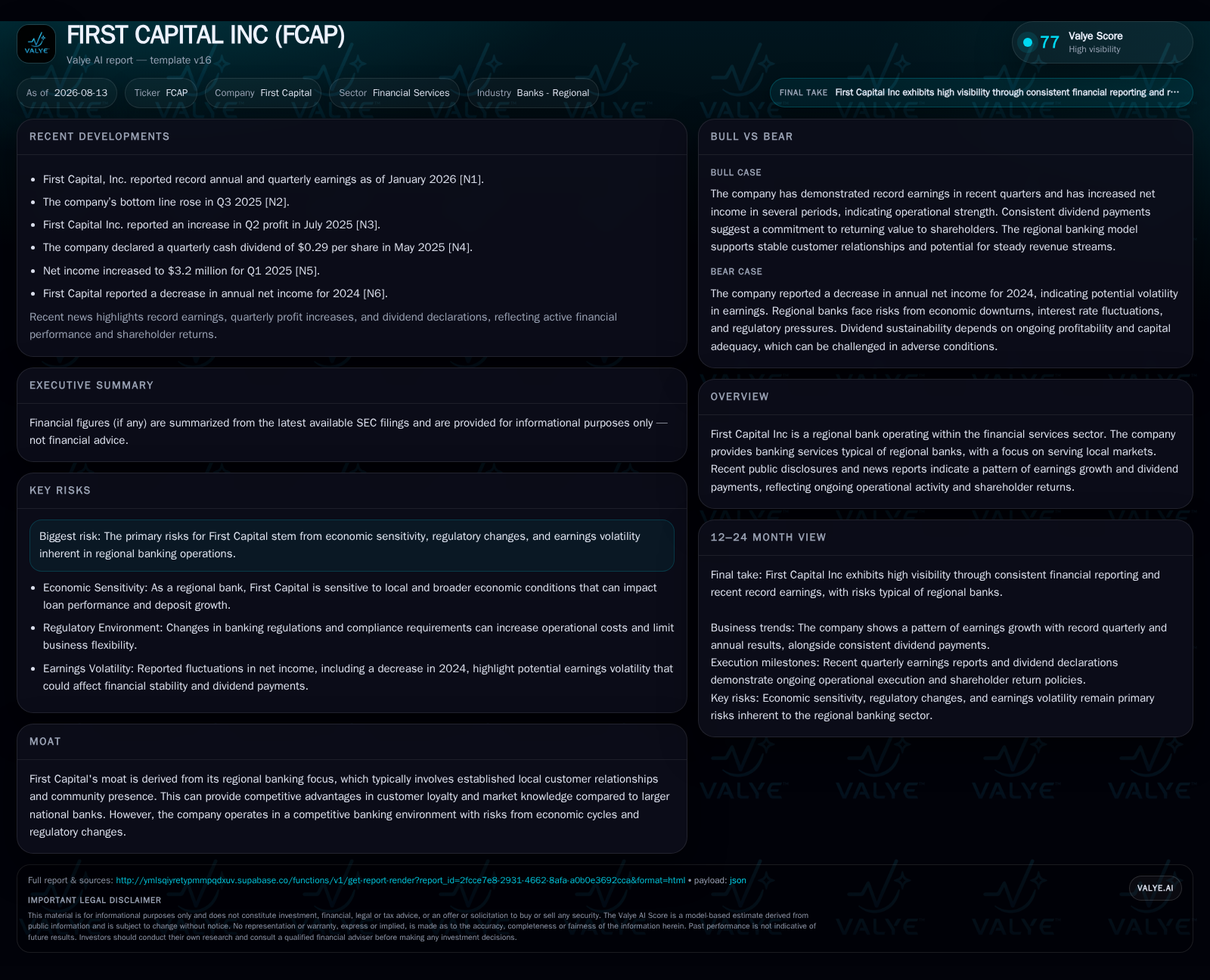
In its 2026 second quarter filing, First Capital Inc demonstrated resilience typical of regional banks with stable loan growth, maintained net interest margin, and consistent credit quality indicators. The company’s localized banking model drives revenue through interest spread management and fee income from community-focused services. Despite operating in a competitive and regulated environment, First Capital’s efficiency and capital ratios suggest a solid foundation for sustainable growth. Near-term risks center on economic cyclicality and regulatory shifts, while growth is underpinned by local economic activity and product expansion efforts.
Quarterly Operating Update: Evidence of Earnings Stability in a Challenging Environment
First Capital Inc’s latest quarterly filing for Q2 2026 reveals continuing operational strength within its regional banking niche. The filing discloses steady loan growth alongside maintenance of net interest margin despite ongoing volatility in the broader interest rate environment [S2]. This stability suggests effective management of deposit beta—the sensitivity of deposit costs to changes in benchmark rates—and careful balancing of asset yields against funding costs. Credit quality metrics remain reassuring, with controlled levels of non-performing assets and measured provisioning for loan losses, indicating disciplined credit risk management amid uncertain economic conditions [S2],[S3]. Management commentary alludes to close monitoring of evolving regional economic factors impacting borrower repayment capacity.
This latest period emphasizes First Capital’s operational resilience. The ability to sustain margins while navigating typical regional bank credit headwinds points to robust underlying business practices. Efficiency ratios appear well-contained according to recent disclosures, reflective of prudent expense control that supports operating leverage even without dramatic top-line growth shifts. The filing underscores how geographic focus aids risk assessment accuracy but also implies exposure concentration risk inherent in localized lending markets.
Revenue Mechanics: Managing Net Interest Margin and Fee Income in Localized Markets
As detailed in the prior annual filing, First Capital’s revenue model primarily leverages net interest income derived from lending activities offset by deposit costs [S1]. The interplay between loan yields—often influenced by local commercial real estate (CRE) demand and consumer borrowing—and stable deposit base costs is central. Fee income streams supplement this core revenue through wealth management services tailored to local customers alongside payments processing fees aligned with community banking operations. This diversified revenue mix enhances margin stability.
Further anchoring this model is First Capital’s rooted community presence that fosters customer loyalty and moderates deposit volatility relative to larger national banks with more diffuse bases. Such customer stickiness can result in more favorable deposit mix characteristics supporting lower funding cost structures over time despite rising market rates. However, managing deposit beta remains critical to preserve net interest margins when external rate shocks occur.
Competitive Dynamics: Carving a Regional Niche Amid Peer Bank Benchmarks
Within its regional banking peer set sharing similar asset scale and geographic footprint, First Capital exhibits typical traits of community-centric institutions [S1]. Its capital adequacy ratios align with prudent tier 1 capital thresholds expected in the sector while tangible book value per share trends support confidence in balance sheet strength.
Efficiency ratio benchmarks reflect focus on cost discipline amid moderate revenue expansion—common among regional banks balancing growth investment with operational control. The company’s cautious stance on commercial real estate exposures aligns with prudence observed across comparable peers facing cyclical CRE market dynamics.
While First Capital's competitive edge arises from localized knowledge and established client relationships, it contends with challenges prevalent among regional banks including regulatory compliance burdens that tend to grow disproportionately at smaller scale relative to large national peers. Additionally, emerging fintech players continue pressuring traditional fee streams; however, this is partially offset by incremental technology adoption improving service delivery.
Growth Vectors: Local Economic Tailwinds and Product Expansion Opportunities
Reported commentary alongside typical sector drivers suggests First Capital leverages local economic fundamentals to fuel loan and deposit growth—the lifeblood for regional bank earnings trajectory [S3],[S1]. Expanding product offerings such as wealth management enhance fee income diversity helping smooth cyclicality impacts.
Technology investments aimed at enhancing digital access improve customer experience and operational efficiency permitting scalable servicing as the client base grows. Furthermore, strategic branch footprint adjustments or selective acquisitions could provide measured expansion pathways without substantial capital strain.
Nevertheless, capacity constraints related to regulatory capital requirements or market saturation may limit aggressive scaling. Growing commercial real estate lending cautiously within defined parameters illustrates prudential risk appetite calibrated against opportunity.
Risks On the Horizon: Credit Quality Vigilance and Regulatory Impacts
First Capital discloses typical industry risk factors including susceptibility to economic downturns which could weaken borrower creditworthiness elevating non-performing assets ratios necessitating higher loan loss provisions [S15],[S13]. Interest rate volatility also poses margin compression threats if deposit beta accelerates faster than asset repricing.
Regulatory landscape shifts remain a persistent source of compliance cost escalation impacting smaller banks disproportionately relative to sales volume—challenging efficiency gains. Deposit outflows or pricing competition raising funding costs could pressure net interest income absent compensating asset yield improvements.
Additionally, concentration risks particularly within commercial real estate portfolios remain an ongoing watchpoint amid potential localized market stresses. Operational considerations such as cybersecurity threats also continue warranting attention given increasing digital finance dependence.
'Looking Forward': Key Execution Milestones and Industry Signals to Monitor
Investors should track forthcoming quarterly filings for confirmation of sustained loan growth rates reflecting healthy borrower demand without underwriting loosening [S2],[S3]. Monitoring net interest margin trajectories will verify how effectively deposit beta is managed amid possible future rate fluctuations.
Credit loss provision trends provide early signals on asset quality shifts potentially linked to macroeconomic cycles or sector-specific headwinds. Efficiency ratio movements will indicate whether ongoing cost management offsets any margin pressures or revenue moderation.
Regulatory announcements affecting capital adequacy or community banking rules could materially influence future lending capacity or expense structure requiring attentive review alongside disclosed capital ratio metrics.
Financial Profile Discussion: Capital Strength and Earnings in Context
This financial posture provides a buffer against episodic credit losses while supporting measured reinvestment into technology upgrades or product development initiatives vital for competitive momentum within crowded regional banking landscapes.
Disclaimer: This analysis is based solely on publicly available information as of August 2026 and does not constitute investment advice.
Disclaimer: This is research-only, informational analysis and not investment advice. It may include AI-generated interpretation and general industry context. Always verify important details using primary sources.

Comments