
Commercial Bancgroup Maintains Regional Banking Growth with Acquisition and Technology Focus
Q2 2026 update highlights ongoing organic and acquisition-driven growth anchored in community banking and technology investments.
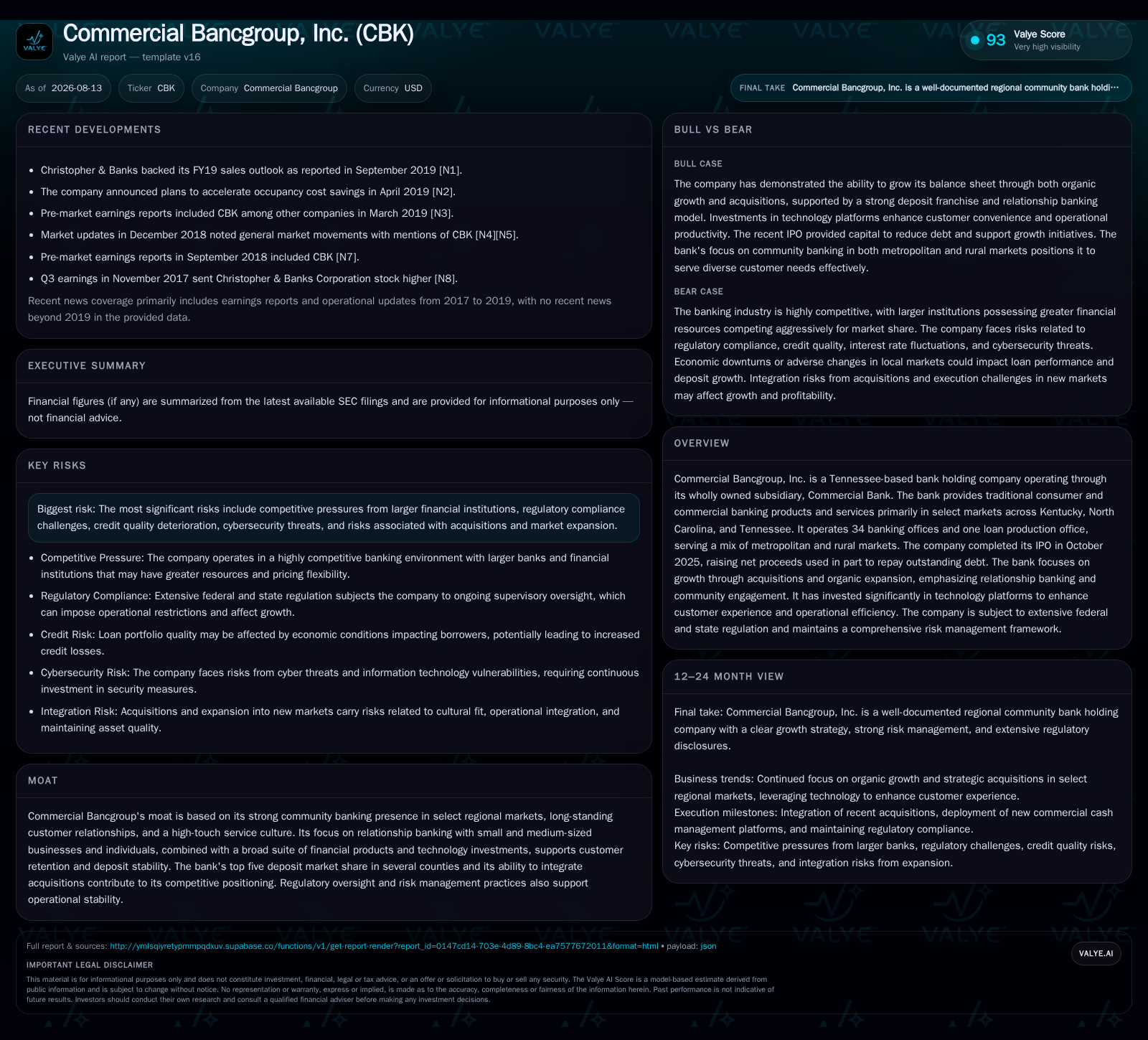
Commercial Bancgroup, Inc. reported steady continuation of its growth strategy in the second quarter of 2026, emphasizing acquisition integration and organic expansion predominantly across Tennessee, Kentucky, and North Carolina. The bank’s business model centers on relationship banking with small to medium-sized enterprises and consumers, leveraging a 34-branch network augmented by technology platforms for both operational efficiency and customer experience. Industry challenges include competition from larger banks and fintechs, credit risk concentration in commercial real estate, and regulatory compliance needs. Growth is powered by deposit franchise strength, loan portfolio expansion, and digital banking capabilities, while capital adequacy remains solid under current regulatory standards.
Recent Operating Update: Q2 2026 Highlights
Commercial Bancgroup’s latest quarterly report (period ended June 30, 2026) confirms steady progression of its core strategic priorities without material shifts in risk profile or business fundamentals [S2]. Notably, the company declared a quarterly cash dividend of $0.12 per common share payable September 30, 2026, reflecting confidence in earnings stability amid ongoing investment in growth initiatives [S3].
Business Model Overview
Operating primarily through its wholly owned subsidiary Commercial Bank, Commercial Bancgroup positions itself as a community-focused regional bank serving select markets in Tennessee, Kentucky, and North Carolina via a network of 34 branches plus one loan production office (LPO) [S1]. The company targets both consumer customers—as mortgage borrowers or holders of home equity lines—and commercial clients concentrated in small to medium-sized enterprises (SMEs), including commercial real estate (CRE) owners.
Revenue derives chiefly from net interest income generated by lending activities funded largely through low-cost core deposits—defined as total deposits excluding large time deposits over $250k and brokered deposits—which accounted for approximately 91.6% of total deposits at year-end 2025 [S5]. This deposit base provides a foundation for sustaining a loan-to-deposit ratio slightly above 100%, signaling efficient asset utilization and balanced liquidity management supportive of profitability.
The bank supplements interest income with fee-based revenue streams including treasury management services tailored to commercial customers who typically maintain deposit accounts coupled with business lending relationships. Relationship banking is emphasized as both a revenue driver and competitive moat; many borrowers holding loans over $2 million simultaneously maintain deposit accounts with the bank enabling cross-selling opportunities for ancillary financial services.
Industry Structure and Competitive Position
Within the regional banking sector characterized by intense competition from larger regional banks such as Regions Financial Corporation and Fifth Third Bancorp—and even more significant national institutions—Commercial Bancgroup leverages its localized footprint emphasizing high-touch service culture and community engagement to sustain customer loyalty [S1][S19].
While competing on competitive pricing remains important due to pressure on loan yields and deposit costs especially against fintech lenders offering agile digital credit products, Commercial Bancgroup’s advantage lies in its deep market knowledge across multi-state MSAs including fast-growing areas like Nashville-Davidson-Murfreesboro-Franklin (TN), Charlotte-Concord-Gastonia (NC-SC), Knoxville (TN), and Tri-Cities MSA (TN-VA). This geographic diversity spans urban growth corridors balanced by rural markets where community ties contribute to stable deposit bases.
The effective integration of past acquisitions—most recently Alliance Bank & Trust Company in mid-2024 which expanded presence into North Carolina—demonstrates management’s capability to grow scale while preserving asset quality and operational culture [S1][S5]
Growth Drivers
Commercial Bancgroup pursues sustained growth through:
- Organic Expansion: Leveraging experienced relationship managers focused on building loan portfolios aligned with predictable cash flows primarily within CRE lending and SME finance segments. By cross-selling consumer lending products including mortgages alongside their commercial relationships, the bank deepens wallet share among existing customers.
- Strategic Acquisitions: Selective acquisitions targeting adjacent markets fill geographic gaps or extend reach into metropolitan hubs showing higher growth potential than legacy rural areas. These acquisitions support economies of scale vital for cost-efficiency while maintaining the bank’s community ethos.
- Technology Investments: Adoption of Jack Henry & Associates core processing systems coupled with investments in mobile banking platforms improve customer convenience comparable with larger peers while boosting internal workflow efficiency through automation reduced manual errors [S26]. These tech upgrades underpin better risk management practices especially relevant amid heightened regulatory scrutiny.
- Deposit Franchise Strength: Maintaining a high percentage of core deposits stabilizes funding costs relative to wholesale or brokered sources that typically carry higher interest expense volatility. Core deposit stability combined with moderate loan-to-deposit ratios supports healthy net interest margin dynamics despite fluctuating interest rate environments.
- Community Banking Culture: Strong emphasis on local market reputation sustains positive brand equity which assists both customer retention and selective talent recruitment necessary to sustain quality loan origination pipelines.
Risks and Watchpoints
Several notable risks confront Commercial Bancgroup including:
- Credit Quality Concentration: Heavy exposure to commercial real estate loans—with reported three-year CRE portfolio growth exceeding 60%—invites enhanced regulatory focus. Inadequate allowance for loan losses could force earnings charges if deteriorating asset quality emerges from sector pressure or localized economic downturns [S20][S22].
- Competitive Pressures: Larger banks wield pricing power due to scale advantages; fintech entrants offer alternative credit channels potentially disrupting traditional SME lending. The bank may face challenges retaining younger consumer segments more inclined toward digital-only banking experiences.
- Regulatory Compliance Burden: Extensive federal/state banking regulation coupled with evolving anti-money laundering requirements necessitates ongoing investment in controls; failure risks significant penalties or restrictions impacting dividend capacity or growth initiatives [S9][S11][S13].
- Integration Risk: While previous mergers have been successful, any future acquisition presents execution risks including cultural mismatches or operational disruptions potentially eroding shareholder value [S27].
- Interest Rate Environment: Rising rates could increase deposit funding costs limiting net interest margin expansion if loan repricing lags or competitive forces push up deposit betas.
- Cybersecurity Threats: Dependence on third-party IT vendors for critical banking infrastructure exposes vulnerabilities that could result in financial losses or reputational damage if mitigations fail.
What to Watch Next
Key upcoming milestones and indicators include:
- Monitoring quarterly earnings releases for signs of credit cost trends especially related to CRE portfolio performance.
- Updates regarding acquisition plans or new market entries reflecting strategic intent versus opportunistic moves.
- Regulatory communications on capital regime changes particularly regarding potential crossing of $3 billion asset threshold which would trigger enhanced consolidated capital rules at holding company level potentially constraining leverage strategies [S4][S6][S18].
- Progress on technology platform rollouts supporting further enhancements in digital service offerings that might impact customer acquisition/retention metrics.
- Deposit growth velocity compared against local competitors especially under varying interest rate regimes signaling franchise strength or vulnerability.
Financial Profile Discussion
As of June 30, 2026, Commercial Bancgroup held approximately $170 million in cash and equivalents against total debt near $73 million, resulting in a negative net debt position indicative of strong liquidity [F1]. This liquidity supports the declared quarterly dividend and ongoing investments in growth initiatives such as technology upgrades and branch expansions.
Capital adequacy remains robust with the subsidiary bank classified as well-capitalized under applicable guidelines, providing operational flexibility. Management continues to monitor asset growth trajectories that may approach regulatory thresholds triggering enhanced consolidated capital standards for bank holding companies [S4][S6][S18].
In summary, Commercial Bancgroup demonstrates a defensible position within regional community banking marked by consistent execution of a relationship-driven model supported by targeted acquisitions and technology adoption. While macroeconomic pressures on credit quality and evolving regulatory demands pose tangible risks requiring vigilant management attention, the company’s strategic emphasis on deposit franchise strength coupled with localized market expertise creates durable foundations for sustainable expansion.
Disclaimer: This is research-only, informational analysis and not investment advice. It may include AI-generated interpretation and general industry context. Always verify important details using primary sources.

Comments