
American Strategic Investment Co. Navigates Occupancy Declines and Foreclosure Resolution Amid Strategic Shift
The company’s August 2026 quarterly filing reveals intensified occupancy pressures, progress in a key foreclosure, and liquidity constraints following its exit from REIT status in early 2023.
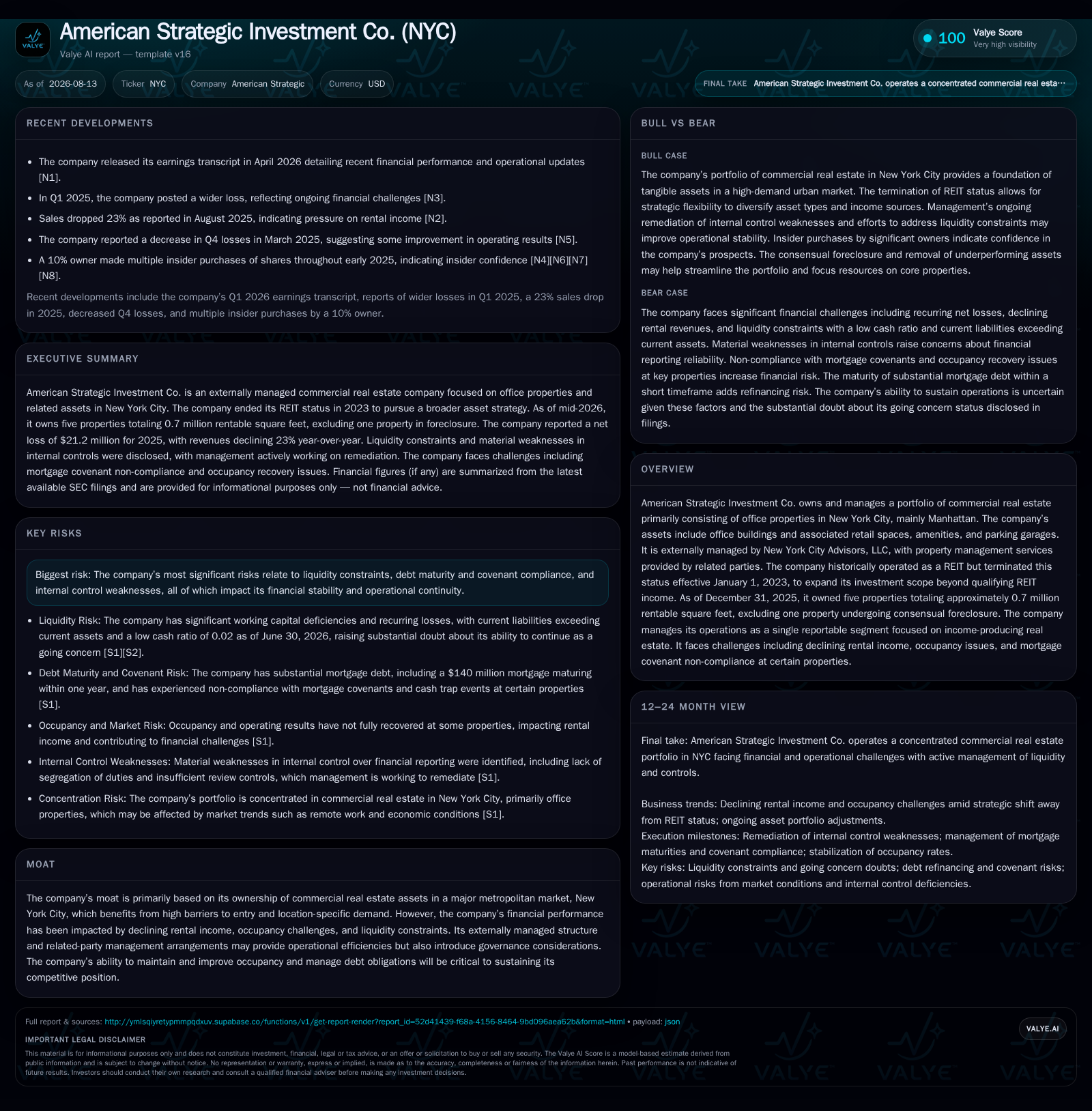
American Strategic Investment Co. manages a concentrated portfolio of primarily Manhattan office properties totaling about 0.7 million rentable square feet across five assets. Its latest quarterly report highlights ongoing occupancy declines compressing net operating income and advancing a consensual foreclosure process at 1140 Avenue of the Americas, which materially influenced prior period results. The company’s termination of REIT status broadens investment flexibility but introduces greater income volatility and tax complexity. With approximately $140 million in debt against $2.4 million in cash, refinancing risks and covenant compliance challenges loom amid persistent leasing headwinds. External management arrangements provide operational continuity but raise governance considerations under financial stress. Key near-term indicators include lease renewal outcomes, foreclosure developments, and debt covenant testing that will shape recovery prospects within NYC’s competitive commercial real estate market.
Latest Quarterly Filing Highlights Intensifying Occupancy Pressures and Foreclosure Progress
American Strategic Investment Co.’s August 12, 2026 quarterly filing details mounting occupancy challenges within its predominantly Manhattan office portfolio that have resulted in compressed net operating income (NOI) [S2]. The company’s portfolio consists of five primary properties totaling approximately 0.7 million rentable square feet, excluding the property at 1140 Avenue of the Americas currently undergoing a consensual foreclosure initiated in September 2025 [S1]. This foreclosure culminated with appointment of a court receiver and recognition of a $47.9 million non-cash gain reflecting distressed asset resolution dynamics [S1].
Occupancy rate serves as a pivotal operating metric given its direct influence on leasing income—the core revenue source for American Strategic. Declining occupancy reduces rental revenue while fixed costs such as property maintenance and externally managed fees remain largely inflexible, thereby squeezing NOI margins [S2][S1]. This trend mirrors broader metropolitan office market softness where hybrid work adoption and supply growth have intensified competition for tenants.
Strategic Shift Away from REIT Status: Implications for Income Stability and Portfolio Composition
Effective January 1, 2023, American Strategic terminated its REIT election following board approval to broaden permissible asset classes beyond traditional qualifying REIT income streams [S1]. This strategic pivot breaks with over eight years of tax-efficient REIT operations but enables investment in alternative real estate or ancillary businesses potentially outside conventional office leasing.
While diversification may offer opportunities to mitigate cyclical risks or capture new revenue streams, it also introduces complexities around income classification, taxation, and earnings volatility [S1]. Loss of REIT pass-through tax advantages could increase corporate tax burdens and affect net shareholder returns while altering the company’s risk profile
External Management Structure: Operational Efficiency Versus Governance Challenges
The company operates under an external management model via New York City Advisors, LLC with related-party entities providing property management services [S1]. This arrangement can yield cost efficiencies through aligned incentives but raises governance concerns especially amidst liquidity strain or underperformance.
External management contracts potentially limit direct board control over capital allocation decisions including discretionary expenditures or refinancing strategies essential during financial stress periods [S1]. Related-party relationships elevate risks of conflicts of interest or cost escalations that may impede proactive financial management.
Competitive Positioning Within New York City Office Market Dynamics
American Strategic’s concentrated Manhattan portfolio situates it within one of the most competitive commercial real estate corridors globally—an environment dominated by larger peers like SL Green Realty and Vornado Realty Trust who benefit from scale and diversified tenant bases. These comparators highlight the importance of occupancy rates, rental rate per square foot growth, and lease expiry management as critical drivers for sustained NOI improvement.
Persistent remote work trends have softened demand citywide, challenging landlords to offset occupancy losses through rent escalations or lease renewals. American Strategic’s smaller scale relative to major landlords limits pricing power compared to newer or more diversified assets attracting prime tenants. While location remains a value proposition, it alone is insufficient to counteract cyclical headwinds.
Growth Drivers Balanced Against Structural Constraints
Despite adverse conditions, several operational levers exist to improve performance: targeted lease renewals could stabilize occupancy; tenant retention initiatives may reduce downtime; ancillary revenues from retail or parking might enhance cash flows; and potential urban economic rebounds could support demand [S2][S1]
However, these growth avenues contend with structural limitations including concentrated exposure limiting diversification benefits; capital expenditure demands necessary to maintain asset competitiveness; pressure on average rental rates; and margin erosion from underutilized space.
Key Risks: Liquidity Pressure, Debt Covenants, and Operational Dependencies
As of June 30, 2026, total debt approximates $140 million secured by mortgage notes payable while cash on hand is limited to about $2.4 million—yielding net debt near $138 million—indicating constrained liquidity amid significant liabilities [F1]. Current liabilities stood at nearly $99 million as of mid-2025 further accentuating refinancing risk given tightening credit markets.
Declining rental income compresses debt service coverage ratios increasing the likelihood of covenant breaches that could trigger accelerated repayment demands or foreclosures beyond the consensual process underway at the Avenue of Americas property [S1][F1]. The external management structure adds complexity to rapid financial decision-making during distress.
Outlook: Monitoring Lease Metrics, Foreclosure Developments, and Covenant Compliance Milestones
Upcoming lease expirations will critically test tenant retention capabilities amid challenging leasing conditions; progress in foreclosure proceedings will clarify valuation realizations; scheduled debt covenant tests will influence creditor confidence; and any strategic communications regarding recapitalization efforts will be vital signals of financial stabilization intent [S2][S3]. Success in these domains would mark meaningful steps toward reversing NOI declines and mitigating financial distress risks.
Financial Profile Discussion: Leverage Intensity Amid Limited Liquidity
Recent metrics emphasize financial vulnerability typical for firms navigating NYC commercial real estate downturns post-REIT conversion. Total secured debt stands at approximately $140 million against modest cash reserves near $2.4 million resulting in high net leverage as of June quarter-end [F1]. Prior-year net losses exceeding $21 million reflect profitability pressures mainly linked to rental revenue declines compounded by earlier foreclosure-related impairments.
This capital structure restricts discretionary investments into tenant improvements or asset repositioning crucial for occupancy gains while heightening lender scrutiny over refinancing timing and terms.
This analysis synthesizes recent SEC disclosures supplemented by sector context appropriate for a commercial real estate firm focused on New York City office assets facing strategic transition alongside notable operational headwinds and balance sheet pressures. It provides a detailed professional assessment emphasizing key operating drivers, financial health indicators, competitive positioning, growth potential, risks, and critical upcoming milestones shaping American Strategic Investment Co.’s trajectory as of mid-2026.
Disclaimer: This is research-only, informational analysis and not investment advice. It may include AI-generated interpretation and general industry context. Always verify important details using primary sources.

Comments