
Hashdex Nasdaq CME Crypto Index ETF Integrates Staking and Updates Authorized Participant Network
Recent amendments enable Hashdex’s NCIQ ETF to commence staking activities and expand authorized participant agreements, enhancing operational capabilities.
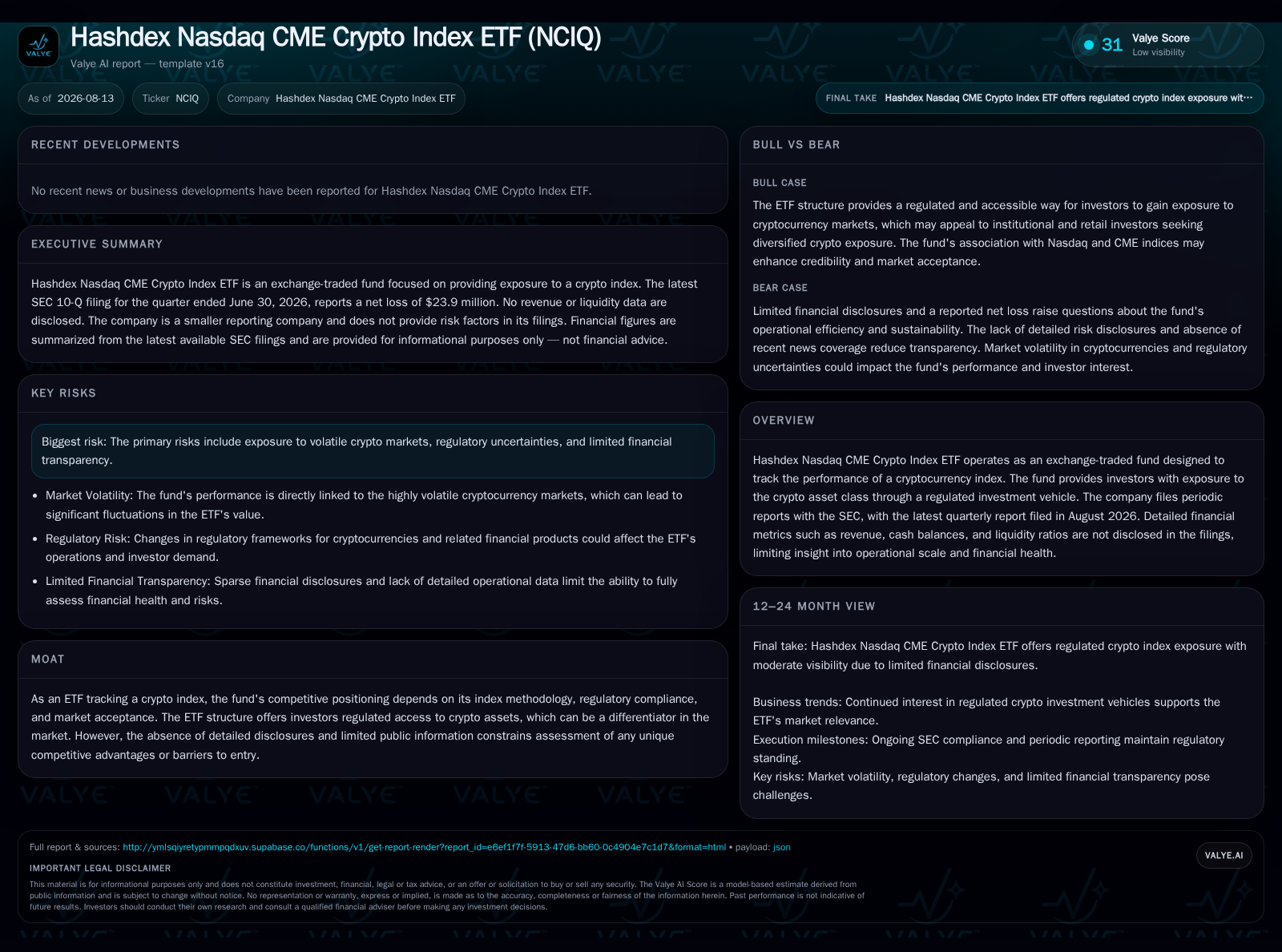
Hashdex Nasdaq CME Crypto Index ETF (NCIQ) recently amended key agreements to allow staking of crypto holdings and onboard Marex Capital Markets Inc. as an authorized participant, potentially improving liquidity and yield generation. The fund transitioned its underlying index early in 2026 to the Nasdaq CME Crypto Settlement Price Index, maintaining comparable methodology while signaling alignment with leading industry benchmarks. The ETF operates under a typical crypto ETF business model, generating revenues primarily from management fees tied to assets under management (AUM). Staking introduces a new revenue stream, but also adds operational complexity and risk related to digital asset custody and market volatility. Regulatory uncertainty and tracking error remain notable risks as the crypto ETF landscape evolves. Investors should monitor growth via AUM changes, staking income, and authorized participant activity for signs of successful execution.
Recent Operating Update
The Hashdex Nasdaq CME Crypto Index ETF (ticker: NCIQ) filed its latest quarterly report on August 12, 2026, highlighting key operational developments that shape its near-term trajectory. Notably, in late July 2026, the Trust amended its Sponsor Agreement to authorize staking activities on certain crypto assets held by the Fund, marking a strategic expansion into yield-enhancing opportunities inherent in proof-of-stake protocols [S16]. Concurrently, Marex Capital Markets Inc. joined as an authorized participant under a formal agreement that governs creation and redemption procedures of ETF shares — a move expected to improve liquidity and trading efficiency [S3][S16]. These two agreements collectively signal proactive steps toward optimizing both asset utilization through staking and share marketability via expanded authorized participant relationships.
Earlier this year, specifically on January 20, 2026, the ETF transitioned its underlying benchmark from the Nasdaq Crypto US Settlement Price Index (NCIUSS) to the Nasdaq CME Crypto Settlement Price Index (NCIS). While both indexes maintain substantially identical methodologies—tracking similar constituent cryptos—the change reflects alignment with an index co-sponsored by CME Group, which adds credibility given CME’s stature within regulated derivatives markets [S1][S21]. The transition did not alter the investment objective or portfolio composition materially but may enhance investor confidence through affiliation with a premier financial market institution.
Business Model Overview
As a cryptocurrency exchange-traded fund listed on NASDAQ under the symbol NCIQ, Hashdex’s fund structure enables investors to gain regulated exposure to multiple digital assets without requiring direct custody or active trading in volatile marketplaces [S1]. The Fund issues shares representing fractional undivided interests in crypto holdings intended to closely track its designated underlying index’s net asset value (NAV), adjusted for expenses
Revenue principally derives from annual management fees assessed as a percentage of assets under management (AUM). Though specific fee rates are not readily disclosed in filings, an extended temporary fee reduction at 0.25% per annum through December 31, 2026 suggests competitive pricing aimed at encouraging inflows during a still-maturing product lifecycle [S20]. Management fees align incentives between the Sponsor (Hashdex Asset Management Ltd.) and investors but also create sensitivity to fluctuations in AUM driven by investor flows or NAV volatility.
Importantly, recent amendments permit the Fund to engage in staking activities—an emerging product innovation within crypto ETFs whereby eligible proof-of-stake tokens generate rewards by validating blockchain transactions [S16]. Staking is facilitated by Coinbase Cloud Pte. Ltd., which provides the operational infrastructure under an established Master Infrastructure-as-a-Service agreement dating back to late 2025 [S26]. This model allows staked assets to remain under trusted custodianship while earning additional yields that can enhance overall returns beyond index price appreciation. Revenues from staking are allocated via a scheme where initial net staking income up to specified basis point thresholds accrues exclusively to the Sponsor via a special class of non-listed shares termed "Sponsor Shares," with any excess income shared partially with common shareholders [S14]. This novel income stream could materially impact net operating results if adequately scaled.
Creation and redemption mechanics critically underpin liquidity and tracking efficiency [S12][S24]. Authorized participants like Marex Capital Markets can transact creation or redemption baskets either in cash or increasingly through in-kind transfers of actual digital assets held by custodians such as Coinbase Custody Trust Company LLC or BitGo Trust Company Inc. These mechanisms facilitate tight bid-ask spreads on ETF shares and minimize persistent premiums or discounts relative to NAV — factors essential for attracting institutional investors sensitive to tracking error and execution costs
Industry Structure and Competitive Positioning
The cryptocurrency ETF sector straddles traditional financial regulation while delivering exposure to inherently volatile digital assets including Bitcoin (BTC), Ethereum (ETH), XRP, and other leading cryptocurrencies. NCIQ’s reliance on an index jointly maintained by Nasdaq and CME places it within a cohort of ETFs leveraging hyper-regulated benchmarks aimed at institutionalizing crypto investment products. Peers include vehicles like Grayscale Bitcoin Trust (GBTC), though GBTC operates as a trust with differing redemption constraints, ProShares’ futures-based ETFs like BITO providing derivative-based access rather than direct holdings, physical-backed ETFs such as CoinShares Physical Bitcoin (BITC), and diversified funds like VanEck Digital Assets ETF offering broader basket exposure.
Key differentiators for NCIQ rest on its index sophistication paired with regulatory compliance designed for U.S. exchange listing standards and efficient share creation/redemption processes that mitigate liquidity risks common among crypto products. Integration of staking capabilities may further elevate its appeal compared with competitors lacking yield-generating features; however, this benefit is contingent upon robust infrastructure deployment without compromising security or incurring excessive operational risks.
Growth Drivers
Several factors support potential expansion for NCIQ:
- Institutional Adoption: Growing demand for regulated access points into crypto markets motivates inflows into ETFs perceived as safer due to custodial oversight and standardized pricing mechanisms.
- Regulatory Approvals: Favorable SEC recognition of compliant crypto ETFs could broaden available product lines incorporating newer tokens or strategies.
- Enhanced Product Features: Staking offers new yield layers attractive amid low-yield macro environments; its rollout may differentiate NCIQ ahead of competitors.
- Authorized Participant Network Expansion: Addition of firms like Marex Capital Markets enhances market-making capabilities ensuring share liquidity essential for scaling.
- Index Evolution: Broader constituent inclusion or methodology refinement within NCIS can attract diverse investor profiles wishing for exposure beyond large-cap cryptos.
Risks and Watchpoints
Despite advances, NCIQ faces distinctive risks:
- Market Volatility: Crypto asset prices exhibit high fluctuations impacting NAV stability; this is amplified compared to traditional equity or bond ETFs.
- Regulatory Uncertainty: Ongoing shifts in regulatory policy or SEC stances could impose compliance costs or limit allowable assets within the index.
- Tracking Error: Differences between fund performance and index can arise due to expense deductions, liquidity constraints during volatile periods, or inefficiencies in creation/redemption cycles.
- Custody Security Risks: Digital asset custody remains complex; any security breach could damage reputation and investor confidence.
- Operational Complexity: Introducing staking operations necessitates reliable technological infrastructure; service failures could affect rewards realization or asset availability.
- Limited Financial Transparency: The Trust does not disclose granular revenue or cost figures publicly limiting external assessment of profitability margins or cash conversion dynamics.
What to Watch Next
Key milestones and metrics will indicate how effectively NCIQ leverages recent enhancements:
- Staking Activity Commencement: Monitor announcements confirming launch timing and scale of staking operations alongside reported Net Staking Income performance metrics.
- AUM Trends: Growth or contraction will reflect investor appetite amid evolving macro conditions.
- Authorized Participant Engagement: Increased creation/redemption volume via Marex or other participants signals improved market liquidity.
- Tracking Error Statistics: Regular reporting on deviation from NCIS offers insights into operational execution quality.
- Regulatory Developments: Updates from SEC regarding permissible constituents or rules affecting crypto ETFs will materially influence strategy.
Financial Profile Discussion
While detailed financial disclosures remain limited due to structure as an ETF trust entity, available data show that operating income reached nominal positive levels ($6) as of September 30, 2025 whereas net income reported a small loss (-$1.98 million) at year-end December 31, 2025 [F1]. This pattern aligns with nascent-stage expenses related to product development including regulatory compliance costs and infrastructure investments outpacing fee revenues at modest AUM scales typical during early commercialization phases.
The extension of reduced management fees at 0.25% annually through end-2026 signifies efforts to incentivize shareholder accumulation despite low short-term profitability margins [S20]. The initiation of staking income streams post-July 2026 may gradually improve net earnings by supplementing fee revenues without proportionate cost escalation if managed efficiently [S14][S26]. Meanwhile, firming up an expanded authorized participant base supports operational scalability reducing premium/discount volatility which can indirectly lower capital costs for investors.
This analysis synthesizes public regulatory disclosures up through August 2026 reflecting current known operations without projecting future financial outcomes or providing investment research views.
Disclaimer: This is research-only, informational analysis and not investment advice. It may include AI-generated interpretation and general industry context. Always verify important details using primary sources.

Comments