
Battalion Oil's Reserve Development Strategy Tests Capital and Dilution Limits
Q2 2026 filings reveal Battalion Oil’s ongoing capital deployment to convert reserves amid shareholder dilution pressure.
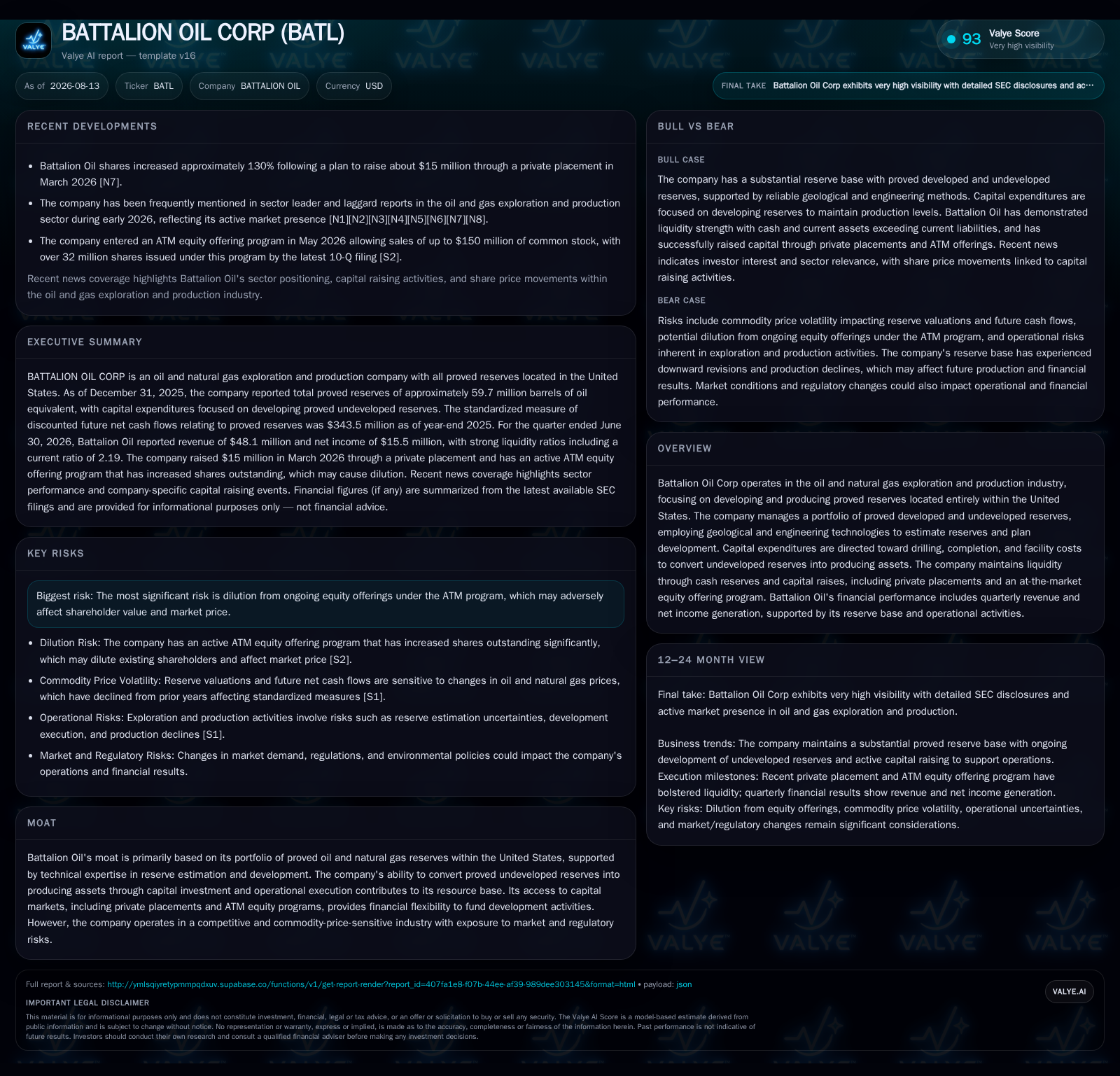
Battalion Oil Corp reported in its August 2026 quarterly filing that it continues deploying substantial capital expenditures to transition proved undeveloped reserves into production, supporting revenue generation despite commodity price headwinds. The company has raised over $150 million via an ATM equity offering since May 2026, diluting shareholders but bolstering liquidity to fund drilling and development programs critical for reserve replacement. Risks include the capital-intensive nature of reserve development, leverage covenant compliance, and potential continued equity dilution. Key industry dynamics such as volatile oil prices, drilling execution success, and access to capital markets remain central to Battalion’s operational trajectory.
Recent Operating Update: Capital Deployment Amid Equity Issuance
The most recent quarterly filing dated August 12, 2026 ([S2]) provides critical insight into Battalion Oil’s operational posture. The company continues allocating capital expenditures primarily toward drilling, completion, and facility buildout aimed at converting proved undeveloped reserves into producing assets — a fundamental growth lever in upstream E&P business models. This strategy reflects standard industry practice where investment must precede production gains.
However, this capital intensity requires ample liquidity sources. To address this, Battalion entered into an at-the-market (ATM) equity offering agreement in May 2026 with Roth Capital Partners enabling issuance of up to $150 million of common stock ([S10], [S2]). By the date of the Q2 report, the company had already issued approximately 32.3 million shares through this ATM program. While this raises vital development funding, it also materially dilutes existing shareholders — a risk explicitly highlighted by management as potentially depressing the market price ([S10]). This dual-edge impact is characteristic of smaller-scale upstream operators needing flexible capital access amid cyclical pressures.
Business Model: Upstream Exploration & Production with Reserve Conversion Focus
Battalion Oil operates wholly within the upstream segment focused on developing proved oil and natural gas reserves exclusively in the United States ([S1]). Revenue derives from selling hydrocarbons extracted from producing wells—comprising crude oil, natural gas, and natural gas liquids—monetized via market-driven commodity prices. The company’s core operational activities involve applying geological expertise alongside horizontal drilling and modern completion techniques to both identify reserves and successfully convert them from proved undeveloped (PUD) status into producing categories.
The balance between converting PUD reserves and sustaining production underpins future revenue streams. This requires sizable capex investments primarily allocated across three categories: drilling new wells; well completion technology implementation; and facility infrastructure to support the additional production capacity ([S1]). Such expenditure must be judiciously timed given commodity price volatility affects profit margins significantly.
Battalion’s ability to replenish reserve base — measured by reserve replacement ratio relative to annual depletion — is crucial. As of December 31, 2025, total proved reserves were approximately 59.7 MMBoe representing a roughly 7% decline year-over-year predominantly due to negative revisions reflecting lower pricing assumptions amidst market headwinds ([S1]). Despite these headwinds, working down PUD reserves via development spending partially offsets declines from production extraction.
Industry Structure and Competitive Positioning
The upstream E&P industry remains highly capital intensive with significant commodity price sensitivity impacting operating cash flows and margin structure. Battalion competes with larger peers such as Devon Energy or Pioneer Natural Resources who benefit from scale advantages including diversified asset bases across multiple basins which can mitigate geographic concentration risks. In contrast, Battalion’s portfolio is more concentrated geographically within U.S. onshore plays necessitating tight operational execution.
Competitive advantage hinges on cost control (operating cost per Boe), finding & development efficiencies (F&D cost per Boe), reserve quality (liquids-rich acreage vs dry gas), and execution reliability (drilling success rates). Battalion’s technical capability in horizontal drilling and completion allows conversion of sizeable PUD inventories though at costs sensitive to raw materials price inflation noted in filings ([S1]).
Liquidity management through capital markets access—illustrated by the ATM equity offering—is also a key differentiator determining ability to finance capex cycles without excessive leverage expansion.
Growth Drivers: Reserve Development and Production Expansion
The primary growth driver for Battalion involves successful conversion of their remaining proved undeveloped reserves (which comprised about 40% of total proved reserves at year-end 2025) into producing assets through targeted drilling campaigns supported by technological advances in completions ([S1], [S2]). This translates directly into higher production volumes—a KPI measured in barrels of oil equivalent per day (Boe/d)—fueling revenue growth when combined with favorable commodity prices.
Additional minor contributors include accretive acquisitions such as the purchase of approximately 7,090 net acres from RoadRunner Resource Holding LLC completed during early 2026 ([S22]) which enhance leasehold acreage under development.
Finally, optimizing operational efficiencies through cost controls helps improve margins despite inflationary input cost pressures referenced in annual disclosures ([S1]).
Risks and Growth Constraints: Dilution Pressure and Financial Covenants
A foremost risk is dilution stemming from ongoing equity offerings under the ATM program. Since May 2026 alone over 32 million shares have been issued potentially pressuring share price performance due to oversupply effects ([S10]). Given Battalion’s small market capitalization scale relative to potential raised amounts, further ATM sales could prolong valuation headwinds.
Financial leverage is another critical watchpoint. Battalion carries indebtedness exceeding $200 million principally under a term loan maturing in late 2028 ([F1]), subject to strict financial covenants including asset coverage ratios above ~1.85x-2.0x depending on measurement periods as well as net leverage caps aligned to current credit agreements ([S4], [S16]). Failure to comply could trigger default scenarios limiting borrowing flexibility or precipitating acceleration of repayment obligations.
Operational uncertainties inherent in shale drilling include unpredictability in well productivity requiring consistent drilling success rates alongside volatile commodity prices posing cash flow variability risks ([S1]). Environmental regulatory oversight also remains a latent constraint affecting project timelines or additional costs—an industry-wide challenge referenced by numerous peers.
What To Watch Next
Key upcoming markers for Battalion’s trajectory comprise:
- Quarterly production volumes juxtaposed against historical depletion rates to gauge reserve replacement effectiveness.
- Pace of planned capital expenditures tied directly to transitions from PUD reserves into producing status.
- Further share issuances or changes announced related to the ATM program impacting liquidity versus dilution tradeoffs.
- Compliance updates on financial covenants especially asset coverage ratios amid evolving debt maturities.
- Any additional acquisitions expanding leasehold acreage especially targeting higher-margin liquids-rich plays for portfolio diversification.
Financial Profile Discussion
As of June 30, 2026, Battalion held cash and equivalents approximating $83.1 million against current liabilities near $49.1 million yielding a current ratio around 2.19 which signals moderate short-term liquidity buffer ([F1]). Total debt was about $208 million as of December 31, 2025 ([F1]), reflecting significant leverage typical for upstream operators undergoing aggressive development phases.
Market acceptance will likely hinge on effective transition from undeveloped reserves into stable cash flowing wells while managing shareholder dilution expectations prudently.
This analysis synthesizes recent public filings highlighting Battalion Oil Corporation’s operational focus on reserve development funded partly through equity offerings carrying dilution risk typical of small-cap U.S.-based upstream companies confronting cyclic commodity dynamics along with capital structure discipline requirements inherent in leveraged exploration enterprises. The outlook depends critically on discipline in execution against increasingly tight financial covenants combined with market conditions influencing commodity prices.
Disclaimer: This is research-only, informational analysis and not investment advice. It may include AI-generated interpretation and general industry context. Always verify important details using primary sources.

Comments