
Power REIT Maneuvers Asset Sales and Leasing to Offset Greenhouse Portfolio Challenges
Latest quarterly results reveal ongoing losses, liquidity efforts, and strategic asset repositioning amid concentrated tenant risk.
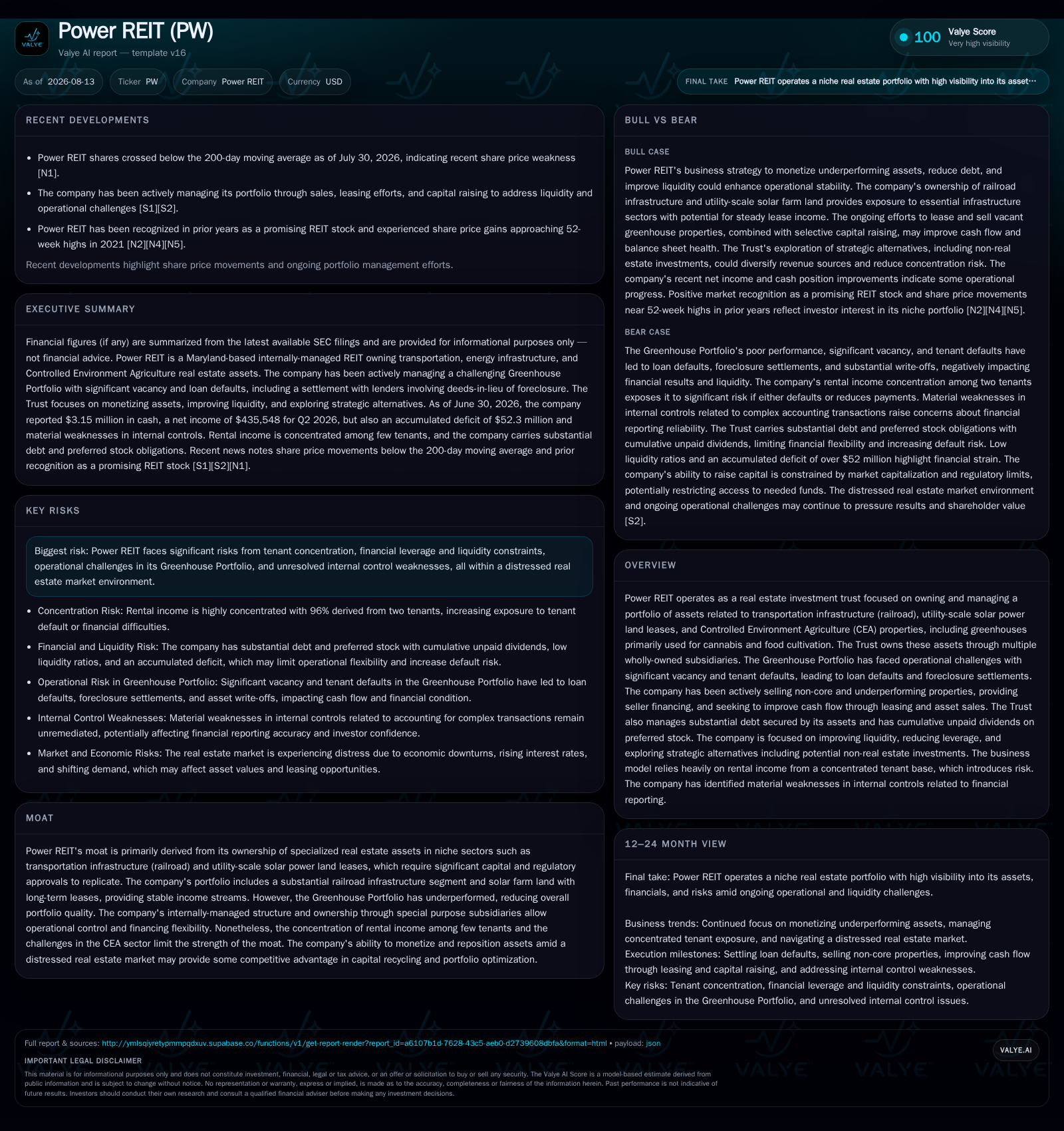
Power REIT, an internally-managed REIT owning specialized transportation, solar, and controlled environment agriculture assets, reported a net loss of $784,000 for the first half of 2026 with an accumulated deficit exceeding $52 million. The company continues to address operational challenges in its underperforming greenhouse portfolio through asset sales and leasing, while maintaining stable income from railroad infrastructure and utility-scale solar land leases. Significant tenant concentration with two tenants accounting for over 95% of rental income heightens cash flow risk. Financial flexibility is constrained by substantial debt and cumulative preferred stock dividends. Power REIT's path forward hinges on successful capital raising and asset monetization to restore liquidity and operational sustainability.
Recent Operating Update
Power REIT reported a net loss attributable to common shareholders of approximately $784,000 for the six months ended June 30, 2026, showing some improvement compared to a roughly $1.4 million net loss in the first half of 2025 [S2]. Despite that progress, the company grapples with an accumulated deficit north of $52 million as of mid-2026. Cash reserves improved modestly to about $3.1 million versus $2.2 million at the end of 2025 [S2], driven partially by asset dispositions and sales of common shares under an at-the-market (ATM) program initiated in early 2025 [S7].
The latest filings highlight Power REIT's continued efforts to monetize its troubled Controlled Environment Agriculture (CEA) properties—chiefly greenhouses harvested for cannabis and food cultivation—which have experienced significant vacancy rates and severe tenant defaults culminating in litigation and foreclosure settlements finalized in April 2025 [S1]. This resolution led to deeds-in-lieu of foreclosure for certain Michigan and Nebraska greenhouse assets with a corresponding write-off approaching $17 million on their balance sheet [S1]. Revenue stabilization depends heavily on re-leasing or selling remaining vacant properties within this segment while managing cash flows from occupied locations.
Alongside these hurdles, Power REIT derives substantive recurring income from its core railroad infrastructure subsidiary—Pittsburgh & West Virginia Railroad (PWV)—and from utility-scale solar farm land leases held by PW Regulus Solar LLC (PWRS) [S19][S21]. These two tenants accounted collectively for approximately 96% of the Trust's rental income during Q1 2026; NSC represented about 51%, with PWRS contributing around 45%, underscoring considerable tenant concentration risk that could amplify operational volatility if either party faces difficulties
Business Model Specifics
Power REIT functions as a specialized real estate investment trust (REIT), internally managed with ownership structures segmented into nineteen special purpose subsidiaries each holding distinct asset types—railroad right-of-way infrastructure totaling roughly 112 miles; approximately 447 acres leased to an 82-megawatt utility-scale solar project; plus circa 82 acres housing around 357,000 square feet of CEA-related greenhouses dedicated primarily to cannabis or food production [S1]. The Trust earns revenue predominantly from long-term lease agreements with a limited slate of major tenants operating specialized capital-intensive businesses that tend to require high barriers to entry including regulatory approvals for cannabis grow operations and energy infrastructure.
Leasing revenue mechanics rely significantly on tenancy stability given specialized nature: these are few but large tenants paying rent over multi-year contracts frequently underpinned by collateral such as deed restrictions or property liens. The railroad assets serve as critical transportation corridors that offer steady occupancy potential due to limited competition within their geographic service area. Similarly, utility-scale solar projects involve long-term land leases tied directly to renewable energy supply contracts.
Conversely, CEA greenhouse assets have struggled due largely to market pricing dynamics in cannabis cultivation combined with poor operator credit performance triggering lease defaults—this segment imposes operational overhead via property taxes and maintenance costs even when largely unoccupied [S1]. To protect financial interests amid these challenges Power REIT negotiated deed-in-lieu forfeitures with its lender on problematic greenhouse loans—a relief that also illuminated ongoing risks since residual greenhouse holdings require active leasing or disposition
Importantly, Power REIT’s internally-managed setup through special purpose subsidiaries allows tailored financing strategies such as non-recourse loans secured against specific assets like PWV’s $15.5 million loan or PWRS’s $5.8 million indebtedness [S4][S6]. However, these debts concentrate senior claims on underlying collateral restricting the parent’s flexibility while cumulative unpaid dividends on Series A preferred stock now exceed $2.4 million as management defers distributions since late 2022
Industry Structure and Competitive Position
Power REIT occupies a niche intersection between transportation infrastructure real estate (railroads), renewable energy land leasing (solar farms), and controlled environment agriculture facilities (greenhouses). Each subsector demands specialized knowledge coupled with substantial capital outlays—barriers which underpin the company's moat rooted in regulatory complexity and asset specificity.
Peers span from infrastructure-focused REITs like Brookfield Infrastructure Partners emphasizing diversified transport & energy assets; Hannon Armstrong focusing narrowly on sustainable infrastructure financing; agriculture-oriented entities such as Farmland Partners Inc.; plus broad commercial diversified players like CIM Commercial Trust Corp providing contrast on scale and tenant diversification. Compared to these peers Power REIT’s more concentrated scale elevates firm-specific tenant credit exposure as well as refinancing sensitivity.
Railroad leases typically benefit from long-lived contractual durations enhancing NOI stability but offer modest upside absent expansion or rate resets tied to escalators negotiated during renewals. Utility-scale solar farm leases similarly enjoy government-backed incentives but hinge on power purchase agreement longevity influencing valuation cap rates. In contrast Greenhouse Portfolio challenges reflect volatile end markets that have pressured occupancy rates well below peer CEA averages thus compressing FFO contribution.
Growth Drivers
Long-term growth depends largely on stabilizing core assets' income streams complemented by executing its strategy for repositioning or shedding underperforming greenhouse real estate:
- Continued leasing or sales success targeting vacant CEA properties promises immediate cash flow uplift.
- Lease renewal outcomes with existing anchor tenants NSC (rail) and Regulus Solar will sustain predictable revenues.
- Capital recycling via dispositions enhances liquidity reinvestment potential supporting opportunistic acquisitions aligned with portfolio criteria.
- Structural demand tailwinds stem from increasing emphasis on renewable energy infrastructure development plus gradual expansion within controlled environment farming driven by evolving food security priorities.
Management also seeks incremental cash flow improvement through better collections from existing tenants reflecting tighter credit policies implemented post-greenhouse default experiences [S1][S7]
Any material breakthrough stabilizing income streams combined with demonstrated capital access enhancements would mark positive inflection points helping curtail continuing net losses that have weighed heavily since prior years.
Financial Profile Discussion
As of June 30, 2026, Power REIT held approximately $3.15 million in cash & equivalents providing limited but improved liquidity relative to prior quarters [F1][S2]. The Trust’s current ratio is critically low at roughly 0.01 reflecting heavy near-term liabilities including accounts payable and liabilities associated with assets held for sale [F1].
This capital structure constrains flexibility, making successful monetization of underperforming greenhouse assets along with improvements in tenant cash flow collection essential levers for preserving solvency while defending against refinancing risks amid present issuance limitations constrained by NYSE American rules alongside SEC registration thresholds affecting share-sale capacity [S7][N1]
Material weaknesses flagged since mid-2024 remain unremedied despite consultant engagements creating audit/compliance risks that could impact investor perception negatively until resolved fully [S7][S22]
Disclaimer: This analysis does not constitute investment advice or research views but aims solely to provide an informed business perspective based upon publicly disclosed information sourced principally from Securities and Exchange Commission filings dated up through August 12, 2026.
Disclaimer: This is research-only, informational analysis and not investment advice. It may include AI-generated interpretation and general industry context. Always verify important details using primary sources.

Comments