
Resideo Focuses on Core Products Post-Spin-Off Amid Elevated Leverage Profile
Following the August 2026 spin-off of its ADI Global Distribution segment, Resideo Technologies repositions as a narrower manufacturer of residential and commercial sensing and control products with notable financial leverage challenges.
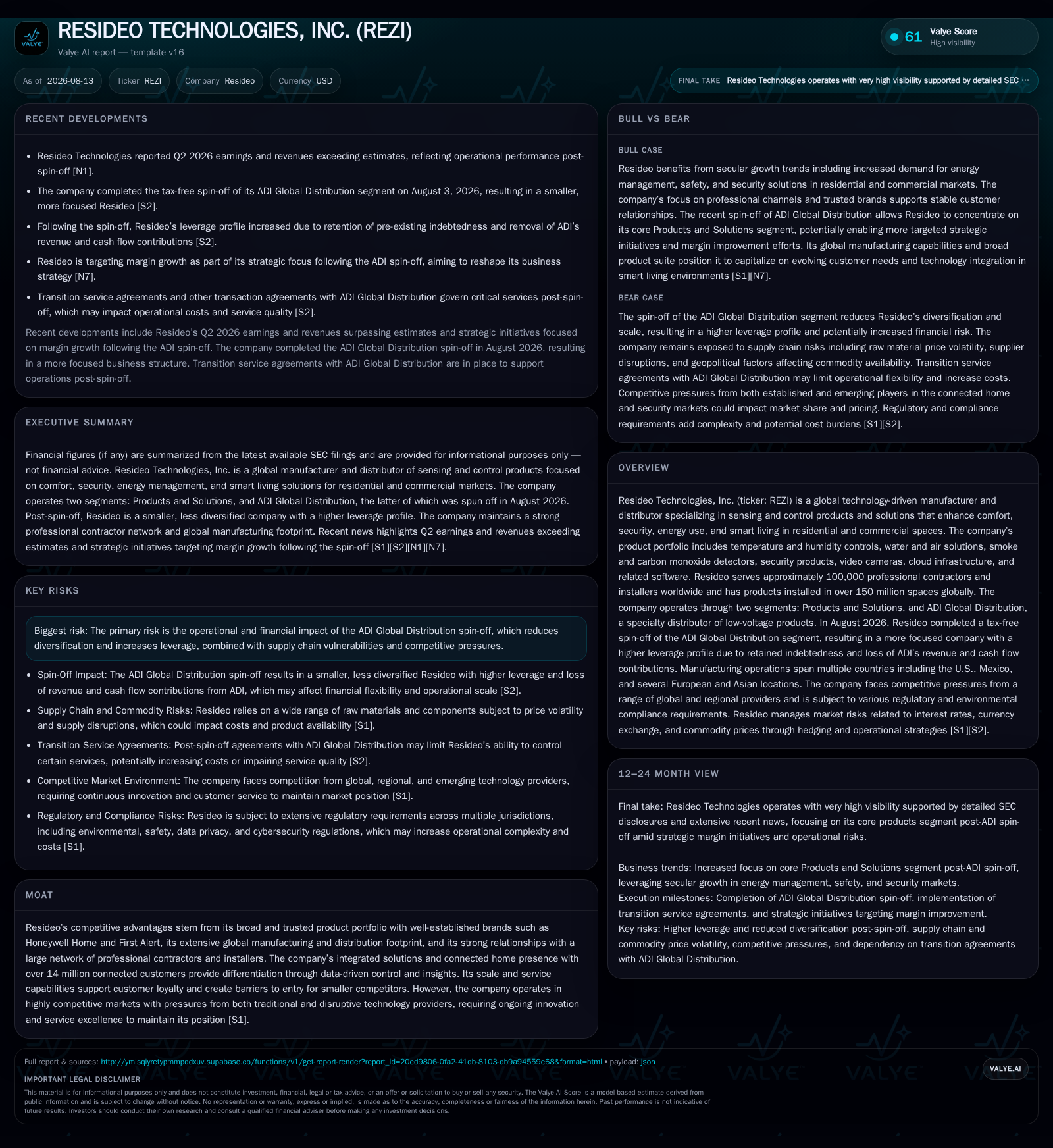
Resideo Technologies completed the tax-free spin-off of its ADI Global Distribution business in August 2026, divesting a majority revenue contributor to become a focused player centered on technology-driven sensing and control products for building comfort, security, and energy management. This strategic simplification sharpens its product portfolio anchored by well-established brands but results in higher standalone leverage due to retention of pre-existing indebtedness despite loss of ADI's cash flow. The company remains reliant on its professional contractor network and strives to integrate hardware with cloud software services amid competitive pressures from both traditional manufacturers and new IoT entrants. Supply chain risks, elevated debt, and execution against innovation pipelines remain key watchpoints.
Recent Operating Update: ADI Spin-Off Completes Strategic Refocus
Resideo Technologies announced the completion of its tax-free spin-off of the ADI Global Distribution business effective August 3, 2026 [S2], [S3]. Prior to separation, ADI accounted for roughly 64% of Resideo’s consolidated revenue for both the first half of 2026 and full-year 2025 periods, contributing approximately 27-28% to consolidated income from operations [S2]. The divestiture sharply narrows Resideo's operational scope to focus exclusively on its Products and Solutions segment composed predominantly of sensing and control devices for residential/commercial comfort, safety, security, and energy efficiency.
This maneuver simplifies corporate structure but materially alters Resideo’s scale basis and financial profile. Notably, while ADI's revenue and earnings contributions are no longer consolidated within Resideo’s results starting in Q3 2026 onward, substantially all pre-existing indebtedness remains with Resideo [S2]. This asymmetry results in higher standalone leverage ratios for the remaining business.
Following the spin-off, Resideo entered into several transaction agreements with ADI Global Distribution (ADI) covering separation governance, transition services (TSA), tax matters, intellectual property rights usage, commercial agreements for product purchases, employee assignments, and shared corporate services arrangements [S2]. These contracts ensure continuity yet impose operational dependencies during the transition period that could affect cost structures or service levels if not managed tightly.
Business Model: Focused Manufacturer with Trusted Brands Serving Professional Channels
Post-spin-off Resideo operates as a technology-driven manufacturer primarily targeting professional contractors/installers who serve residential and light commercial end markets [S1]. Its portfolio centers on sensors and controls that improve comfort (e.g., temperature/humidity controllers), safety (smoke/carbon monoxide detectors), security (video cameras), water/air quality management, cloud infrastructure platforms, plus related software enabling smart living solutions [S1]. Leading brand names such as Honeywell Home and First Alert lend credibility and distribution pull.
The company’s revenue generation hinges on hardware sales through longstanding relationships with approximately 100,000 professional contractors worldwide who are critical gatekeepers for installations [S1]. This channel model supports high customer retention barriers but requires ongoing product innovation to stay relevant amid changing technology demands. Recurring revenues from software subscriptions or maintenance contracts tied to connected products provide ancillary but growing cash flow streams.
Distribution is supported by global manufacturing footprints aligned with broad product breadth spanning HVAC controls to fire safety devices. The firm also supplies components incorporated by other OEMs such as water heater manufacturers [S1]. Unlike pure-play retailers or e-commerce providers capturing direct consumer sales, Resideo’s business leans on B2B2C contractor-led transactions where technical support and service quality underpin competitive differentiation.
Industry Structure and Competitive Positioning
Resideo occupies a well-established niche within the industrial hardware sector focused on building control systems combined increasingly with cloud-enabled smart home functionalities. Competitors span legacy manufacturers like Honeywell Home—former parent company—alongside specialized safety brands such as First Alert. Larger analog peers include Johnson Controls targeting broader building automation hardware while security-focused firms like ADT Inc. compete on integrated system offerings.
Moreover, rising penetration of IoT-enabled home security providers (e.g., Alarm.com) as well as low-voltage product distributors akin to Snap One add complexity to distribution channels. Technology entrants leveraging software/cloud platforms challenge traditional pricing power by offering seamless integration across multiple devices. This intensifies pressure on margins especially where hardware commoditization undermines differentiation.
Resideo maintains competitive strength through brand heritage combined with an integrated product-software-cloud strategy delivering actionable data insights for end users. Its installed base exceeds 150 million spaces globally with over 14 million connected customers reflecting sustained adoption momentum [S1]. Yet competition remains formidable given rapid technology cycles requiring swift innovations alongside sustained investments in cloud infrastructure.
Growth Drivers: Energy Efficiency, Safety Regulation & Connected Living Trends
Demand tailwinds arise from secular market shifts favoring energy-efficient buildings driven by regulatory mandates as well as consumer preference for smart living solutions that enhance convenience and personal safety. Specifically:
- Regulatory requirements for carbon monoxide/smoke detectors drive consistent replacement/upgrades supporting fire safety product sales.
- Increasing adoption of smart thermostats/HVAC controls linked with sustainability trends fuels temperature/humidity controller demand.
- Proliferation of connected home ecosystems expands opportunity for video surveillance cameras integrated via cloud platforms.
- Urbanization coupled with new residential/commercial construction activity generates incremental hardware installations.
- Expanding professional contractor network fuels broad-based distribution reach critical for volumetric growth.
- Innovation pipeline focusing on advanced sensing technologies paired with cloud analytics unlocks higher-margin recurring revenues over time.
Collectively these factors create a layered growth platform blending hardware volume expansion alongside software/cloud monetization potential.
Risks & Watchpoints: Higher Leverage & Execution Complexity Post Spin-Off
While strategic refocusing sharpens operational clarity, risks have intensified notably due to:
- Substantially all outstanding debt remains at Resideo despite removal of ADI’s cash flows increasing net leverage above previous levels (~$3.07B net debt vs $549M cash at July 2026) with elevated interest costs requiring close capital discipline [F1].
- Exposure to commodity price volatility affecting steel, copper, semiconductors may compress gross margins. Though some costs are contractually passed through to customers there is risk of timing delays or partial absorption [S1].
- Potential service disruptions during TSA execution period if contractual commitments from ADI fall short or cost structures escalate unexpectedly could impair operational effectiveness [S2].
- Intensified competition from disruptive IoT/technology entrants may compress pricing power unless Resideo accelerates innovation cadence effectively.
- Dependence on professional contractors for market access means any erosion in network loyalty or shifts toward direct-to-consumer sales models would be detrimental.
- Integration challenges combining hardware/sensing products with evolving software/cloud platforms require ongoing investment risking time-to-market delays impacting customer retention.
- Cybersecurity vulnerabilities inherent in connected devices represent compliance & reputational risks.
Monitoring leverage reduction trajectory alongside innovation execution will be critical metrics validating durable recovery after structural recalibration.
What To Watch Next
Investors should closely observe:
- Quarterly financial results starting Q3 2026 to track top-line impact post-spin-off excluding ADI contribution.
- Leverage ratios trending given recent large debt repayments funded by cash consideration received from ADI [$900M dividend from ADI applied toward debt reduction as per event filings] [S16], but still maintaining sizable gross/net indebtedness [F1].
- New product launches addressing evolving energy management & safety market opportunities forming near-term catalysts.
- Contract renewal rates alongside professional contractor base size reflecting channel health inclusive of any shift dynamics post-separation.
- Expansion pace of subscription/recurring revenue streams deriving from connected product ecosystems providing margin uplift potential.
- Supply chain resilience metrics pertaining to component lead times or cost inflation passthrough efficacy particularly semiconductor availability scenarios.
Execution against these milestones will shape whether Resideo can leverage focused asset base into sustained growth trajectory while managing incremental financial strain post spin-off.
Financial Profile Discussion
At quarter-end July 4, 2026 balance sheet data reflects $549 million in cash & equivalents against a total debt load near $3.62 billion generating net debt approximately $3.07 billion [F1]. Current assets stand at about $3.83 billion versus current liabilities approximating $1.72 billion yielding a current ratio near 2.22 indicating short-term liquidity adequacy [F1]. However elevated net leverage marks a material shift following removal of ADI’s sizable revenue/cash flow contribution paired with debt retention post-spin off [S2].
Interest rate sensitivity is partially mitigated as approximately $280 million notional amount remains hedged converting variable-rate borrowings into fixed-rate obligations via interest rate swaps executed in prior years [S1]. Yet rising interest expense remains an ongoing cost pressure factor impacting profitability margins going forward particularly absent scale benefits formerly derived from combined operations including ADI Global Distribution segment revenues accounting for nearly two-thirds top-line pre-spin off [S2].
Capital allocation priorities will likely emphasize deleveraging complemented by targeted investments aimed at enhancing core sensing/control product lines integrated within emerging smart building solutions markets while maintaining robust working capital positions necessary to support professional contractor channels undergirding revenue stability [S4],[S5],[F1].
This analysis synthesizes recent SEC filings through August 12, 2026 along with contemporaneous operating context framing intrinsic industry dynamics without offering investment advice or forecasts.
Disclaimer: This is research-only, informational analysis and not investment advice. It may include AI-generated interpretation and general industry context. Always verify important details using primary sources.

Comments