
Sizzle Acquisition Corp. II Advances Business Combination with Trasteel Amid SPAC Sector Competition
Sizzle Acquisition Corp. II remains on track to complete a business combination targeting sectors aligned with its management expertise, leveraging $230 million raised in its IPO.
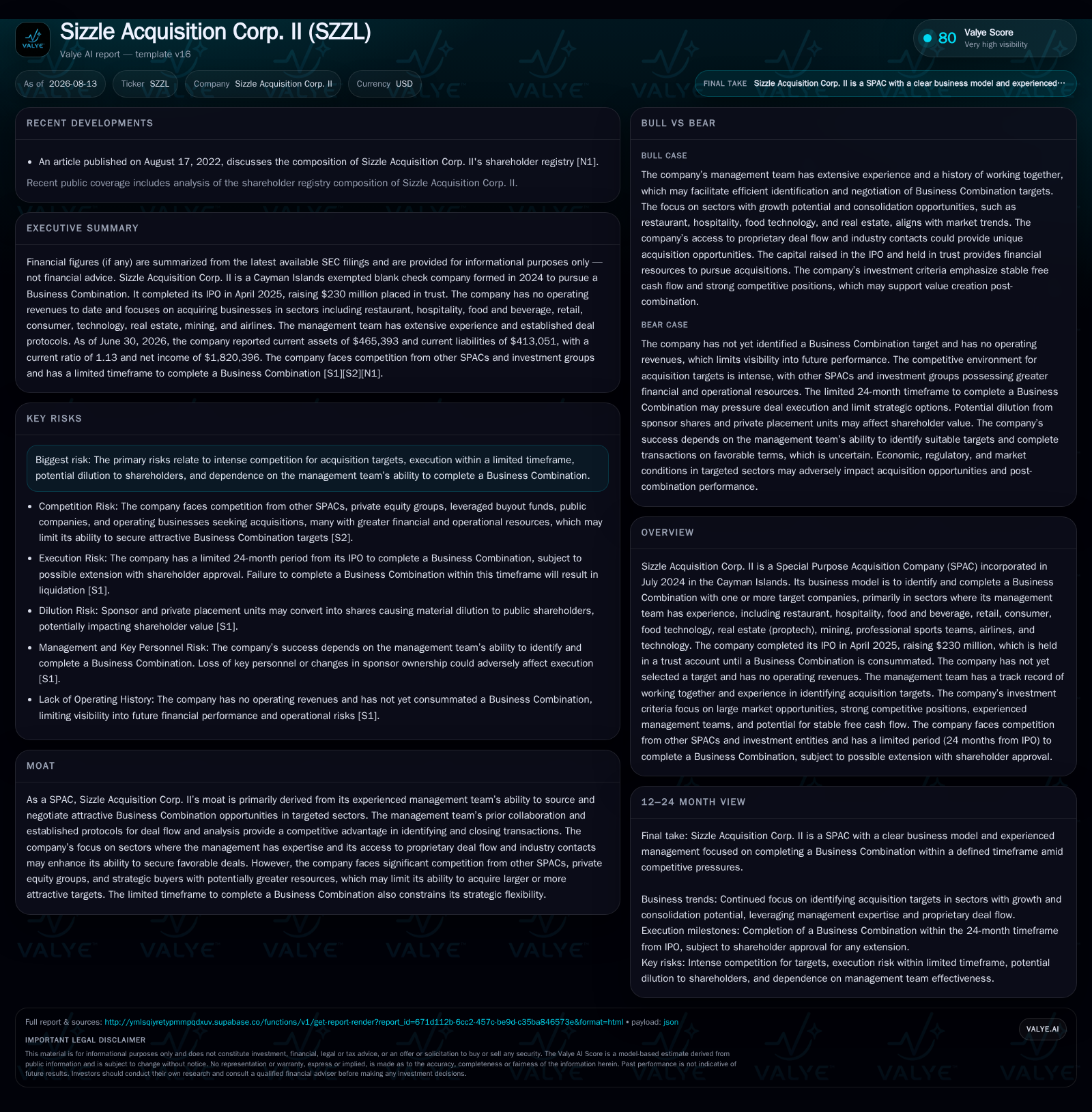
Sizzle Acquisition Corp. II is a Cayman Islands-based SPAC focused on sectors including restaurant, hospitality, food and beverage, and related technology. Having raised $230 million in its April 2025 IPO, it has yet to close its business combination but signed a definitive agreement in April 2026 with Luxembourg-based Trasteel Holding S.A., signaling progress toward de-SPAC. The company's value proposition centers on an experienced management team skilled in identifying attractive acquisition targets, though it faces intense competition and shareholder redemption risk common in the SPAC ecosystem. Maintaining sufficient trust account capital and securing shareholder approval are critical near-term milestones before completing the transaction.
Recent Operating Update
As of the latest quarterly filing dated August 12, 2026, Sizzle Acquisition Corp [S2][S16][S20][S26]. II remains positioned as a Special Purpose Acquisition Company without self-generated revenues but progressing toward consummation of its initial Business Combination. Its significant development came earlier in April 2026 when it entered into a Business Combination Agreement (BCA) with Trasteel Holding S.A., a Luxembourg-based industrial company specializing in steel production. This agreement marks a decisive step toward the de-SPAC transaction that will convert Sizzle II from a blank-check vehicle into an operating public company through Trasteel's acquisition
The filing confirms no material changes to previously disclosed risk factors since the IPO [S2], reflecting stable execution conditions during competitive pressures.
Business Model and Strategic Focus
Operating as a blank-check company incorporated in the Cayman Islands since July 2024, Sizzle Acquisition Corp [S1][S21]. II’s fundamental business model is to raise capital via an IPO and hold those funds in a trust account while identifying suitable private companies for merger or acquisition. Revenue generation is contingent upon successfully completing such a Business Combination, typically followed by operating revenues deriving from the acquired entity’s business activities
The Management Team’s investment thesis targets large market opportunities characterized by increasing demand across several industries where they possess demonstrated sector experience. These include restaurants, hospitality, food and beverage production and technology (including food tech), retail consumer products, proptech real estate ventures, mining operations focusing on critical materials like lithium, professional sports franchises, airline operations, and broader technology domains linked to these sectors [S1][S11]
The team prioritizes deals that exhibit strong brand equity or asset value combined with clear growth paths supported by their operational expertise in scaling brands, marketing strategies, distribution channels, and data-driven enhancements. They aim for platform businesses capable of synergistic bolt-on acquisitions to leverage scale economies post-merger [S11]. This sector-focused approach contrasts with more generalized SPAC sponsors that pursue opportunistic deals without thematic concentration.
Industry Structure and Competitive Position
SPACs function upstream within the capital markets value chain as intermediaries linking private companies seeking public-market access with investors seeking liquid equity exposure. Unlike operating companies, SPACs do not generate autonomous revenues pre-combination but instead monetization is contingent upon equity upside post-business combination.
Within this framework, Sizzle Acquisition Corp. II confronts notable competition from other SPACs sponsored by seasoned financiers focusing on consumer or industrial verticals as well as established private equity groups armed with deeper pockets and broader operational resources. Additionally, strategic corporate buyers often compete for overlapping target companies due to complementary growth or consolidation incentives [S27].
A key differentiator for Sizzle II is its management team's cohesive track record managing deals collaboratively for over seven years alongside private equity partners. Their structured protocols for sourcing proprietary deal flow internally rather than relying solely on auction processes are poised to offer competitive advantage in navigating crowded M&A pipelines [S18]. This integration of sector expertise with relationship-driven sourcing may increase deal quality but execution risks persist given finite time constraints and valuation dynamics.
Growth Drivers
Growth catalysts for Sizzle II hinge primarily on successful deal completion enabling transformation from capital holder to operating public company:
- Sector Tailwinds: Target industries like food & beverage and hospitality are experiencing ongoing structural change accelerated by evolving consumer preferences post-pandemic alongside inflationary cost pressures creating strategic consolidation motivations [S11].
- Experienced Management: The team’s background fosters higher probability identification of undervalued assets suitable for platform creation along with the potential to unlock operational improvements post-combination [S18].
- Capital Readiness: Availability of approximately $230 million raised at $10 per unit secures substantial war chest enabling competitive offers including flexibility through debt or PIPE financing if required [F1][S1][S12].
- Regulatory Framework: Favorable SEC rules permitting blank check vehicles maintain channel viability relative to traditional IPO processes with potential for PIPE participation enhancing deal structures.
Risks and Constraints
Key risks borne by shareholders reflect inherent vulnerabilities of the SPAC model compounded by industry-specific factors:
- Failure to Complete Deal: As commonly experienced across SPAC cohorts, inability to consummate an initial Business Combination by April 2027 deadline would trigger liquidation risks returning limited capital net of expenses [S24].
- Shareholder Redemptions: Public shareholders retain redemption rights upon combination approval which can elevated cash outflows diminishing available transaction funds or increasing dilutive capital raise needs impacting economics negatively [S17][S25].
- Competitive Pressures: Intense rivalry among financial sponsors including other SPACs targeting similar sectors elevates acquisition valuation multiples making accretive deals harder to source at scale [S27].
- Sponsor Promote Dilution: Founder shares and sponsor promote structures typically lead to meaningful dilution of public investor stakes post-combination detracting from net upside despite structural alignment claims [S25].
- Regulatory Scrutiny: Variable SEC examination intensity around disclosures and proxy statements creates timing uncertainty affecting transaction closing horizons.
- Operational Integration: Post-merger performance risks hinge on acquiring management competence adapting industrial or consumer verticals at scale which can undercut anticipated synergies or growth trajectories.
What To Watch Next
Critical milestones shaping near-term prospects include:
- Shareholder Vote Outcome: Approval or tender offer success constituting formal merger consent required for closing [S17][S20].
- Regulatory Clearances: SEC filings approvals and compliance sign-offs particularly relating to proxy solicitation materials are key gating items before final de-SPAC steps [S26].
- Financing Arrangements: Whether additional PIPE or debt transactions are necessary beyond trust cash balances directly affects deal structure dilution profiles and funding adequacy [S12][S25].
- Market Sentiment Dynamics: Investor appetite shifts toward SPAC offerings influence redemption rates which materially impact liquidity available at consummation.
- Closing Execution Timing: Managing timing efficiently before structural deadlines preserves optionality versus forced liquidation scenarios.
Observing company communications around proxy filings issuance timelines, redemption statistics ahead of vote deadlines indicating investor confidence levels will be particularly instructive.
Financial Profile Discussion
At June 30, 2026, Sizzle Acquisition Corp. II reports current assets of $465,393 against current liabilities of $413,051 yielding a current ratio of approximately 1.13 indicating modest near-term liquidity consistent with an inactive operating entity awaiting business combination consummation [F1]. Operating income was negative prior to year-end 2025 reflecting typical pre-combination expenses while net income field positive largely due to non-operating accounting effects tied to trust income components reported at year-end 2025 [$ -537K op.inc., +$6.47M net inc.] [F1].
The bulk of substantive capital resides within the Trust Account established with proceeds from the April 2025 IPO totaling $230 million less redemptions fees or expenses — providing a secure pool earmarked exclusively for transaction funding pending deal closure [S1][F1]. This segregated cash mechanism is pivotal both as collateral securing shareholder redemption rights and a baseline funding resource fortifying negotiating leverage.
Absent ongoing operations or debt issuance as per latest statements there appears limited immediate financial leverage risks although post-merger capitalization plans including potential PIPE financings remain contingency dependent subject to negotiation outcomes.
Conclusion
Sizzle Acquisition Corp. II exemplifies a focused modern SPAC strategically targeting consumer-facing and industrial sectors leveraging a tightly integrated management team's domain knowledge accrued over years collaborating within private equity contexts. The recently executed Business Combination Agreement with Luxembourg's Trasteel signals progression beyond capital raising toward tangible operational presence via de-SPACing.
Maintaining financial stability through sizeable trust account resources supports these endeavors yet execution discipline will determine ultimate realization of envisioned value creation pathways embedded in sector selection rationale.
This case underscores classic SPAC dynamics where upfront transparency about target focus coupled with proven acquisition skills may confer relative advantages but does not obviate broader market cyclicality nor investor sentiment volatility characterizing alternate listing vehicles generally.
This analysis is based solely on publicly filed documents and industry-standard interpretations without providing investment advice or price forecasts.
Disclaimer: This is research-only, informational analysis and not investment advice. It may include AI-generated interpretation and general industry context. Always verify important details using primary sources.

Comments