
Atea Pharmaceuticals Advances Phase 3 Hepatitis C Trials with NDA Submission Targeted for 2027
Atea's late-stage clinical progress with a novel pan-genotypic HCV regimen and early HEV program position it amid a competitive antiviral landscape.
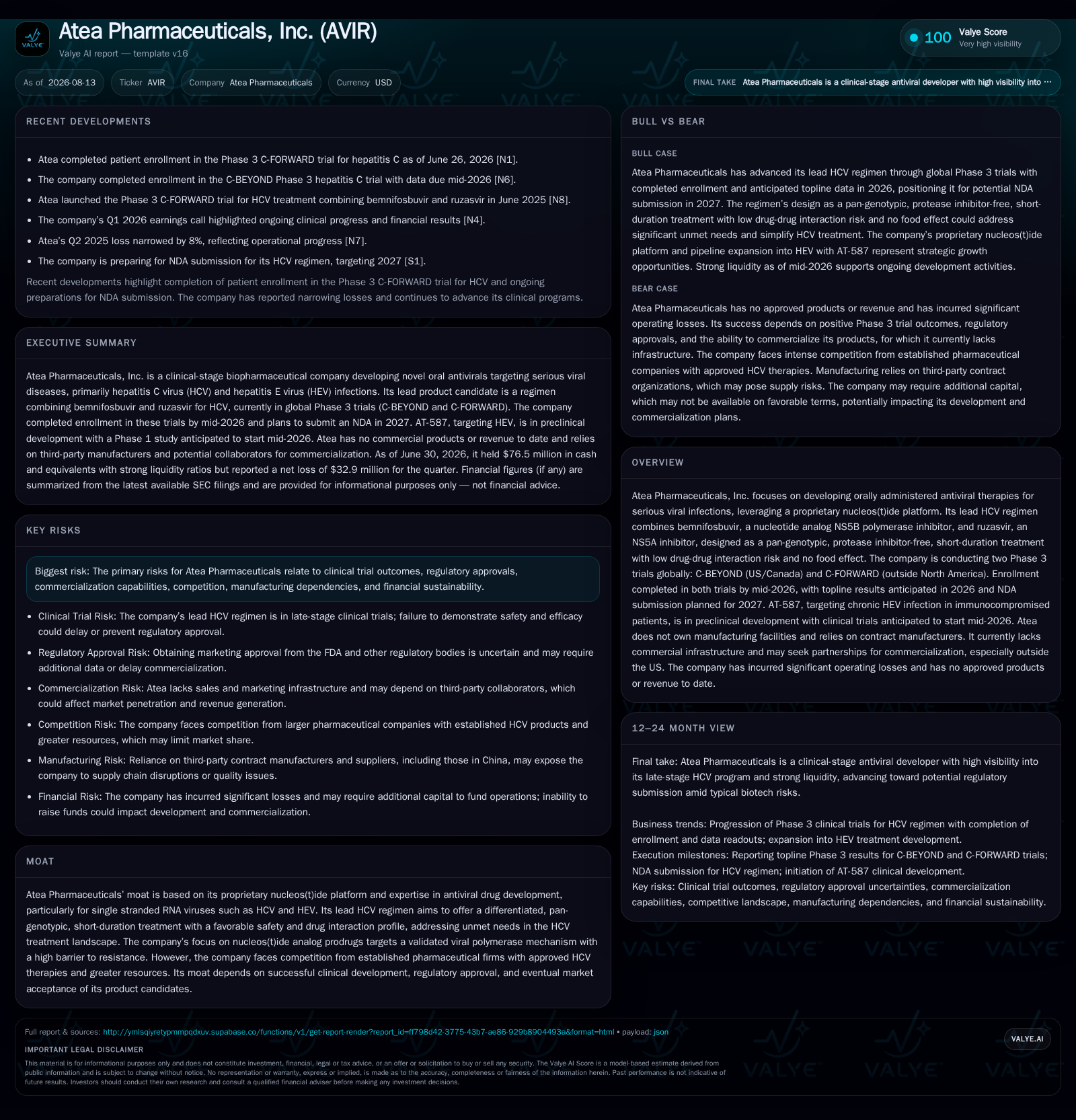
Atea Pharmaceuticals, Inc. reported continued progress in its late-stage drug development pipeline, highlighted by the full enrollment of its global Phase 3 HCV trials, C-BEYOND and C-FORWARD. Its lead regimen combining bemnifosbuvir and ruzasvir offers a differentiated, nucleos(t)ide analog-based pan-genotypic treatment designed for short duration and low drug interaction risk. With topline results expected in 2026 and an NDA submission planned for early 2027, Atea is preparing to transition from clinical development toward commercialization. The company’s financial position remains conservative with substantial cash reserves and limited liabilities as of mid-2026. Atea faces typical late-stage biotech risks including regulatory approval uncertainty, competition from established antiviral therapies, and manufacturing dependencies on contract organizations.
Recent Operating Update
In August 2026, Atea Pharmaceuticals disclosed through its quarterly 10-Q filing that both pivotal Phase 3 clinical trials for its hepatitis C virus (HCV) treatment regimen—C-BEYOND conducted in the US/Canada and C-FORWARD conducted internationally—have completed enrollment ahead of schedule or on target [S2][S3]. The company expects topline results from C-BEYOND by mid-2026 and from C-FORWARD by year-end 2026. Based on these outcomes, Atea plans to submit a New Drug Application (NDA) in the first quarter of 2027 to the US Food and Drug Administration (FDA) for marketing approval [S1]. This advance marks a critical inflection point from research toward potential commercialization. Additionally, Atea reported preparing for early clinical trials of AT-587, an investigational candidate for chronic hepatitis E virus (HEV) infection in immunocompromised populations, anticipated to commence mid-2026 signaling pipeline expansion beyond HCV [S1].
Business Model: Mechanisms Drive Value Creation and Challenges
Atea operates as a late-stage clinical pharmaceutical developer focused on orally administered antiviral treatments targeting serious viral infections. Its revenue model currently depends on licensing agreements potentially triggering milestone payments upon regulatory approvals alongside eventual royalties on net sales once commercialized; however, no such revenues have arisen thus far due to its clinical-stage status [S1]. Its lead asset is a fixed-dose combination (FDC) tablet comprising bemnifosbuvir—an NS5B polymerase nucleotide analog inhibitor—and ruzasvir—an NS5A inhibitor. The regimen is differentiated by its pan-genotypic coverage across all major HCV genotypes without incorporating protease inhibitors commonly associated with drug-drug interactions (DDIs) or food effect issues. This profile supports a shorter course treatment of eight weeks aimed primarily at younger non-cirrhotic patient populations who value treatment simplicity and safety [S1].
Drug development success depends heavily on robust clinical trial data confirming efficacy endpoints like sustained virologic response rates combined with demonstrable safety including low adverse event incidence and minimal DDIs with common concomitant medications such as proton pump inhibitors. Patient adherence is expected to benefit from the oral once-daily dosing without food restrictions.
Manufacturing is fully outsourced to contract manufacturing organizations (CMOs), reflecting industry norms where specialized pharmaceutical CMOs supply active pharmaceutical ingredients (APIs) and finished dose formulations under stringent current Good Manufacturing Practice (cGMP) regulations. This arrangement reduces capital investment needs but introduces supply chain reliance risks that must be managed carefully as commercial launch nears [S1]
The pipeline's second candidate AT-587 targets chronic HEV infections primarily in immunocompromised patients—a niche unmet medical need where no approved direct-acting antivirals currently exist. This investigational drug remains preclinical but poised for rapid clinical development pending regulatory clearance.
Industry Structure and Competitive Positioning
The antiviral therapeutics sector sits at a high-value corner of biotechnology emphasizing medicinal chemistry innovation, virus biology expertise, and complex multi-phase clinical evaluation. Companies typically transition from early discovery through costly Phase 3 trials before seeking FDA or equivalent marketing authorization globally.
Key competitors include established firms like Gilead Sciences and AbbVie with deeply entrenched portfolios of FDA-approved HCV treatments leveraging various direct-acting antiviral mechanisms including protease inhibitors and nucleos(t)ide analogs. These incumbents benefit from extensive marketing reach, payer access agreements, and physician familiarity.
Atea’s targeted niche lies in offering a nucleos(t)ide analog-based pan-genotypic regimen free of protease inhibitors enabling reduced DDIs—a relevant clinical differentiator given the polypharmacy prevalence in patient groups—and a shorter treatment duration that could improve real-world adherence and outcomes if confirmed by Phase 3 data.
For HEV treatment candidates such as AT-587, competition is less defined due to absence of approved DAAs addressing this viral infection segment representing an early-mover opportunity.
Growth Drivers
Several factors underpin potential growth if development milestones are met:
- Successful completion of Phase 3 trials demonstrating non-inferiority or superiority versus standard-of-care regimens will validate market entry potential.
- Regulatory acceptance worldwide beyond the US could broaden patient access.
- The convenient oral FDC formulation with low DDI risk may enhance prescriber uptake especially among younger patients needing simplified regimens.
- Expansion into pediatric or special population indications could extend label scope.
- Launching the novel HEV antiviral candidate could open new revenue streams addressing unmet immunocompromised patient needs.
- Strategic partnerships or licensing deals leveraging Atea's nucleos(t)ide platform chemistry may generate milestone revenue inflows.
These growth factors rely heavily on achieving positive regulatory milestones anchored chiefly in topline trial results expected over the next several quarters.
Risks and Watchpoints
Atea faces typical late-stage biotech enterprise risks including:
- Clinical Trial Risk: Negative or inconclusive Phase 3 outcomes would stall approval possibilities indefinitely.
- Regulatory Risks: Delays or requests for additional data from the FDA or foreign agencies remain possible given evolving drug safety expectations.
- Commercialization Capabilities: Transitioning from discovery/development-focused operations toward commercial launch requires substantial organizational scaling which has yet to be demonstrated by Atea.
- Competitive Landscape: Entrenched competitors maintain durable market share supported by payer contracts; new entrants must surmount physician inertia and reimbursement negotiations.
- Manufacturing Dependencies: Outsourced CMOs pose supply continuity risks particularly as scale increases near launch; dual sourcing strategies may be necessary.
- Intellectual Property Challenges: Patent disputes notably around nucleotide analog chemical space could impede market exclusivity periods affecting return horizons.
- Pricing & Reimbursement Uncertainty: Third-party payors increasingly review cost-effectiveness; favorable coverage decisions are neither assured nor uniform across regions.
- Regulatory Compliance: Extensive healthcare law compliance encompassing anti-kickback statutes, promotional restrictions especially about off-label marketing present ongoing legal risks if not strictly adhered.
Monitoring upcoming C-BEYOND/C-FORWARD topline data readouts critically informs risk calibration along with iterative management commentary on NDA submission progress 2026–27 timelines.
What To Watch Next
The following milestones will prominently influence Atea’s trajectory:
- Mid-2026: Topline data release from US/Canada C-BEYOND trial evaluating bemnifosbuvir/ruzasvir combination’s efficacy compared against sofosbuvir/velpatasvir active comparator arm [S1][S2].
- End-of-2026: Reporting of international C-FORWARD trial topline results broadening genotype coverage insights including potentially more diverse patient cohorts [S1][S2].
- Early 2027: Planned NDA filing submission contingent upon successful Phase 3 data confirming safety/efficacy endpoints critical for initial regulatory approval consideration by FDA.[S1]
- Mid-2026 onwards: Initiation of clinical trials for AT-587 targeting chronic HEV infection expanding pipeline validation steps [S1].
- Ongoing: Updates on Merck royalty arrangements linked to product sales upon commercialization will affect future financial modeling.[S1]
- Quarterly financial updates tracking cash burn rates reflective of continued sizable R&D spend as well as liquidity runway approximating beyond one year given current balances.[F1]
Financial Profile Discussion
As of June 30, 2026, Atea Pharmaceuticals holds cash and equivalents of approximately $76.5 million, with current assets totaling about $228.7 million against current liabilities near $28.1 million, resulting in a current ratio of approximately 8.13x, indicative of strong short-term liquidity [F1]. Operating losses continue due to the company's developmental-stage focus with no revenue recognized from product sales to date. The firm expects operating losses to persist throughout 2026 as it invests in pivotal trial readouts and sustained R&D activities but appears adequately capitalized for the near term absent unexpected setbacks or accelerated commercial activities requiring additional capital raises or partnerships.
This liquidity position supports management’s strategy to fund key milestones leading up to NDA submission while maintaining pre-commercial infrastructure including quality assurance related to contract manufacturing oversight. The absence of significant debt reduces financial distress risk and enhances operational flexibility during this critical development phase.
In summary, Atea’s financial posture currently supports execution against planned regulatory timelines, though scalability toward commercialization will likely require incremental capital or strategic alliances given typical biopharma launch cost profiles within the antiviral therapeutic domain.
This analysis synthesizes publicly available SEC disclosures through August 2026 combined with industry context relevant to antiviral pharmaceutical development. It aims to provide an informed perspective based strictly on evidenced developments without projecting future investment outcomes or offering financial advice.
Disclaimer: This is research-only, informational analysis and not investment advice. It may include AI-generated interpretation and general industry context. Always verify important details using primary sources.

Comments