
FinWise Bancorp Expands Fintech-Driven Loan Origination Amid Deposit Growth and Credit Risk Challenges
The latest quarter spotlights FinWise's evolving BaaS model, diversified loan portfolio growth, and critical deposit and credit risk dynamics.
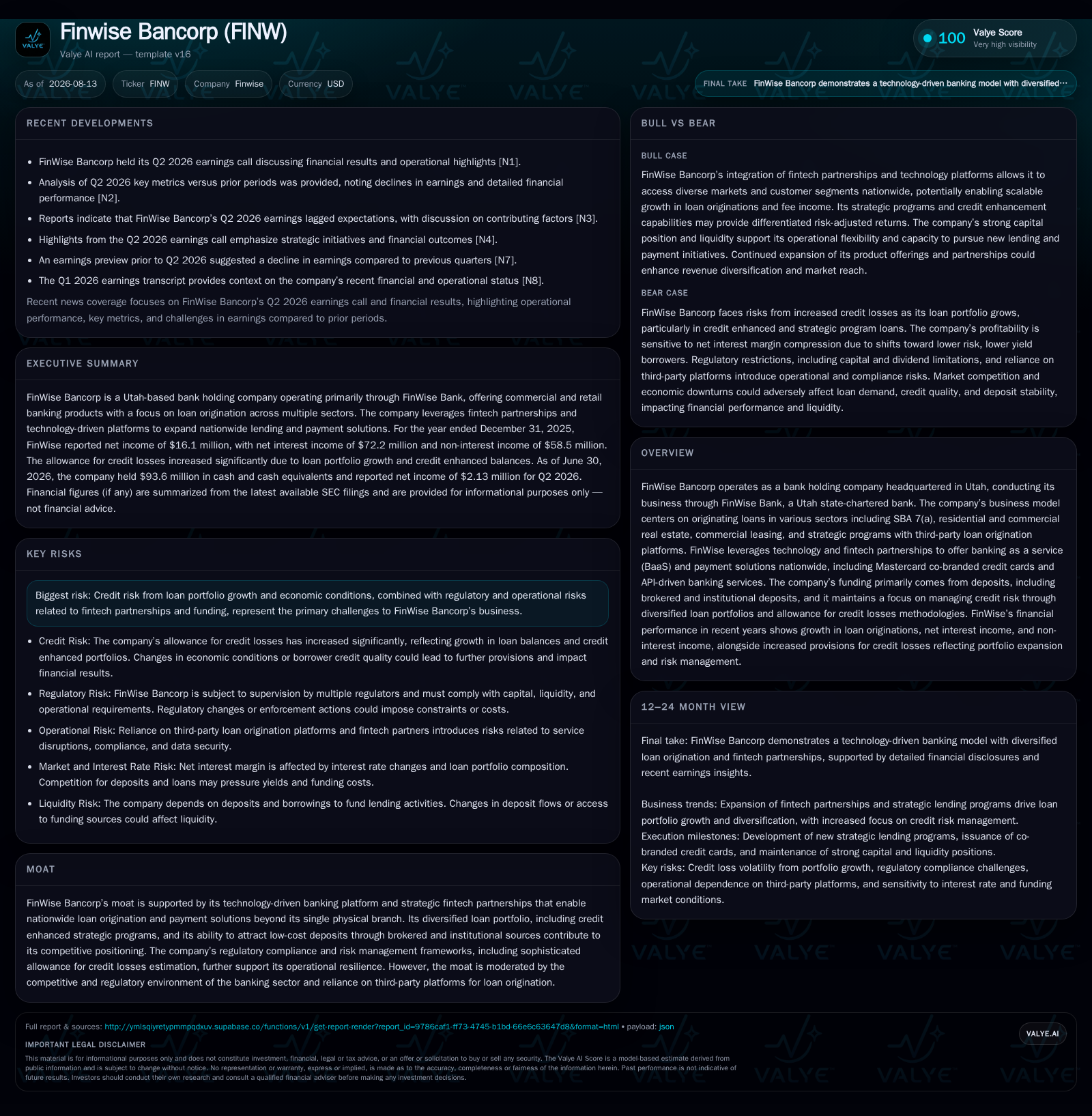
FinWise Bancorp’s Q2 2026 filings reveal growth in fintech-enabled loan originations and deposits, with an ongoing emphasis on managing credit risk and liquidity. The bank leverages strategic partnerships for nationwide SBA, commercial real estate, and leasing loans while funding growth through a rising mix of brokered deposits. Credit risk management remains a key challenge given portfolio growth and macroeconomic uncertainties. FinWise’s technological platform supports scalable expansion beyond its single Utah branch, positioning it well in the evolving regional bank landscape. Key near-term markers include monitoring loan performance metrics, deposit stability, and capital adequacy ratios.
Recent Operating Update
FinWise Bancorp’s Q2 2026 10-Q filing highlights continued momentum in loan originations driven predominantly by its fintech-enabled platforms targeting SBA 7(a) loans, commercial real estate financing, and commercial leasing programs [S2]. The company emphasized growing volume through strategic third-party origination partners nationwide despite maintaining a solitary physical branch in Utah. This has enabled them to extend banking as a service (BaaS) capabilities including API-driven payment solutions such as Mastercard co-branded cards [S1].
Deposit gathering remains a critical underpinning for FinWise’s business model. The June 30 balance sheet reflected healthy growth in total deposits compared to prior periods, fueled by both consumer-driven core deposits and a sizeable increase in brokered time deposits. While brokered deposits enhance liquidity and enable rapid loan portfolio scaling, they also introduce sensitivities to funding costs and potential run-off risks should market conditions shift unfavorably [S1]
Credit risk management surfaced as a notable theme with the allowance for credit losses (ACL) climbing substantially year-over-year due to sharply higher loan balances—including a marked rise in credit-enhanced loans secured through strategic programs—with the ACL-to-total-loans ratio moving towards levels designed to absorb potential losses during economic volatility. The company’s CECL methodology incorporates stress scenarios that suggest moderate sensitivity to elevated unemployment forecasts but within manageable limits currently [S1].
Business Model
At its core, FinWise Bancorp functions as a bank holding company funneling all material operations through FinWise Bank—a Utah state-chartered institution. The bank’s main revenue source is net interest income generated by originating loans funded through customer deposits supplemented by borrowings when necessary. Unlike traditional regional banks with extensive branch networks, FinWise leverages technology partnerships extensively to broaden origination scale without commensurate physical footprint expansion.
Its loan portfolio spans multiple specialized sectors: SBA 7(a) lending facilitated via relationships such as Business Funding Group referrals; residential and commercial real estate loans mainly concentrated locally around Salt Lake City; commercial leasing loans; and innovative strategic programs implemented via fintech platforms with credit enhancement features reducing borrower default exposure [S1].
Non-interest income largely flows from payment processing fees tied to BaaS services including co-branded credit cards and transactional banking APIs. This diversification beyond lending helps stabilize earnings relative to pure loan-driven institutions.
Funding strategy focuses on accumulating both consumer/core deposits through competitive interest rates enabled by high-yielding loans plus sizable brokered certificates of deposit sourced nationally. This mix allows optimized cost of funds while preserving liquidity buffers mandated by regulatory policies overseen jointly by Utah Department of Financial Institutions (UDFI), FDIC, and the Federal Reserve system [S1]
Industry Structure and Competitive Position
FinWise Bancorp sits at the intersection of traditional regional banking and fintech-enabled specialty lending—a hybrid that offers both advantages and challenges. Its technological prowess allows lending scale nationwide without incurring heavy fixed costs typical of brick-and-mortar branch expansion seen in peers like Cullen/Frost Bankers (CFR). However, it lacks broad local brand recognition or extensive consumer storefront presence that some larger regional banks maintain.
The competitive landscape includes established SBA-focused lenders who benefit from long-standing government relationships and deep underwriting expertise alongside emerging fintech firms increasingly pursuing formal bank charters or partnering directly with regulated banks. FinWise’s ability to offer integrated BaaS solutions via APIs differentiates it from pure-play lenders lacking payments infrastructure.
However, reliance on third-party origination platforms introduces counterparty risk unlike vertically integrated peers who own full end-to-end origination processes. Operational dependence raises potential vulnerabilities should service providers face financial or regulatory challenges—an industry-wide trend where thorough vendor oversight becomes critical.
Growth Drivers
Several tailwinds support FinWise’s growth trajectory:
- Fintech platform expansion: Continued onboarding of third-party originators enables access to new customer segments across multiple states rapidly without opening branches.
- Increased demand for SBA and CRE loans: These sectors benefit from supportive government programs post-pandemic recovery phases plus steady commercial real estate activity restarting after cyclical softness.
- Rising adoption of BaaS offerings: Corporates looking for embedded banking/payment capabilities favor API-driven models which FinWise actively markets.
- Deposit base diversification: Attracting institutional brokers alongside retail depositors enhances funding flexibility while supporting asset growth plans.
- Technology innovations: Enhanced digital onboarding tools improve acquisition efficiency lowering unit economics compared with legacy community banks.
Risks and Growth Constraints
Key challenges remain centered on:
- Credit risk management amid portfolio growth: Maintaining stable NPL ratios especially if economic headwinds worsen will require vigilant underwriting oversight.
- Deposit reliability: Heavy use of brokered deposits risks sudden outflows if competitors offer better rates or adverse market perceptions arise.
- Regulatory compliance costs: Heightened scrutiny related to fintech partnerships demands ongoing investments in governance frameworks.
- Operational dependencies: System outages or failures at partner platforms could disrupt origination pipelines or payment services impacting revenue.
- Competitive pressures: Larger regional banks’ broader product suites and deeper capital buffers may limit pricing flexibility or market share gains over time [Industry Knowledge; S1].
What to Watch Next
Investors should monitor several indicators for signs of trajectory shifts:
- Quarterly updates on non-performing loans (NPL) ratio trends especially within new strategic program portfolios will reveal credit quality progression.
- Composition changes in deposit sources reflecting core versus brokered proportions will indicate funding sustainability.
- Net interest margin fluctuations driven by market rate cycles impacting loan yields versus funding costs.
- Capital adequacy levels reported under community bank leverage ratio frameworks demonstrating buffer strength against shocks.
- Progression or setbacks in expanding fintech partnership pipeline suggested by operational commentary or backlog disclosures [S2]
Financial Profile Discussion
As of June 30, 2026, FinWise reported cash and cash equivalents totaling approximately $93.6 million supporting daily operations and liquidity requirements [F1]
The balance sheet reflects strong equity capitalization with tangible common equity representing nearly 20% of total assets—footing consistent with well-capitalized regulatory classifications ensuring cushion against downturns [S1]. Return metrics such as return on average assets (ROAA) hovered around low double-digit margins previously but faced modest compression linked to rising provisions for credit losses prompted by portfolio scaling and cautious CECL methodology application [S1].
Net interest margin contracted slightly year-over-year from near 10% levels partly due to competitive deposit pricing but remains materially above large bank peer benchmarks reflecting selective underwriting discipline [S1]. Operational expenses declined year-over-year benefitting from efficient segment reporting rollout separating traditional banking, BaaS, and treasury functions for clarity on resource allocation [S1].
Overall liquidity management appears prudent with ample reserves in liquid securities portfolio combining Treasury holdings alongside interest-bearing deposits primarily at Federal Reserve accounts ensuring readiness for unexpected deposit fluctuations or increased funding needs stemming from rapid loan origination expansions [S1]
This analysis synthesizes publicly filed regulatory documents through August 12, 2026 including Q2 earnings disclosures along with recognized industry frameworks relevant to regional specialty banking institutions operating at the intersection of traditional banking and fintech-enabled services. It does not constitute investment advice or research views.
Disclaimer: This is research-only, informational analysis and not investment advice. It may include AI-generated interpretation and general industry context. Always verify important details using primary sources.

Comments