
Humacyte Advances Bioengineered Vascular Products Amid Nasdaq Compliance Risks
Clinical progress in bioengineered blood vessels intersects with financial strain and listing pressure.
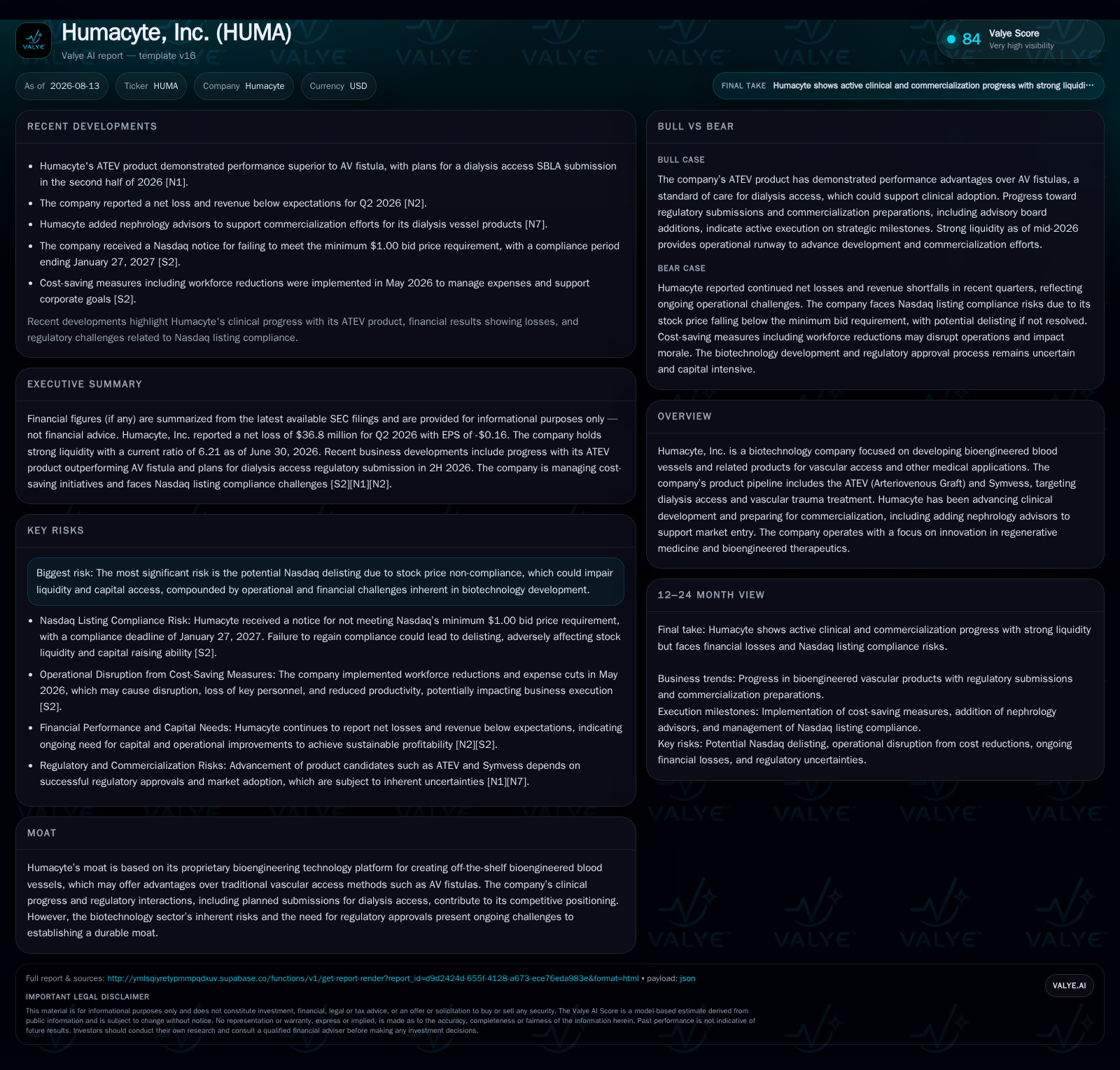
Humacyte, Inc. reported ongoing clinical development and regulatory preparations for its flagship acellular tissue engineered vessel (ATEV) products targeting dialysis access and vascular trauma. The company is strategically advancing commercialization efforts, including securing advisory expertise in nephrology and pursuing international partnerships. However, operational challenges persist with workforce reductions and Nasdaq delisting risk due to stock price non-compliance. Financially, Humacyte retains a strong liquidity position but continues to operate at an operating loss typical for clinical-stage biotechs, underscoring the need for carefully managed capital deployment and milestone achievements.
Recent Operating Update
Humacyte’s Q2 2026 filing dated August 12 details a strategic push to manage cash burn while advancing clinical development of its off-the-shelf biologic therapies [S2]. In May 2026, the company reduced its workforce by approximately 45 employees and deferred additional hiring, reflecting efforts to extend financial runway during ongoing pivotal trials and regulatory activities. While key personnel were retained to preserve core capabilities, management acknowledges risks that these cost-cutting measures could disrupt productivity or impact innovation continuity.
Compounding operational pressures, Humacyte received a Nasdaq notice for failing to maintain the minimum $1.00 bid price over a consecutive 30-day period ending July 30, triggering a compliance deadline of January 27, 2027 to avoid delisting [S2], [S21]. This listing risk introduces volatility in equity liquidity and potentially complicates future capital raises essential for sustaining late-stage development.
Despite these headwinds, Humacyte advanced critical clinical milestones. Phase 3 data presented for its acellular tissue engineered vessel (ATEV) product — marketed as Symvess — demonstrated superior outcomes compared to traditional arteriovenous fistulas in female patients requiring hemodialysis access [N4], [S17]. These findings support an FDA Small Business Liability Act (SBLA) filing planned in the second half of 2026 aimed at expedited regulatory review.
Commercially, Symvess remains early-stage but strategically positioned internationally. The company secured a binding minimum purchase commitment (~$1.48 million) in Saudi Arabia to facilitate surgeon training and hospital evaluations alongside negotiations for forming a local joint venture to commercialize the product there [S18]. Concurrently, Humacyte filed a Marketing Authorization Application (MAA) in Israel targeting vascular trauma indications, with plans to enable hospital-level access ahead of formal approval.
Business Model Overview
Operating within regenerative medicine’s intersection with vascular therapeutics, Humacyte develops proprietary bioengineered vessels that are fully acellular—reducing immunogenicity—and available off-the-shelf without donor matching delays. This positions the company against conventional synthetic grafts and native fistulas by offering potentially improved patency and safety profiles.
Revenue generation is expected primarily through direct sales to healthcare providers such as hospitals and dialysis centers post-approval, supplemented by milestone payments from licensing arrangements. The recent April 2026 amendment reverting ex-U.S. commercialization rights from Fresenius Medical Care back to Humacyte reflects a strategic decision to consolidate global control while maintaining royalty obligations on U.S. sales [S19]. This shift allows more direct oversight of regulatory filings and commercialization strategy outside the U.S., potentially accelerating market penetration.
Manufacturing scale-up is a crucial operational focus given the complexity of producing consistent high-quality biologic vessels at commercial volumes without excessive capital expenditure or quality compromise.
Industry Structure and Competitive Positioning
Humacyte operates within a competitive landscape spanning regenerative medicine developers and vascular device manufacturers. Its unique off-the-shelf ATEV platform differentiates it from synthetic graft suppliers like Becton Dickinson or biologic implant providers such as CryoLife by integrating human cell-derived extracellular matrix scaffolds into ready-to-use vascular conduits.
Peers include both large-cap biologics companies like Amgen with established commercial infrastructures and smaller regenerative medicine firms like Organovo or Athersys focusing on cell therapies. Clinical differentiation—demonstrated through superior safety/efficacy endpoints relative to standard AV fistulas—will be pivotal in driving physician adoption and payer reimbursement decisions.
Growth Drivers
Key growth catalysts hinge on successful completion of late-phase clinical trials validating ATEV’s performance benefits and subsequent regulatory approvals across major geographies including the U.S., Israel, and Saudi Arabia.
The rising global prevalence of end-stage renal disease underpins structural demand growth for improved dialysis access solutions.
Strategic partnerships or licensing agreements—especially those facilitating localized market entry—can accelerate adoption beyond North America. Manufacturing improvements enabling scalable production will be critical to meet anticipated demand without margin erosion.
Expansion into additional indications such as coronary artery bypass grafting is underway following FDA clearance of an investigational new drug application for first-in-human trials, representing longer-term market opportunity expansion [N7].
Risks and Watchpoints
Risks remain typical of clinical-stage biotechs: potential delays or failures in pivotal trials could impede approval timelines; regulatory pathways may prove complex given device-biologic combination classifications; manufacturing scale-up might encounter yield or cost challenges; intellectual property protections require vigilance against infringement threats; and capital access could be constrained by equity market volatility tied to Nasdaq compliance issues.
Operational risks include possible negative impacts from workforce reductions on innovation pace or employee morale [S2]. Market acceptance depends critically on favorable reimbursement coverage outcomes which remain uncertain until broader payer engagement occurs.
What to Watch Next
Investors should monitor:
- Timing and outcome of SBLA submission for dialysis access indication,
- Progress on international regulatory approvals including MAA decisions,
- Commercial rollout updates especially hospital adoption metrics outside the U.S.,
- Manufacturing capacity expansion announcements,
- Nasdaq compliance status developments ahead of January 2027 deadline,
- New partnership formations or licensing deals enhancing geographic reach,
- Early clinical data from coronary bypass indication trials. These milestones will clarify Humacyte’s path toward commercial viability amid ongoing execution risks.
Financial Profile Discussion
As of June 30, 2026, Humacyte maintained $79.9 million in cash and equivalents supported by current assets totaling approximately $92.8 million against current liabilities near $14.9 million, resulting in a strong current ratio above 6x that underscores solid short-term liquidity available to fund R&D activities [F1]
Operating income remains negative as expected for a development-stage biotech investing heavily in clinical programs; net losses totaled $40.8 million for the prior full year indicating sustained cash burn typical before revenue scale-up [F1]. Cost-saving initiatives launched mid-2026 reflect management’s response to uncertain capital markets combined with internal budget recalibrations aimed at extending runway without compromising critical development milestones [S2].
Overall, Humacyte faces the challenge common to emerging regenerative medicine companies: balancing aggressive clinical advancement toward product approvals with prudent financial stewardship amid market uncertainties including Nasdaq listing compliance pressures.
Disclaimer: This is research-only, informational analysis and not investment advice. It may include AI-generated interpretation and general industry context. Always verify important details using primary sources.

Comments