
U.S. GoldMining Advances Whistler Project with Active Drilling and Navigates Legal and Financing Challenges
The latest quarterly filing highlights U.S. GoldMining’s intensified exploration efforts at its flagship Whistler gold-copper project in Alaska, alongside emerging legal risks related to warrant issuances, which together shape near-term operational and financial dynamics.
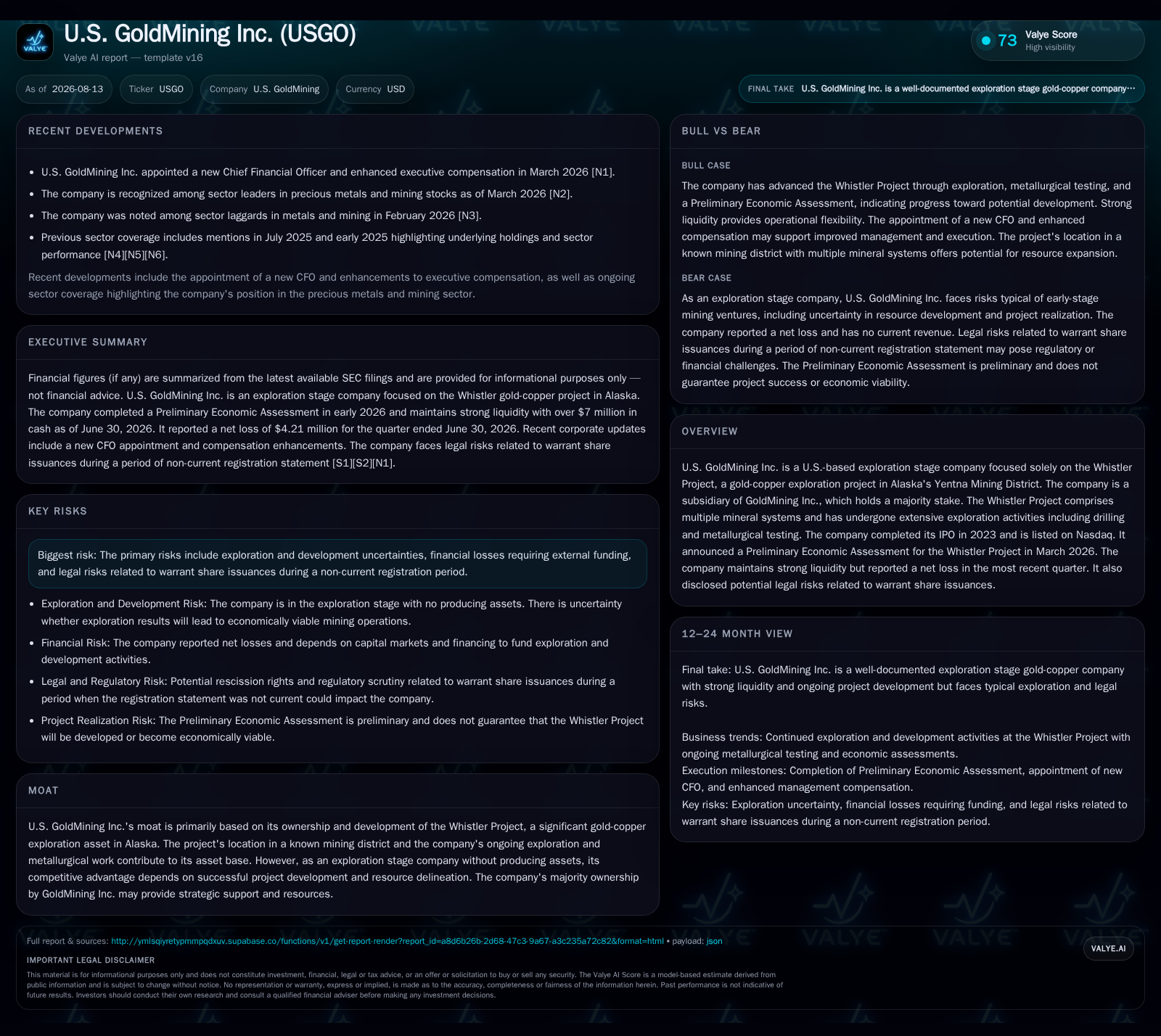
U.S. GoldMining Inc. has initiated a focused drilling program in 2026 targeting priority zones at its wholly owned Whistler Project, aiming to expand resource estimates and refine metallurgical processing ahead of an updated Preliminary Economic Assessment (PEA) [S2][S4]. As an exploration-stage company without production or revenue, it remains reliant on capital markets for funding, supported by a strong cash position of $7.4 million and a high current ratio as of Q2 2026 [F1]. However, legal uncertainties linked to warrant share issuances during a registration lapse pose potential challenges to financing flexibility [S2]. Majority ownership by parent GoldMining Inc. provides strategic capital access but also complicates shareholder structure [S1]. Key upcoming catalysts include drill results, PEA updates, and resolution of compliance issues affecting investor confidence.
Q2 2026 Exploration Program Advances Resource Definition
U.S. GoldMining’s August 12, 2026 quarterly report ([S2]) details the launch of an active drilling campaign at the Whistler Project targeting several high-priority exploration zones. This step is pivotal in expanding meters drilled—a key performance indicator reflecting technical progress in mineral resource delineation. Enhanced drilling data supports improved geological models essential for estimating resource size and grade distributions that directly influence the project's economic potential.
Alongside drilling, metallurgical testing continues to optimize extraction processes such as sulfide flotation and gravity gold recovery. These efforts inform process flowsheet development critical to refining the Preliminary Economic Assessment (PEA), which underpins investment decisions by quantifying expected metal recoveries and project economics ([S1],[S4]). Together these technical milestones reduce execution risk by providing more robust data supporting future feasibility studies.
Business Model: Exploration-Focused with Capital Market Reliance
As an exploration-stage entity without producing assets or revenues, U.S. GoldMining exemplifies the junior mining archetype where value accrues through successful resource identification and advancement along regulatory milestones like PEAs ([S1],[S2]). Revenue generation is prospective; it depends on converting mineral resources into economically mineable reserves or monetizing assets via sale or joint ventures.
This model requires continuous capital raising primarily through equity or warrant issuances to fund exploration expenditures—typically non-cash flow generating activities. Consequently, operational execution on drill programs and metallurgical testing directly impacts investor confidence and financing terms.
Whistler Project’s Strategic Location Amid Industry Challenges
Situated approximately 170 km northwest of Anchorage in Alaska’s Yentna Mining District ([S1]), the Whistler Project benefits from recognized mineralization trends enhancing geological upside. However, remote location entails logistical complexities including access infrastructure constraints and higher costs for equipment mobilization.
Additionally, Alaskan regulatory frameworks impose rigorous permitting processes involving environmental assessments and indigenous consultations ([S8]). These factors can elongate timelines from discovery through development stages requiring careful stakeholder management to mitigate delays.
Parent Company Influence on Capital Access and Governance
GoldMining Inc., holding roughly 74% equity plus warrants ([S1]), provides U.S. GoldMining with strategic capital support uncommon among independent juniors. This relationship enhances liquidity stability facilitating sustained exploration activity but also introduces shareholder structure complexity.
Notably, recent legal disclosures concerning inadvertent warrant share issuances during a registration lapse ([S2]) raise compliance concerns that may affect market perception. Such issues could constrain fundraising efficacy if investors perceive heightened regulatory risk or potential dilution from rescission claims.
Commodity Price Impact on Funding Environment
Exploration budgets are sensitive to gold and copper price cycles given Whistler’s asset composition ([F1],[S2]). Bullish commodity markets generally improve investor appetite for junior equities enabling capital raises at favorable terms; bearish phases heighten dilution risks by depressing valuations.
Therefore, commodity price volatility represents a significant external variable influencing U.S. GoldMining’s ability to finance ongoing operations without excessive shareholder dilution.
Legal Risks from Non-Compliant Warrant Issuances
Between March 2024 and May 2026, approximately 8,633 common shares were issued upon warrant exercises when the company's registration statement was not current ([S2]). This procedural oversight potentially exposes holders to rescission rights demanding exercise price refunds plus interest while inviting regulatory scrutiny.
Though corrective actions have been implemented effective May 15, 2026 ([S2]), this outstanding legal uncertainty complicates future capital raising efforts as investors weigh compliance credibility alongside operational prospects.
Growth Drivers: Drilling Successes and Metallurgical Refinements
Key growth catalysts include positive drilling results expanding resource size or grade which underpin stronger economic projections in updated PEAs ([S1],[S4]). Enhanced metallurgical recoveries improve projected metal output volumes boosting project valuation fundamentals.
Strategic partnerships or joint ventures remain potential avenues for non-dilutive funding thereby reducing financial risk while accelerating project advancement.
Constraints: Permitting Timelines, Geological Uncertainty, Dilution Pressure
Despite progress, constraints persist including Alaska’s stringent permitting environment which can delay transitions from exploration to development phases ([S8]). Geological uncertainties intrinsic to early-stage deposits pose reserve conversion risks that may temper investor enthusiasm.
Continued operating losses driven by exploration expenditures (approximately $7 million net loss reported for year-end 2025) require ongoing funding injections potentially diluting existing shareholders’ stakes ([F1]).
Outlook: Monitoring Milestones and Financial Health Indicators
Investors should watch for publication of detailed drill assay results confirming expansion potential ([S4],[S6]), advancement beyond PEA toward feasibility studies indicating reserve maturation progressions ([S1]), resolution of warrant-related compliance issues clarifying fundraising outlooks ([S2],[S3]), alongside liquidity trends.
Financial Profile Discussion: Strong Liquidity Balancing Operating Losses
As of June 30, 2026, U.S. GoldMining reported $7.4 million in cash equivalents against modest current liabilities yielding a high current ratio (~24x), evidencing robust short-term liquidity supporting ongoing exploration activities ([F1]).
However, persistent net operating losses reflect the capital-intensive nature of early-stage mineral exploration necessitating sustained access to equity markets or parent company backing to maintain operations until commercial viability is established ([F1],[S2]). Monitoring cash burn rates relative to market conditions remains crucial for assessing operational sustainability before production commences.
This analysis integrates recent SEC filings with sector-specific insights into junior mining exploration dynamics where technical milestones drive valuation amidst complex financing environments influenced by regulatory compliance risks and commodity market cycles.
Disclaimer: This report is informational only and does not constitute investment advice or research views.
Disclaimer: This is research-only, informational analysis and not investment advice. It may include AI-generated interpretation and general industry context. Always verify important details using primary sources.

Comments