
InterPrivate Investment Partners V Advances SPAC Lifecycle with Strong Liquidity and Separate Trading Launch
Since its June 2026 IPO, InterPrivate Investment Partners V has maintained robust capital reserves in trust while initiating separate trading of shares and warrants, positioning itself for a timely business combination within the standard SPAC framework.
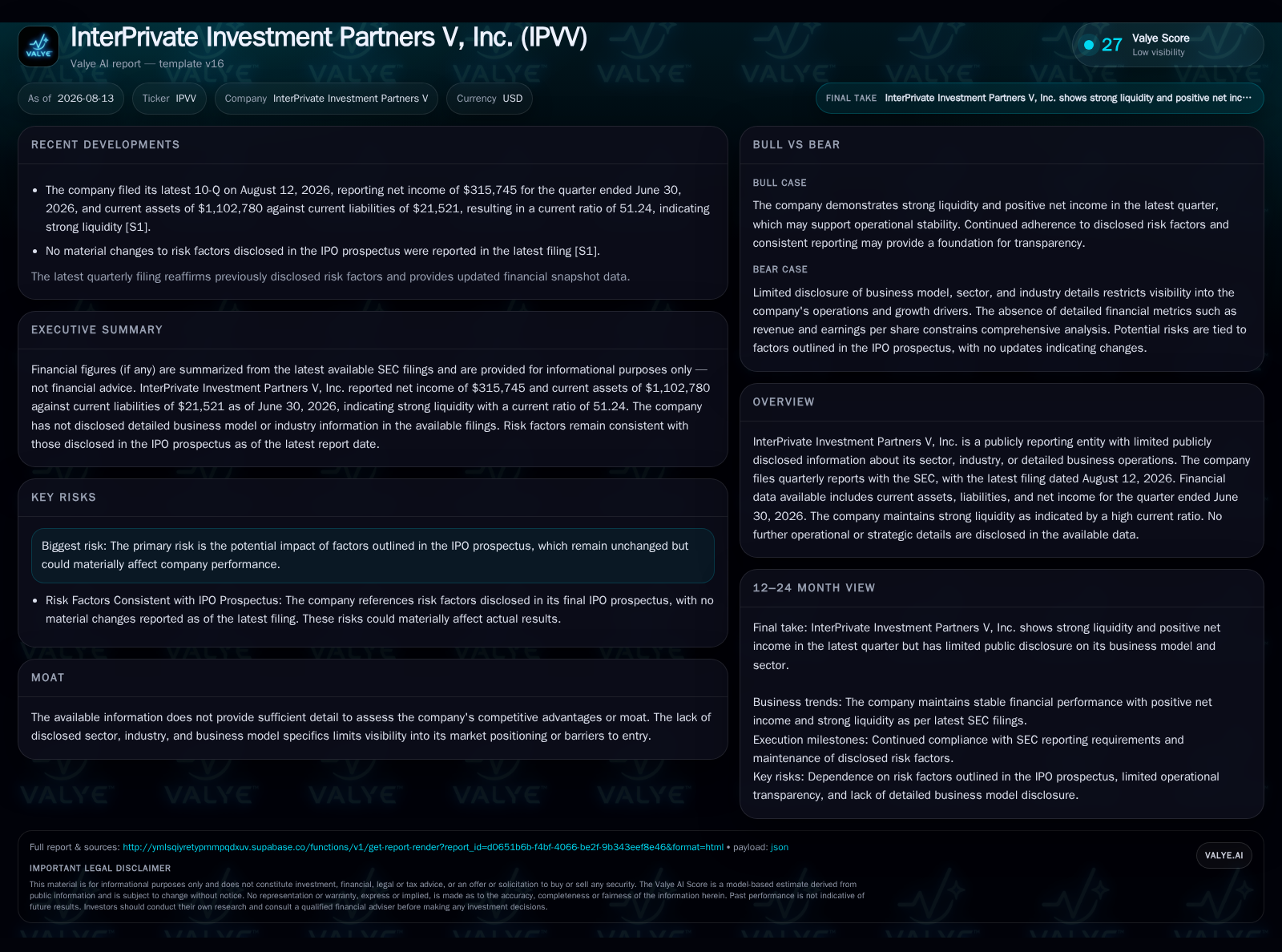
InterPrivate Investment Partners V, Inc. completed its IPO in June 2026, raising approximately $201 million through issuance of units combining Class A ordinary shares and redeemable warrants. The company’s capital is securely held in a trust account, preserving liquidity for acquisition opportunities or shareholder redemptions. Recent filings confirm no material changes to risk factors since the IPO, while the launch of separate trading of component securities enhances investor flexibility and market efficiency. With an exceptionally high current ratio reflecting minimal liabilities against trust-held assets, IPVV remains in the pre-business-combination phase typical of SPACs, focusing on deal sourcing and capital preservation ahead of de-SPAC execution [S2][S3][S5][S12][F1].
Recent Operating Update
InterPrivate Investment Partners V (IPVV) swiftly progressed after its June 5, 2026 IPO by raising approximately $201.25 million through issuance of over 20 million units priced at $10 each [S5][S12]. Each unit consists of one Class A ordinary share plus one-third of a redeemable warrant exercisable at $11.50 per share—standard features designed to provide investors layered participation potential following a successful business combination [S3]. Additionally, the company secured $5.4 million via private placements to sponsors and underwriters subject to customary lock-up restrictions that align sponsor interests with public shareholders’ outcomes [S12][S17].
The IPO proceeds are held predominantly in a trust account administered by Continental Stock Transfer & Trust Company—a fiduciary arrangement that safeguards investor capital until either consummation of an initial business combination or redemption upon failure within the timeline stipulated by the company’s amended articles [S12]. This structure yields exceptionally high liquidity; as of June 30, IPVV reported nearly $1.1 billion in current assets versus minimal liabilities translating into a current ratio exceeding 51—reflecting restricted cash holdings rather than operating cash flow [F1].
Operating income was negative about $134 thousand during this early period due primarily to administrative overhead such as legal and compliance costs typical for SPACs pre-merger, with no operating revenues generated yet [F1]
A notable development occurred on July 27 when IPVV began allowing holders to trade Class A ordinary shares and warrants separately on Nasdaq instead of solely as bundled units [S3]. This move enhances investor flexibility by enabling independent management of equity or warrant exposure—a practice increasingly adopted among mature SPACs approaching de-SPAC transactions to optimize market liquidity and price discovery.
Business Model Overview
As a Special Purpose Acquisition Company (SPAC), IPVV functions as a publicly listed shell entity that raises capital through an IPO structured around units combining shares and warrants. The company’s primary objective is to identify and merge with or acquire a private operating company within a prescribed timeframe (generally up to two years), thereby facilitating faster public market access for the target without traditional IPO complexities.
Monetization arises mainly from sponsor promote arrangements granting founders equity stakes post-merger, potential appreciation in the acquired entity’s stock value after de-SPAC completion, and underwriting/administrative fees established pre-IPO. Until consummation of a business combination, revenues are negligible; expenses primarily relate to corporate overhead.
Industry Context and Competitive Positioning
IPVV operates within the competitive SPAC space characterized by numerous vehicles competing on sponsor reputation, deal sourcing capabilities, timing discipline, and transaction terms including warrant exercise prices and shareholder redemption rights. The sector sits at the intersection between public investors seeking alternative listings and private companies pursuing expedited access to public equity markets.
Prominent peers include Pershing Square Tontine Holdings and Churchill Capital Corp., known for large-scale deals under intense regulatory scrutiny. Unlike some peers disclosing targeted sectors or verticals early on, IPVV remains sector-agnostic pending announcement of an acquisition candidate—a common characteristic during initial SPAC phases.
The company’s well-capitalized trust account positions it favorably relative to typical newly launched SPACs. The adoption of separate share and warrant trading aligns with evolving market practices aimed at enhancing secondary liquidity—a positive indicator for investor engagement ahead of transaction execution.
Growth Drivers
IPVV’s value creation hinges on successfully completing a timely de-SPAC transaction that delivers shareholder returns. Key growth levers include:
- Efficient deployment of capital within the statutory deadline (commonly up to two years) before mandatory liquidation triggers return of funds minus expenses.
- Sponsor expertise in sourcing attractive private targets capable of benefiting from public market access via IPVV’s platform.
- Market conditions favoring SPAC routes over traditional IPOs amid volatility or regulatory shifts.
- Investor appetite sustained by increased transparency measures such as enabling separate trading of component securities.
Low operational expenses extend runway while deal origination efforts intensify.
Risks and Watchpoints
The principal risks reflect standard SPAC challenges:
- Failure to consummate an acquisition within prescribed deadlines resulting in liquidation risk.
- Redemption rates potentially reducing deal financing capacity if significant shareholders opt out post-announcement.
- Dilution from warrant exercises affecting post-merger equity metrics.
- Regulatory developments imposing stricter disclosure or structural constraints.
- Dependency on sponsor track record; reputational issues or pipeline disruptions may delay deal closure.
Recent disclosures affirm no material changes in risk factors since IPO registration emphasizing persistent execution risks requiring close monitoring [S2].
What to Watch Next
Critical near-term indicators include:
- Public announcement of a business combination candidate(s).
- Shareholder vote outcomes impacting redemption levels and capital availability.
- Secondary market pricing trends for separately traded shares and warrants signaling investor sentiment shifts.
- Management updates on strategic direction or governance adjustments responding to evolving conditions.
- Timeline adherence relative to mandated merger completion deadlines; any shareholder-approved extensions will affect valuation outlooks.
These elements will clarify IPVV’s trajectory from shell status toward becoming a listed operating entity benefiting from broader equity market participation.
Disclaimer: This is research-only, informational analysis and not investment advice. It may include AI-generated interpretation and general industry context. Always verify important details using primary sources.

Comments