
Turn Therapeutics Advances GX-03 Trials and Maintains Financial Stability Amid Clinical Development
The clinical-stage biotech refines its atopic dermatitis trial design following interim data and sustains a moderate liquidity position as it prepares for pivotal late-2026 readouts.
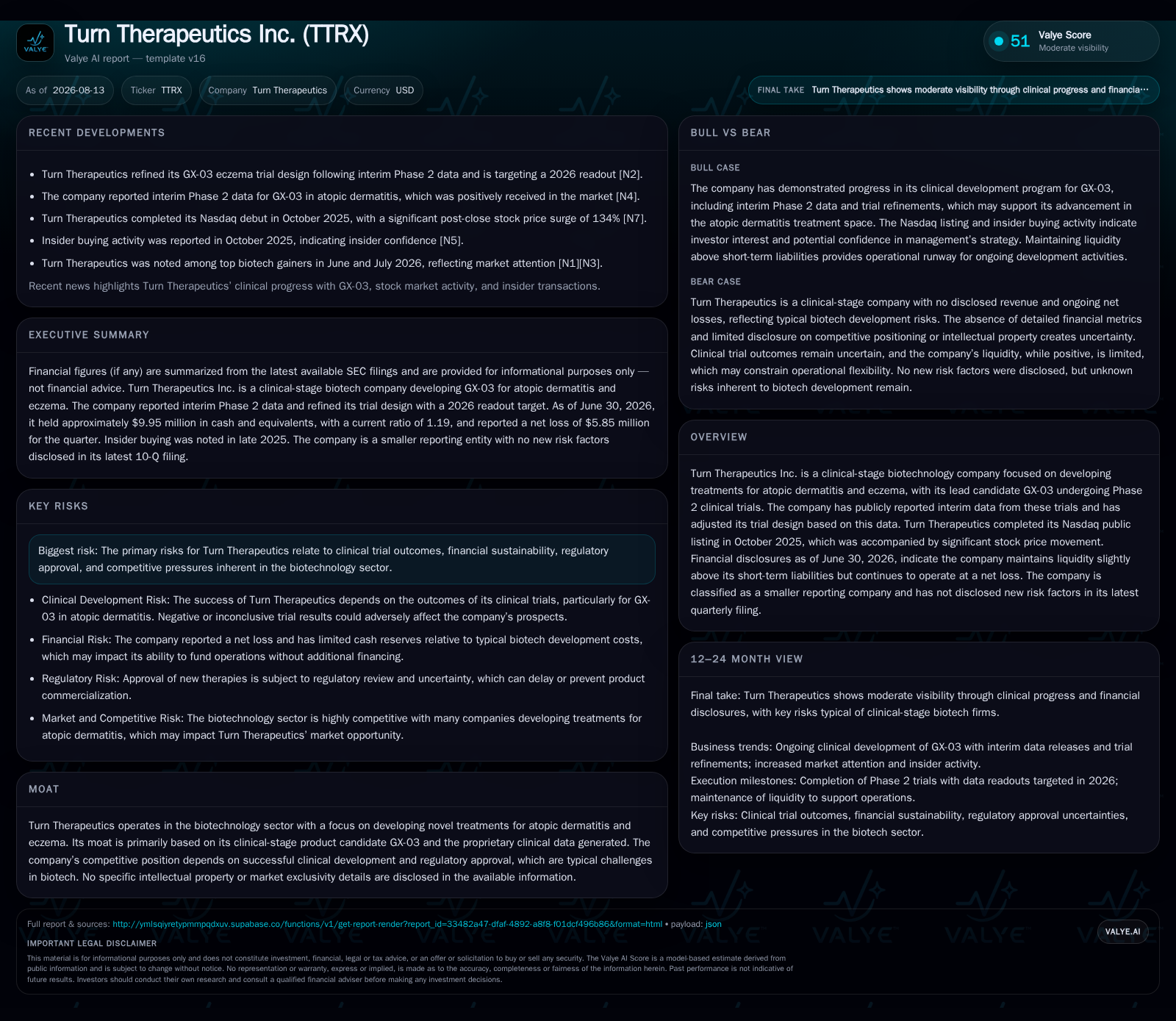
Turn Therapeutics Inc. is progressing its lead candidate GX-03 through Phase 2 trials for atopic dermatitis and eczema, adapting trial design based on interim results to enhance endpoint clarity and enrollment. The recent quarter reflects typical operating losses for a clinical-stage biotech but shows stable liquidity with cash exceeding debt, supporting near-term development activities. The company’s value proposition hinges on successful trial outcomes and regulatory milestones, while financial sustainability depends on managing burn rates within its cash runway. Upcoming data releases in late 2026 will be critical for clinical validation and investor confidence.
Recent Operating Update
Turn Therapeutics’ August 12, 2026 quarterly report highlights continued focus on GX-03’s Phase 2 clinical development targeting atopic dermatitis and eczema [S2]. Interim data released earlier this year led to strategic refinements in trial design intended to sharpen endpoint definitions and improve patient enrollment dynamics [N2]. This adaptive approach suggests management responsiveness to emerging clinical signals, which can enhance the probability of achieving regulatory approval. No new risk factors were reported this quarter [S2], maintaining the company’s previously disclosed risk profile.
Alongside the filing, the company issued a press release reiterating its commitment to advancing GX-03 toward planned late-2026 data readouts despite ongoing net losses typical of early-stage biotechs [S3]
Business Model Analysis
Operating as a clinical-stage biotechnology firm specializing in dermatological therapeutics, Turn Therapeutics follows the established pathway of drug discovery through phased clinical trials. GX-03’s advancement through Phase 2 is critical for establishing safety and preliminary efficacy against dermatology-specific endpoints relative to current standards of care.
Revenue generation remains pre-commercial; the company’s financials reflect net losses driven primarily by R&D expenses necessary for clinical progression [F1]. Without product sales or licensing revenues yet realized, future monetization depends on successful trial outcomes enabling regulatory submissions (e.g., NDA filings) and potential partnerships or milestone payments.
The ultimate payors—insurance companies and healthcare providers—will assess GX-03 based on efficacy durability, safety profiles, and comparative advantage over existing treatments once approved. Early clinical signals thus play a pivotal role in shaping market acceptance prospects.
Industry Structure and Competitive Position
The atopic dermatitis therapeutic landscape includes multiple candidates ranging from small molecules to biologics under development by both specialty biotechs and larger pharmaceutical firms. While specific peer comparisons are limited by available data, companies like DermTech (diagnostics) and Incyte (dermatology therapeutics) illustrate the competitive environment.
Turn’s differentiation relies on proprietary drug candidates backed by robust clinical data. However, absence of publicly detailed intellectual property exclusivity or confirmed partnerships highlights typical sector challenges: navigating stringent regulatory requirements, managing trial execution risks, capital intensity, and competing with established therapies.
The recent trial redesign following interim results demonstrates operational agility but also reflects the developmental uncertainty inherent to smaller biotech firms [S2]. Successfully overcoming these hurdles is essential to securing a sustainable market position.
Growth Drivers
Key growth catalysts include:
- Clinical Trial Milestones: Positive Phase 2 results expected late 2026 will validate efficacy/safety profiles and inform subsequent development steps.
- Regulatory Progress: Advancing towards IND submissions or eventual NDA filings will reduce pipeline risk.
- Strategic Collaborations: Licensing or co-development agreements could provide capital infusions via milestone payments and expand commercialization capabilities.
- Pipeline Diversification: Exploring additional dermatological or immune-mediated indications may broaden future revenue opportunities.
- R&D Investment Discipline: Balancing innovation with controlled burn rates supports sustained development without jeopardizing financial stability.
Risks and Watchpoints
Turn faces standard biotechnology sector risks:
- Clinical Development Uncertainty: Negative outcomes or safety issues could delay or derail programs.
- Financial Constraints: Operating losses continue amid limited cash reserves; reliance on financing or partnerships to extend runway is critical [F1].
- Regulatory Delays: Approval processes remain unpredictable, potentially pushing back commercialization timelines.
- Competitive Landscape: Multiple emerging therapies challenge differentiation efforts.
- Manufacturing Scale-Up Risks: Transitioning from clinical supply to commercial manufacturing requires readiness not yet disclosed.
What To Watch Next
Investors should monitor:
- Full Phase 2 data release timing and content slated for late 2026 [N2].
- Announcements regarding strategic partnerships or licensing deals enhancing financial resources.
- Quarterly updates on cash burn rates relative to liquidity positions.
- Regulatory filing milestones signaling progress toward late-stage development.
- Patient enrollment metrics indicating trial execution effectiveness post-design refinements.
Financial Profile Discussion
As of June 30, 2026, Turn Therapeutics held $9.95 million in cash and equivalents against $7.26 million in total debt, resulting in a current ratio around 1.19—indicating modest but adequate liquidity coverage for near-term liabilities [F1]. Net debt is effectively negative when offsetting cash against debt balances.[F1]
The company’s operating income remains negative due to substantial R&D outlays typical of clinical-stage biotechs; end-2025 figures show an operating loss near $5.86 million with net loss around $3.19 million [F1]. These reflect an ongoing investment phase without commercial revenue streams.
No new risk factors emerged this quarter [S19], suggesting stable internal controls but not mitigating the inherent uncertainties in early-stage drug development.
This analysis synthesizes information from recent SEC filings and public disclosures as of August 13, 2026. It aims to provide an informed perspective grounded solely in cited evidence related to Turn Therapeutics' ongoing clinical development within the biotechnology sector.
Disclaimer: This is research-only, informational analysis and not investment advice. It may include AI-generated interpretation and general industry context. Always verify important details using primary sources.

Comments