
BitGo Holdings Strengthens Institutional Digital Asset Platform Amid Market Volatility
BitGo's latest quarterly report highlights resilience in custody services and infrastructure expansion despite cyclical digital asset pricing pressures.
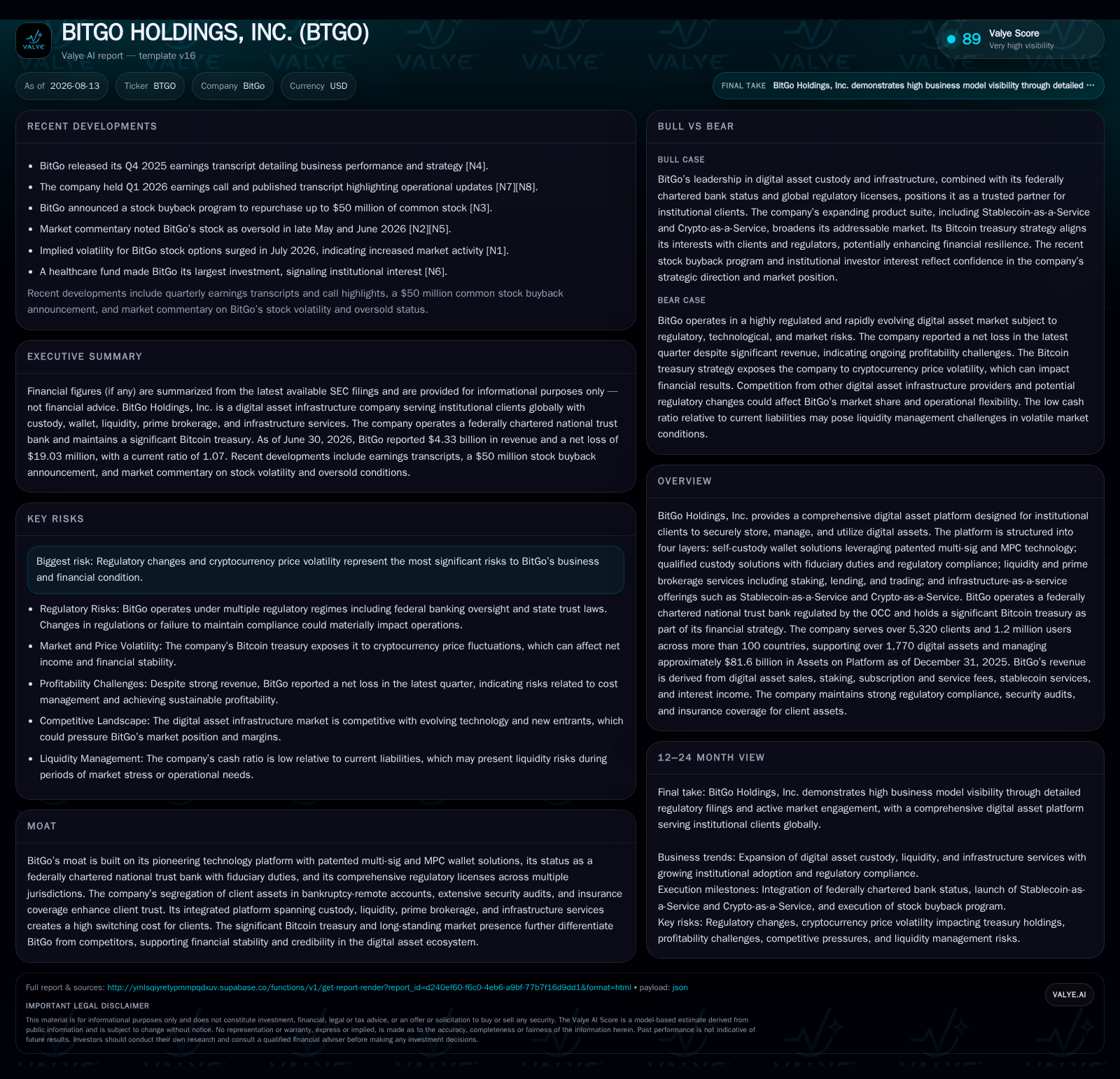
BitGo Holdings, Inc. reported a complex operating environment in its latest quarter with revenue fueled by institutional adoption but challenged by digital asset price volatility. The company leverages a multi-layered platform offering custody, liquidity, prime brokerage, and infrastructure-as-a-service, underpinned by its federally chartered trust bank status and patented security technologies. While regulatory uncertainty and market fluctuations remain key risks, BitGo's strong client base and diversified product portfolio support ongoing growth opportunities. Upcoming milestones include the successful transition of CFO duties and continued development of innovative service layers.
Recent Operating Update
BitGo Holdings' second quarter ended June 30, 2026, underscored robust operational performance with revenues of approximately $4.33 billion despite an operating loss of $17.4 million and net loss near $19.0 million [F1][S2]. This top-line strength is primarily supported by recurring custody fees supplemented by transaction-based revenues from staking, lending, and trading activities. The results indicate BitGo’s capacity to monetize its Assets on Platform (AoP) through a diversified institutional product suite during persistent market headwinds.
During this quarter’s reporting period, BitGo disclosed that CFO Edward Reginelli plans to resign effective September 15, 2026, with an advisory role maintained during the transition while a successor search proceeds [S3][S9]. Such leadership changes introduce short-term execution risk but management has outlined steps to ensure continuity.
Business Model & Revenue Dynamics
BitGo operates a multi-layered platform combining four core interrelated segments:
Self-Custody Wallets: Utilizing patented multi-signature (multi-sig) and multi-party computation (MPC) technologies that enhance security beyond traditional key management methods. This appeals mainly to crypto-native firms requiring secure self-custody solutions without compromising usability.
Qualified Custody: Through BitGo Bank & Trust—a federally chartered national trust bank regulated by the OCC—BitGo offers insured custody services where client assets are held in bankruptcy-remote trust accounts separated from company funds. This fiduciary framework meets stringent institutional compliance demands.
Liquidity & Prime Brokerage: BitGo Prime provides access to staking programs, lending services, and trading capabilities that diversify revenue beyond custody fees but introduce exposure to credit risk and market price fluctuations.
Infrastructure-as-a-Service: Offering Stablecoin-as-a-Service and Crypto-as-a-Service APIs enabling clients to issue stablecoins or embed crypto functionalities securely via regulated backend systems [S1][S22].
Revenue is generated through recurring custody fees based on asset values alongside variable fees tied to transactional activities such as staking rewards sharing or lending interest spreads. As usage expands in DeFi integrations or stablecoin issuance modules, margin expansion potential increases given SaaS-like economics.
Industry Positioning & Competitive Landscape
BitGo operates at the nexus of regulated fiduciary responsibilities typical of traditional banking institutions and advanced cryptographic security innovations native to blockchain ecosystems. Competitors include Coinbase Custody, Gemini Trust Company, Anchorage Digital, Fireblocks, Galaxy Digital—each varying in scale of regulatory authority or product breadth.
BitGo’s competitive moat is anchored by:
- Its national trust bank charter providing uniform federal oversight—conferring credibility for risk-averse financial institutions;
- Patented multi-sig/MPC wallet technologies reducing attack surfaces relative to legacy models;
- Support for over 1,770 digital assets enabling customized client portfolios across diverse token classes;
- Bankruptcy-remote account structures isolating client holdings from corporate insolvency risk;
- Expansion into programmable finance through integrated infrastructure offerings beyond pure custody.
These elements cultivate high switching costs as clients prioritize rigorous security combined with trusted regulatory compliance—critical amid tightening global regulations affecting cross-border custody.
Growth Drivers
Institutional adoption continues growing as more financial firms allocate portfolio portions into digital assets once adequate safeguards are assured. Regulatory clarity achieved via BitGo’s federal bank charter enables engagement from U.S.-regulated entities hesitant toward less compliant custodians.
Product diversification through staking services, prime brokerage offerings allowing yield generation and complex trading strategies within a unified ecosystem further supports revenue growth. Infrastructure services like Stablecoin-as-a-Service align well with decentralized finance trends fostering automated liquidity provision and programmable money issuance.
Global client diversity—with over 5,320 institutions and more than 1.2 million users across over 100 countries—provides geographic expansion avenues leveraging BitGo’s licensing footprint [S1]. API-driven integrations create network effects embedding crypto capabilities into conventional banking or technology platforms accelerating adoption beyond standalone users
Risks & Watchpoints
Digital asset price volatility remains a double-edged factor: it boosts revenue during bull markets via higher AoP but compresses fees during downturns as recently observed with a nearly 9% AoP decline dampening revenue growth despite increased client counts [S1]. Client activity sensitivity also affects transaction fee income when bearish sentiment reduces trading volumes.
Regulatory uncertainty persists as evolving frameworks may impose additional licensing burdens or restrict product features limiting growth (e.g., bans on tokens deemed securities). Compliance failures risk fines or reputational harm critical in trust-dependent businesses [S4][S8].
Security threats remain omnipresent given custodianship involves safeguarding private keys against sophisticated cyberattacks; breaches could severely damage client trust even if insurance coverage exists [S27]. Integration risks stem from DeFi protocols’ vulnerabilities such as smart contract exploits potentially causing client losses or litigation exposure [S4].
The CFO succession process warrants attention given its importance for financial stewardship amid earnings volatility and recent $50 million share repurchase authorization signaling balanced capital deployment between growth investment and shareholder returns [S3][S9][S28]
What to Watch Next
Key near-term milestones include appointment of a permanent CFO vital for leadership stability during strategic execution amid uncertain market conditions [S3]. Monitoring quarterly filings will reveal whether infrastructure-as-a-service contributions begin materially augmenting core custody revenues.
Tracking international client acquisition trends and announcements around staking/lending partnerships will indicate expansion momentum into new verticals broadening total addressable market exposure.
Regulatory developments impacting token eligibility or cross-border custody frameworks remain critical given their influence on supported assets scope and revenue trajectory [N1][N2]
Financial Profile Discussion
As of June 30, 2026, BitGo held approximately $159 million in cash and equivalents against total debt near $133 million resulting in a modest net cash position supportive of liquidity needs [F1]. The current ratio stands at about 1.07 reflecting adequate coverage between current assets ($6 billion) versus liabilities ($5.62 billion), consistent with operational working capital largely driven by custodial holdings rather than traditional inventory or receivables.
Disclaimer: This is research-only, informational analysis and not investment advice. It may include AI-generated interpretation and general industry context. Always verify important details using primary sources.

Comments