
Blue Water Acquisition Corp. III Advances with Sponsor-Backed Working Capital Amid SPAC Lifecycle Pressures
Recent financing moves and management overhaul position Blue Water Acquisition III for approaching its business combination deadline.
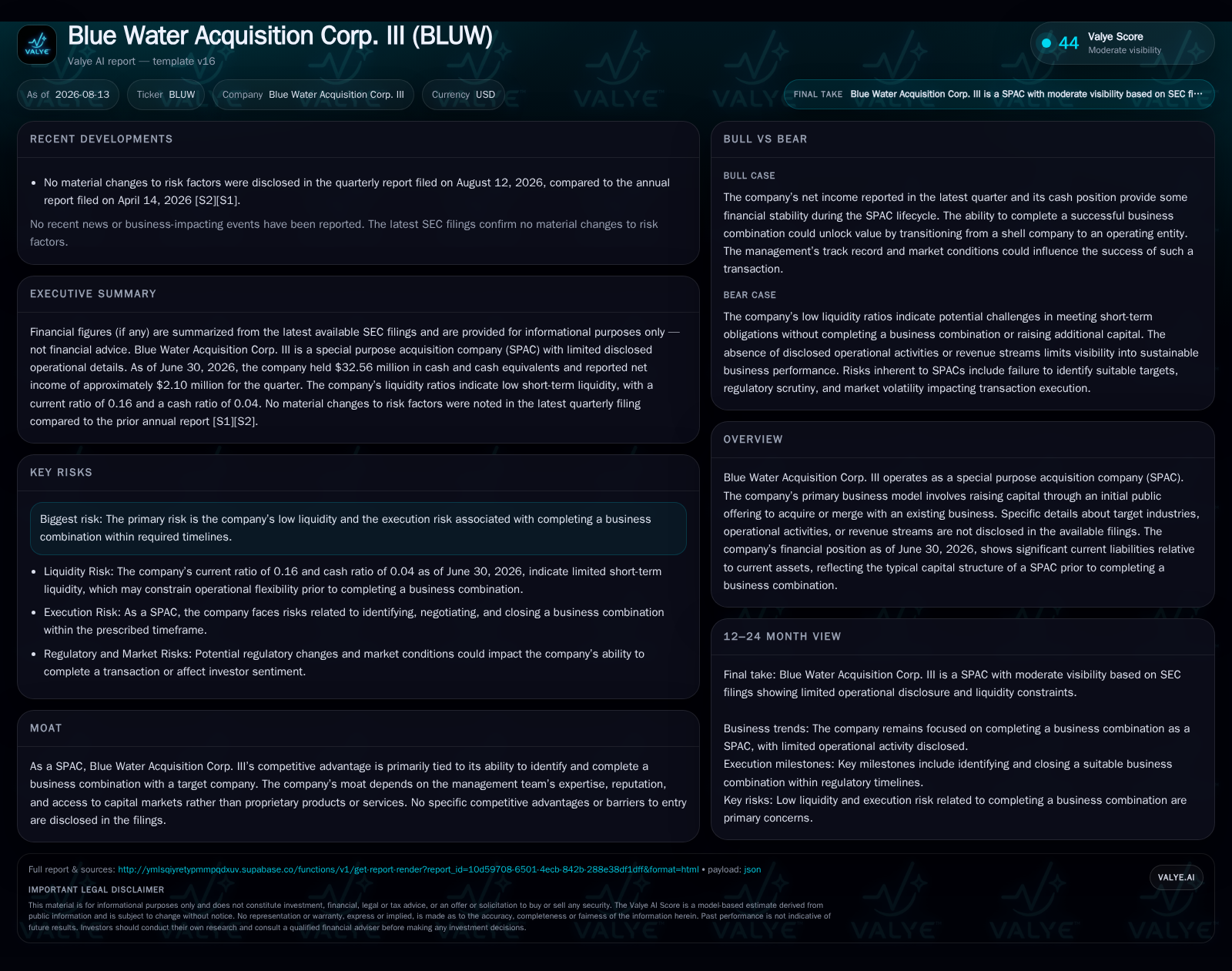
Blue Water Acquisition Corp. III, a special purpose acquisition company (SPAC), reported incremental working capital infusions from its sponsor as it approaches the critical phase of completing a business combination. The company’s capital structure and liquidity metrics reflect typical SPAC tensions, with limited operating history and large liabilities relative to liquid assets. Management changes in late 2025 signal renewed focus on deal execution though risks persist around merger completion and shareholder redemptions. Key industry dynamics such as sponsor reputation, timing of business combination, and cash held in trust remain pivotal monitoring points.
Recent Operating Update: Sponsor Advances Working Capital during SPAC Timing Constraints
Blue Water Acquisition Corp. III continues to secure working capital support from its sponsor entity. Specifically, Yorkville BW Acquisition Sponsor, LLC extended an initial convertible unsecured promissory note for $500,000 on January 26, 2026 followed by an additional $250,000 infusion on August 11, 2026 [S3], signaling ongoing capital demands inherent in sustaining SPAC operations pre-deal close. These notes are convertible into units consisting of ordinary shares plus warrants exercisable at $11.50 post-merger under terms aligned with typical sponsor incentives designed to enhance equity participation upon de-SPAC transaction completion [S3].
The August quarter reports scarce cash resources with cash and equivalents totaling only $32,560 against current liabilities nearing $748,633 as of June 30, 2026 [F1]. Such liquidity constraints underscore the importance of sponsor financing commitments in bridging fund gaps through the final merger stages.
Notably, governance transitions effective November 25, 2025 saw the Prior Sponsor divest control to Yorkville BW Acquisition Sponsor which then appointed a new board and management team charged with advancing merger execution initiatives [S21], [S26]. This reshuffle emphasizes the criticality of management expertise and alignment with shareholder interests to navigate regulatory requirements (including shareholder approval) and competitive pressures inherent in identifying suitable target companies before deadline expirations.
Business Model: SPAC Dynamics Centered on Capital Raising and Merger Execution
As a special purpose acquisition company (SPAC), Blue Water Acquisition Corp. III exemplifies an archetypal blank-check vehicle designed primarily to raise capital through an initial public offering (IPO) aimed exclusively at effecting a business combination with an unidentified private target company [S1]. Pre-combination revenues are generally non-existent; instead revenue potential derives post-merger from equity appreciation as the private enterprise accesses public markets via the de-SPAC route.
Monetization accrues mainly from transaction fees charged during merger negotiation phases and substantial equity stakes retained by the SPAC sponsors often vested via Class B shares or warrants that provide leverage against successful completion of the business combination transaction. The sponsor’s convertible working capital notes convertible into New Units reinforce this incentive alignment by giving sponsors opportunity to deepen ownership economically tied to merger success while providing essential cash injections during periods devoid of operating income generation.
The absence of disclosed sector focus or operational revenue means Blue Water Acquisition lacks differentiated products or services; instead its strategic strength resides in its ability to leverage sponsor relationships in capital markets alongside management team credentials recognized for deal sourcing competence—critical success factors that separate high-performing SPACs from those facing prolonged existential uncertainty.
Industry Structure and Competitive Position: Typical Blank-Check Vehicle Profile
Operating within the broader SPAC industry ecosystem where vehicles compete primarily on management track record and access to institutional investor networks rather than based on product innovation or end-customer loyalty, Blue Water Acquisition occupies space alongside peers such as Pershing Square Tontine Holdings (PSTH), Churchill Capital Corp series, and Social Capital Hedosophia Holdings which distinguish themselves via scale or sector specialization. This company does not currently disclose any specific sector preference or announced acquisition targets limiting its positioning specifically within thematic niches.
Relative to peer benchmarks:
- The continuous injection of sponsor convertible notes mirrors industry norms where backing sponsors provide interim funding pre-merger akin to mechanisms employed by other vehicles seeking to ensure sufficient runway.
- Governance refresh aligns with best practices observed among successful SPACs emphasizing robust boards equipped with financial expertise directed towards complicated acquisition negotiations.
- Liquidity metrics reflective of typical pre-combination balance sheets point toward comparable structural risks prevalent across many generalist SPACs navigating volatile markets impacted by varying redemption rates and regulatory oversight.
Growth Drivers: Market Appetite for Alternative Public Listings Supports De-SPAC Activity
SPACs like Blue Water Acquisition benefit structurally from increasing demand among private companies seeking faster routes to public listing without traditional IPO uncertainties such as lengthy due diligence processes or pricing volatility. Favorable capital market conditions—when present—enhance investor appetite for units combining common shares with redeemable warrants offering leveraged upside potential.
Expanding innovation in deal structuring that incorporates tailored sponsor incentives alongside growing acceptance by institutional investors has stimulated activity levels within this alternative public offering space despite heightened regulatory scrutiny surrounding disclosure standards.
No material changes disclosed recently regarding risk factors reaffirm persistent vigilance warranted regarding these inherent structural hazards typical across the sector [S8], [S14].
What to Watch Next: Milestones Defining Business Combination Progression
Key upcoming indicators include:
- Announcement of definitive agreements identifying merger candidates,
- Scheduling and outcome of shareholder approval meetings,
- Redemption rates exercised by public shareholders ahead of transaction closings providing insight into market sentiment,
- Utilization levels of working capital lines advancing related activities including due diligence costs,
- Post-announcement market capitalization trends signaling investor confidence shifts,
- Potential changes in sponsor ownership stakes if convertible note conversions occur triggering warrant issuance.
Close attention should be paid on whether transaction timing aligns with SEC mandated windows typically spanning two years post-IPO initiation; failure may compel liquidation altering valuation dynamics materially.
Financial Profile Discussion
Disclaimer: This is research-only, informational analysis and not investment advice. It may include AI-generated interpretation and general industry context. Always verify important details using primary sources.

Comments