
21Shares Solana ETF’s Passive Model Confronts Regulatory and Market Challenges
TSOL’s latest quarterly update highlights fee waivers and ongoing regulatory risks amid efforts to track Solana with staking rewards integration.
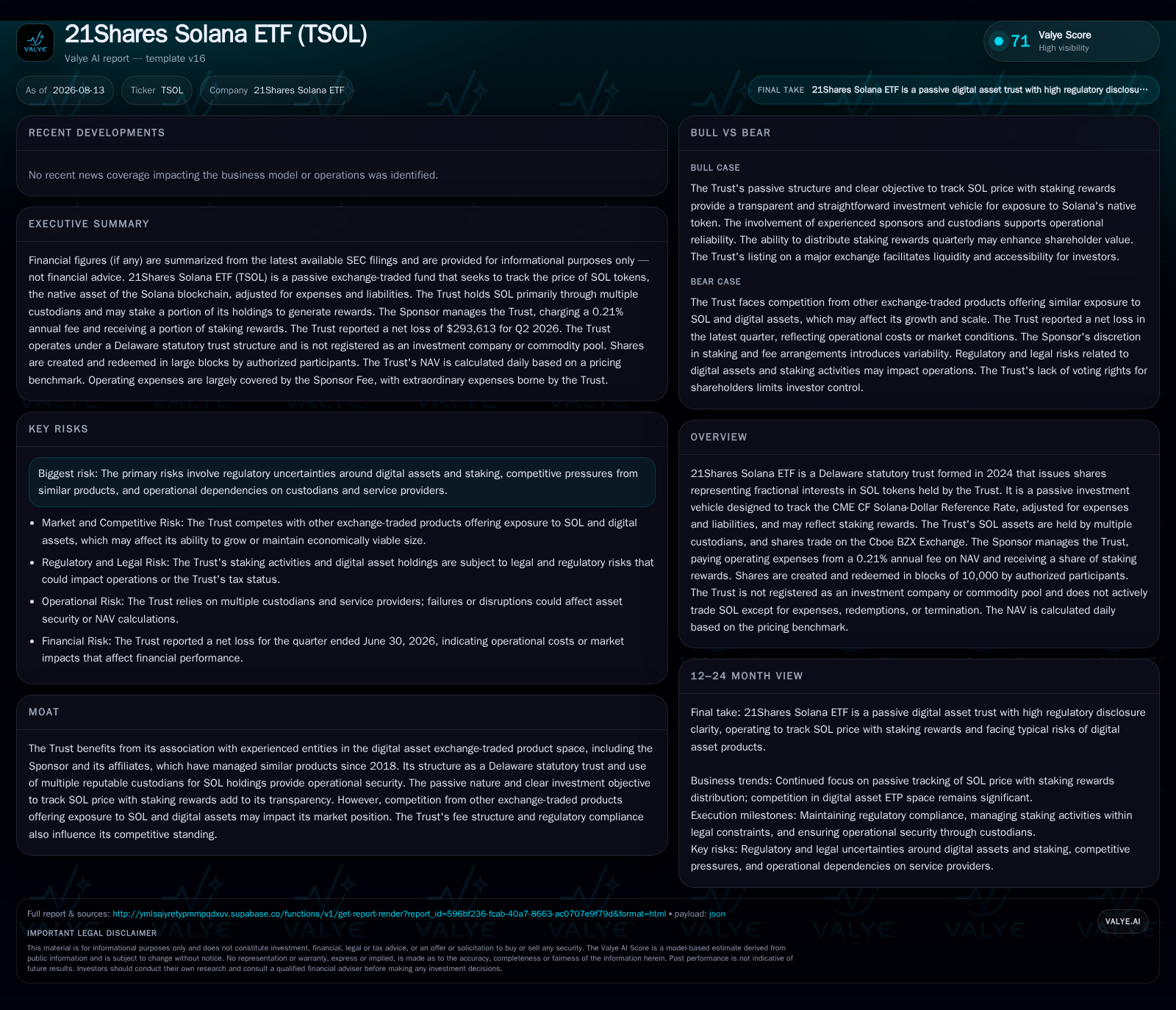
21Shares Solana ETF (TSOL) remains a passive vehicle designed to track the CME CF Solana-Dollar Reference Rate with an overlay of staking rewards, relying on multiple custodians and authorized participants for operations. The latest filings reveal a voluntary one-year fee waiver by the Sponsor, underscoring competitive pressures. Regulatory uncertainty around digital assets, especially regarding SEC classification of SOL tokens, continues to pose material risks that may influence the Trust’s future ability to operate. Operationally, staking rewards add potential yield but require balancing legal risk. The ETF competes within a growing digital asset ETP market, where liquidity, custody security, and tracking accuracy remain key investor considerations.
Recent Operating Update and Fee Waiver
The latest quarterly filing dated August 12, 2026 [S2] confirms no material changes in the Trust’s operational model but also incorporates a significant event from July 27, 2026 [S3]. On this date, the Sponsor—21Shares US LLC—voluntarily waived its management fee for one year starting immediately. This unilateral fee waiver underlines competitive pressure within the digital asset ETF industry where fee compression is common as providers seek to attract flows in an asset class marked by volatility and rapid innovation. The waiver also hints at cost sensitivity among TSOL investors who weigh management fees against net returns especially given alternative vehicles offering exposure to SOL or other digital assets.
This move will temporarily reduce fee-related revenue streams for the Sponsor but may aid in maintaining or growing assets under management (AUM), a critical operational KPI affecting economies of scale in this fee-driven business model.
Business Model: Passive Exposure to SOL With Staking Rewards Integration
TSOL is structured as a Delaware statutory trust formed in 2024 that issues shares representing fractional undivided beneficial interests in SOL tokens held by professional custodians [S1]. Its core investment objective is straightforward: track the CME CF Solana-Dollar Reference Rate (New York Variant), a recognized pricing benchmark for SOL, after deducting expenses and liabilities while incorporating staking rewards from SOL delegated by the Trust [S1], [S12].
Revenue generation for the Sponsor stems primarily from an annual management fee set at approximately 0.21% of NAV [S1], although current operations feature a voluntary fee waiver [S3]. Beyond fees, the Trust monetizes staking rewards derived from delegating a portion of its SOL holdings through agreements with custodian staking service providers like Coinbase Crypto [S17], [S26]. These providers receive a low single-digit percentage cut of staking rewards as compensation ("Staking Provider Consideration"). The remaining rewards net of provider fees are split such that 10% go to the Sponsor as additional compensation while the rest accrue directly to Shareholders via distributions [S17].
This dual income mechanism—management fees plus staking reward participation—provides incremental yield compared to pure spot exposure ETFs but introduces legal complexities related to tax treatment and regulatory classification given evolving U.S. stances on digital asset income streams.
Creation and redemption mechanics emphasize liquidity and share price alignment through in-kind basket transactions comprised of fixed blocks of 10,000 shares, handled by Authorized Participants who are vetted broker-dealers [S12], [S17]. These participants can transact either by delivering SOL tokens or cash equivalents that are then converted into SOL by designated counterparties secured under agreements officiated by the Sponsor. Such processes minimize tracking error by ensuring NAV closely reflects underlying SOL market prices.
Industry Structure and Competitive Position
TSOL sits within a fast-growing segment of Digital Asset ETFs focused on providing liquid access to native blockchain tokens without direct custody complexity for investors. Its principal competitors include other dedicated digital token ETFs such as those tracking Bitcoin or Ethereum issued by entities like Grayscale or Purpose Investments. Within this peer set, critical differentiators include fee structure competitiveness, staking reward integration, custody security protocols, market maker involvement for secondary liquidity, and regulatory compliance postures.
21Shares benefits from affiliation with experienced digital asset product managers active since 2018 and managed under FalconX Holdings Limited’s umbrella [S4]. Custody arrangements leverage industry leaders Coinbase Custody Trust Company LLC, BitGo Bank & Trust Company N.A., and Anchorage Digital Bank N.A., enhancing operational security over token holdings [S12]. Their use of multiple reputable custodians reduces counterparty risk relative to single-custodian structures common earlier in crypto ETP history.
The listing on Cboe BZX Exchange fosters regulated market trading with transparent pricing mechanisms [S1], supporting liquidity though trading volumes can fluctuate materially with sentiment shifts or regulatory news impacting SOL.
Growth Drivers
Key drivers supporting TSOL’s growth include rising institutional acceptance of regulated crypto exposure channels; broadening adoption of Solana’s blockchain ecosystem enhancing token demand; evolving staking paradigms offering incremental returns beyond spot price appreciation; refinement of custody technologies improving safety; progressing regulatory clarity enabling wider participation; expansion in secondary market trading volumes fostering liquidity; new product introductions raising investor education; and growing general awareness legitimizing digital asset ETFs as part of diversified portfolios.
Each driver translates into observable KPIs: increased AUM reflects inflows fueled by investor demand; growth in creation/redemption activity signals active liquidity provision; reduced tracking error indicates improved replication fidelity; consistent staking reward distributions validate yield integration efficiency; and stable custodian performance underscoring operational robustness.
Risks and Growth Constraints
Despite structural strengths, TSOL faces several pronounced headwinds:
These risks collectively exert pressure on growth trajectories and necessitate ongoing monitoring against metrics such as custodian security incident rates, redemption concentration ratios, regulatory developments pertinent to securities classification, fluctuations in staking reward levels due to network events or provider performance lapses, and NAV tracking accuracy over rolling periods.
What To Watch Next
Investor interest should focus on several key milestones:
- Updates from regulatory bodies clarifying SOL’s legal status which may influence operational continuity.
- Quarterly disclosure of staking reward amounts distributed versus accrued indicating effective yield capture.
- Changes in AUM signaling shifts in capital flow dynamics amidst competitive pressures.
- Announcements relating to custodian or prime broker arrangements ensuring continuing security standards.
- Growth or contraction in creation/redemption volumes reflecting market-maker engagement levels.
- Price behavior around major Solana protocol upgrades potentially stressing token valuation models.
- Resumption or extension decisions regarding Sponsor fee waivers which impact cost competitiveness.
Consistent transparency around these points will provide valuable intermediate indicators about TSOL’s ability to sustain scalable passive exposure while navigating an evolving regulatory landscape.
Disclaimer: This is research-only, informational analysis and not investment advice. It may include AI-generated interpretation and general industry context. Always verify important details using primary sources.

Comments