
Reviva Pharmaceuticals Faces Clinical and Market Challenges Amid Late-Stage Development
Clinical progress on brilaroxazine anchors Reviva’s pipeline, but delisting and financial constraints heighten execution risks.
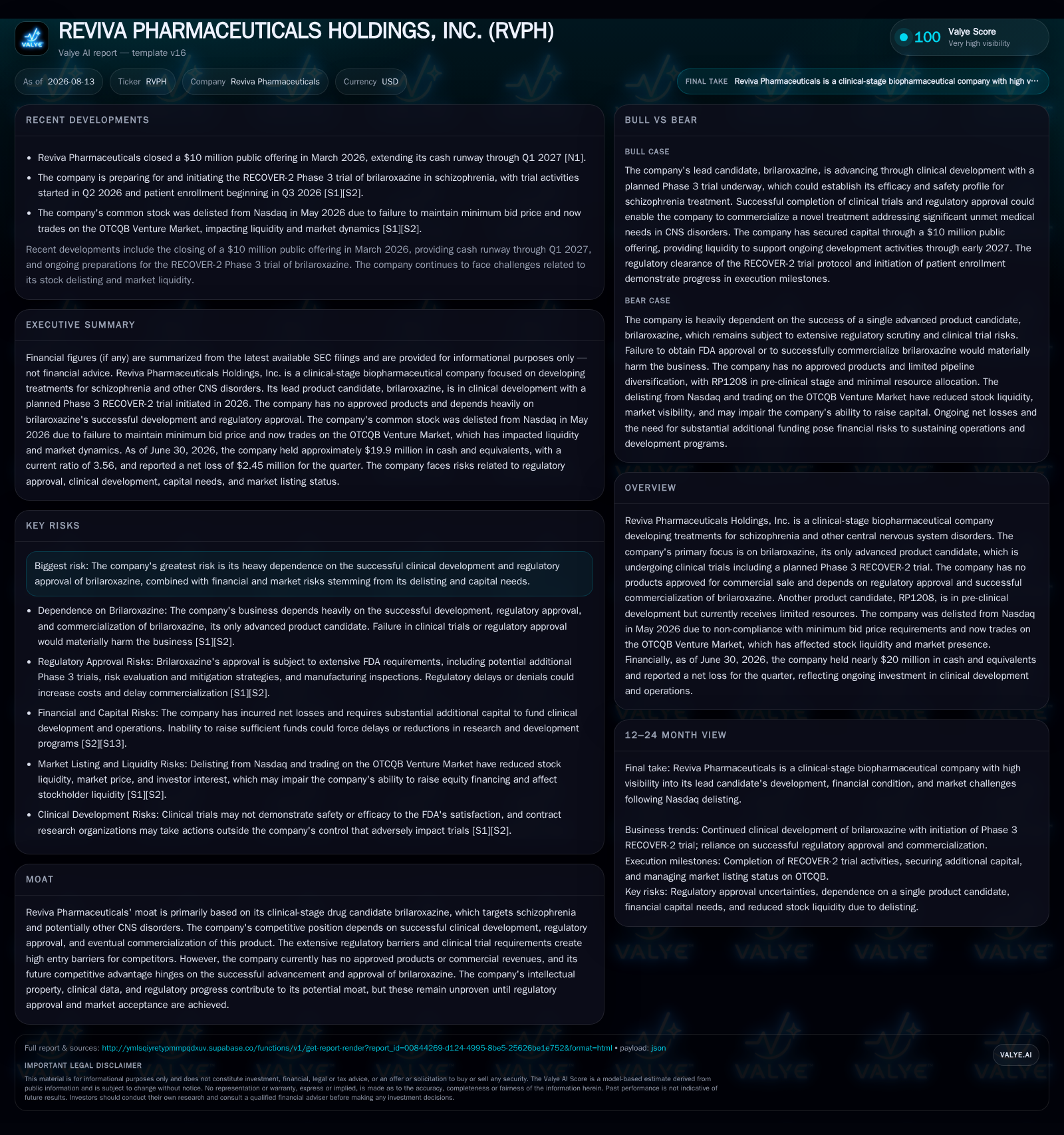
Reviva Pharmaceuticals Holdings, Inc. remains a clinical-stage biopharmaceutical firm primarily advancing brilaroxazine as a treatment for schizophrenia and other central nervous system disorders. The company’s recent quarterly filing confirms ongoing investment in late-stage clinical studies, including a planned Phase 3 trial, but spotlights its dependence on regulatory approval for future viability. Delisting from Nasdaq to OTCQB has constrained liquidity and investor access, complicating capital raising amid persistent net losses and modest cash reserves. With RP1208 in preclinical stages receiving limited focus, Reviva’s near-term prospects hinge heavily on the successful progress of brilaroxazine trials and eventual regulatory clearance.
Recent Operating Update
Reviva Pharmaceuticals Holdings’ latest quarterly report dated August 12, 2026 ([S2]) reveals continued investment in its lead drug candidate brilaroxazine (RP5063), which remains the sole advanced asset actively progressing through clinical development. The company is preparing for its planned Phase 3 RECOVER-2 trial targeting schizophrenia, a critical milestone necessary to support regulatory filing. Notably, no new drug application (NDA) has been submitted yet due to ongoing trial requirements including completing a bioequivalence study on a new formulation. This underscores that while product development is advancing toward late-stage benchmarks typical for biopharma firms nearing market entry, regulatory approval remains uncertain and distant.
The same filing confirms that Reviva has no other product candidates generating revenue or even nearing clinical testing milestones beyond RP1208 in preclinical development. Management explicitly states that RP1208 currently receives minimal resources ([S2]), reinforcing the company’s near-term reliance entirely on brilaroxazine's trajectory. Consequently, operational focus is concentrated on demonstrating safety and efficacy through pivotal trials consistent with industry norms for therapeutics intended for central nervous system (CNS) disorders.
In parallel with development news, Reviva reported that it was delisted from Nasdaq in May 2026 because its common stock did not meet minimum bid price requirements ([S3]). Its shares now trade on the OTCQB Venture Market under symbol RVPH since May 14, 2026. This transition typifies challenges faced by smaller biotech firms experiencing stock-price compression during extended clinical programs without commercial revenues: diminished liquidity and reduced institutional investor access are common consequences likely to complicate fundraising efforts going forward.
Business Model Details
Reviva operates as a clinical-stage biopharmaceutical company characterized by a high-risk/high-reward development model. It invests heavily upfront in research and development (R&D) activities aimed at advancing novel drug candidates through preclinical validation into human trials compliant with Food and Drug Administration (FDA) standards ([S1]). Revenue generation depends exclusively on eventually securing regulatory approvals — specifically NDA acceptance — after demonstrating safety and efficacy via Phase 3 studies. Until these regulatory milestones occur, Reviva cannot commercialize products nor generate sustainable income.
Monetization mechanics are inherently conditional: if brilaroxazine obtains FDA approval, the company would either commercialize directly or seek strategic partnerships/licensing deals leveraging its intellectual property portfolio protecting both brilaroxazine and preclinical candidate RP1208 across major jurisdictions including the U.S. and Europe ([S1]). However, given current financial limitations exacerbated by trading venue downgrade ([S3]), partnering could realistically become an essential avenue to augment commercialization capabilities while mitigating capital needs.
Customers ultimately comprise prescribing healthcare providers specializing in psychiatry and neurology treating disorders such as schizophrenia, bipolar disorder, major depressive disorder, ADHD, behavioral symptoms linked to dementia/Alzheimer’s disease, as well as potential respiratory indications under orphan drug designations. Payers — whether government healthcare programs or private insurers — will evaluate cost-effectiveness rigorously during reimbursement negotiations once/if drugs gain approval.
Industry Structure and Competitive Position
Reviva sits squarely within the biotechnology segment focused on CNS disorders treatment development—a highly specialized sub-industry marked by elevated barriers including complex biology understanding, demanding clinical trial designs sensitive to neuropsychiatric end points, lengthy regulatory review processes, and substantial R&D expenditure commitment. Competitor reference points include late-stage clinical biotech companies such as Acadia Pharmaceuticals or Sage Therapeutics which also pursue novel therapies for schizophrenia and related illnesses but typically possess larger pipelines or established commercial franchises.
Relative competitive strengths derive from Reviva’s internally discovered compounds supported by granted composition-of-matter patents ([S1]) offered protection against generic competition should commercialization be achieved. Yet this intellectual property advantage presently remains prospective rather than demonstrated due to absence of marketed products.
Further complicating competitive dynamics is Reviva’s recent loss of Nasdaq listing status ([S3]), which impacts investor perceptions tied closely to market capitalization thresholds commonly used by institutional funds screening criteria within this sector. This hinders share liquidity vital for financing rounds needed to sustain costly Phase 3 clinical trial progression dominating later-stage biotech economics.
Growth Drivers
The most critical growth driver is successful execution of pivotal Phase 3 trials culminating in positive data readouts sufficient to file an NDA with FDA authorities ([S2]). Such milestones unlock value inflection points recognized industry-wide where risk substantially declines while enabling potential market access discussions.
Additional demand signals include accelerated regulatory pathways afforded via existing orphan drug designations for brilaroxazine addressing pulmonary arterial hypertension (PAH) and idiopathic pulmonary fibrosis (IPF) — rarity-focused indications where exclusivity periods can improve commercial viability ([S1]). Expansion of therapeutic indications beyond schizophrenia potentially broadens target patient populations enhancing revenue opportunities if successfully developed.
Strategic partnerships or licensing arrangements analogous to peers might amplify commercialization capabilities while sharing trial costs bringing complementary expertise necessary to optimize launch outcomes.
Risks and Watchpoints
Reviva faces multiple high-impact risks typical of clinical-stage biopharma but accentuated by its workflow concentration around a single lead candidate:
- Regulatory risk: failure to demonstrate acceptable safety/efficacy profiles across planned trials could halt development irreversibly; FDA requirements may impose additional study demands beyond current plans delaying timeline further ([S2]).
- Financial risk: recurring operating losses mandate frequent capital raises; delisting-associated liquidity constraints compound difficulty attracting investors seeking exchange-listed securities ([S3]).
- Dependence risk: minimal pipeline diversification makes firm vulnerable if brilaroxazine does not advance successfully.
- Market perception risk: OTCQB trading venues tend not to attract professional investors adequately supporting valuation or secondary offering execution relative to primary exchanges like Nasdaq.
Additional watchpoints include progress updates on the RECOVER-2 trial enrollment metrics, interim safety/efficacy data releases expected prior to top-line results disclosure which serve as key indicators of developmental momentum.
What To Watch Next
Reviewing forthcoming deliverables:
- Completion status of the bioequivalence study required before NDA submission expected in near-to-mid term timelines critical to enable FDA filings ([S2]).
- Initiation/completion forecasts for RECOVER-2 Phase 3 pivotal schizophrenia trial serving as principal evidence base for efficacy assessment.
- Cash runway estimates tied directly to quarterly burn rates disclosed quarterly; ability to secure additional financing will be critical especially due to reduced market liquidity post-delisting ([F1]).
- Any announcements regarding partnering/licensing arrangements that could offset internal commercialization burden or provide non-dilutive capital infusions.
Monitoring these milestones provides tangible gauges of execution capability within stringent biopharma timelines dominated by sequential trial completions dictating value realization pace.
Financial Profile Discussion
As of June 30, 2026, Reviva reported cash & equivalents near $19.9 million against minimal total debt approximating $144 thousand, yielding a current ratio of approximately 3.56 which signals adequate near-term liquidity coverage ([F1]).
This operating deficit reflects substantial R&D spending required to sustain ongoing trials primarily focused on brilaroxazine advancement alongside administrative expenses necessary for corporate infrastructure maintenance ([S2]). Given typical Phase 3 study expense profiles spanning tens of millions until completion plus accompanying regulatory submission costs ahead of potential commercialization launch preparations often requiring marketing scale-up investments ([S1]), sustained access to external equity funding or strategic partnerships will be indispensable.
Delisting effects compound financing challenges as OTCQB listings generally yield lower share prices and trading volumes reducing funds raised per offering when compared against Nasdaq-listed peer groups. This scenario accentuates financial risks around dilution levels necessary for adequately capitalized operational continuity until FDA approval events can materially alter earnings trajectories leading toward profitability potential typical among emerging biotech entities with late-stage assets.
Disclaimer: This analysis provides an informed evaluation of Reviva Pharmaceuticals Holdings based strictly on publicly available filings without offering investment advice or definitive forecasts about future outcomes.
Disclaimer: This is research-only, informational analysis and not investment advice. It may include AI-generated interpretation and general industry context. Always verify important details using primary sources.

Comments