
Ashford Hospitality Trust Faces Heightened Liquidity Challenges Amid Heavy Debt Load
Ashford Hospitality Trust’s hotel-focused REIT model hinges on branded full-service assets but faces near-term refinancing risks and NYSE listing threats.
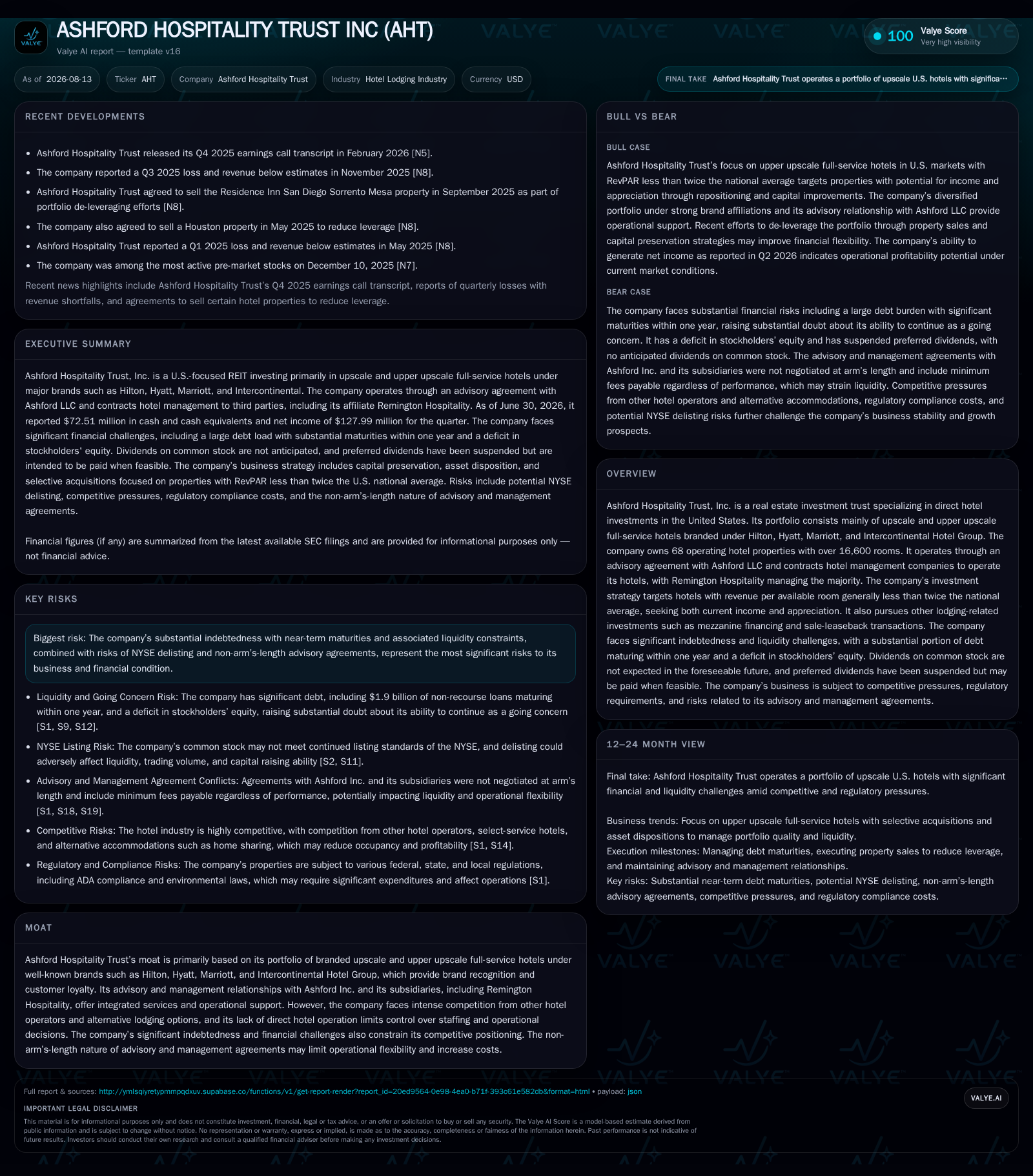
Ashford Hospitality Trust, Inc. operates as a hospitality-focused REIT owning 68 branded upscale and upper upscale full-service hotels managed by third parties. The company’s latest quarterly update highlights persistent liquidity constraints primarily driven by substantial near-term debt maturities totaling around $1.9 billion and closely linked risks of NYSE delisting due to low share price and market capitalization. Revenues depend on hotel performance metrics such as RevPAR impacted by macroeconomic conditions, while operational control is outsourced largely to Remington Hospitality and other managers under contracts. The advisory relationship with Ashford LLC presents operational continuity but also imposes non-arm’s-length risks and cost pressures. Growth remains challenged by capital structure constraints though strategic asset dispositions and refinancing efforts are ongoing.
Latest Operating Update Highlights Liquidity Pressure
As of June 30, 2026, Ashford Hospitality Trust held approximately $72.5 million in cash against roughly $2.0 billion of total debt outstanding — with net debt close to $1.91 billion [F1]. Critically, about $1.9 billion in non-recourse property-level loans are set to mature within the next 12 months [S4][S13], creating an acute refinancing risk given current market conditions.
The company warned of potential NYSE delisting due to failure to maintain minimum average global market capitalization and share price requirements [S2]. Delisting would reduce trading liquidity significantly, hamper capital-raising ability in public markets, and potentially impair preferred stock conversion economics [S2].
In response, Ashford is pursuing capital preservation through selective asset sales; it recently closed transactions including the sale of Hyatt Regency Long Island ($26.5 million) and Sheraton Mission Valley ($45 million) to enhance liquidity [S16][S23]. The realization of such dispositions will be a key determinant in easing near-term capital constraints.
Business Model Focuses on Hotel Real Estate Ownership With Outsourced Operations
Ashford Hospitality Trust operates as a real estate investment trust specializing in upscale and upper upscale full-service hotels primarily located across the United States [S1]. Its portfolio comprises 68 operating properties branded under renowned chains such as Hilton, Hyatt, Marriott International, and Intercontinental Hotel Group, encompassing over 16,600 rooms [S1].
Crucially, Ashford does not manage these hotels directly; instead, it contracts third-party management companies via hotel management contracts responsible for day-to-day operations. Remington Hospitality manages approximately 50 of these properties while the remainder are overseen by other operators [S1][S12]. This separation positions Ashford firmly in the capital ownership role within the hospitality value chain—deriving revenue through asset appreciation and lease-related cash flows rather than operational margins.
Revenue performance depends heavily on key hotel performance indicators including Revenue per Available Room (RevPAR), Average Daily Rate (ADR), and occupancy rates—each susceptible to cyclical economic conditions [S1]. Upscale properties traditionally attract business travelers and higher-end leisure guests who may reduce travel during downturns impacting RevPAR negatively [S1].
The company supplements its core real estate investments with lodging-related financial products such as mezzanine financing arrangements and sale-leaseback transactions intended to diversify returns within its niche focus [S1][S9].
Industry Structure: Competition and Capital Intensity Elevate Risk Profile
Hospitality REITs like Ashford function within an industry marked by high capital intensity—real estate ownership requires substantial leverage to optimize equity returns while simultaneously exposing firms to interest rate fluctuations and cyclical demand shocks.
Peers in this space commonly include Host Hotels & Resorts and Park Hotels & Resorts; these competitors typically possess larger scale portfolios with often more balanced debt profiles contributing to relatively better liquidity positioning. Likewise, companies like Sunstone Hotel Investors similarly specialize in branded full-service hotels yet differ productively in asset distribution or financing strategy.
The reliance on branded franchises such as Hilton or Marriott boosts occupancy rates via loyalty programs but creates exposure to franchise fees and constrains autonomy regarding marketing or operational decisions. Furthermore, outsourcing operations reduces control over cost efficiencies or guest experience improvements critical in competitive urban or resort markets.
Financial flexibility is hindered by rigid loan covenants tied to hotel operating results; performance shortfalls can trigger "cash trap" provisions where profits flow directly into lender-controlled accounts limiting distributions or reinvestment capacity inside the REIT structure [S13]
Growth Drivers Amid Current Challenges
Growth for Ashford hinges fundamentally on hotel industry recovery dynamics — increases in business travel rebound post-pandemic alongside leisure travel underpin upside in RevPAR—a principal driver for increasing asset cash flows.
Selective acquisitions aiming at upper upscale hotels with below-average RevPAR multiples signal strategic intent to capture value from markets where room revenues can converge toward national averages over time [S7]. Likewise, divesting non-core or underperforming assets frees capital for reinvestment into accretive opportunities.
Further ancillary growth avenues lie within lodging finance products such as mezzanine loans or sale-leasebacks providing yield diversification beyond physical hotel ownership.
Operationally, efficiency gains may arise through advisory service agreements optimizing asset-level management — although cost benefits here might be offset by related-party complexities stemming from Ashford LLC’s advisory role which entails potential conflicts or cost inflation risks [S1][S12].
Key Risks and Watchpoints
The company confronts material risks dominated by its heavy indebtedness profile coupled with looming loan maturities over the coming year which require refinancing under potentially unfavorable credit market conditions that could substantially increase interest expense or force distress asset sales at depressed prices [S4][S6][S10]
Failure to meet NYSE listing requirements threatens secondary market liquidity if delisting occurs; this can sabotage efforts to raise new equity or refinance existing obligations efficiently [S2]. Additionally, suspension of all common dividends alongside preferred stock dividend suspensions aims at conserving liquidity but undermines shareholder return prospects over the near term [S5].
Cash trap provisions triggered at many properties (43 out of 68) further throttle cash flow availability for discretionary corporate purposes including distributions or capex investments required for property maintenance or repositioning [S13]. Rising interest rates exacerbate leverage strain since most indebtedness carries variable rates increasing funding costs amidst tightening monetary policy environments.
Lastly, reliance on third-party hotel management limits direct control over day-to-day operational execution which can affect guest satisfaction benchmarks critical for sustaining brand reputation vital in high-tier market segments.
What To Watch Next
Investors should track progress on refinancing initiatives ahead of significant debt maturities due starting late 2026 alongside liquidity improvement from incremental disposals of non-core assets beyond recent sales completed this year.
Changes in RevPAR trends across Ashford’s portfolio relative to national averages will provide leading signals regarding recovery sustainability or further revenue disruption impacting underlying cash flows.
Any adjustments or renegotiations concerning the advisory agreement with Ashford LLC could materially affect cost structures or governance transparency — especially if emerging amid financial distress contexts.
Financial Profile Discussion
Suspended dividends both on common shares and multiple series of preferred stock indicate management's prioritization of survival-centric cash conservation amid uncertainty around earnings normalization timelines [S5]. Any prolongation of this trend may weigh heavily on investor sentiment relative to peers maintaining more balanced payout policies supported by stronger liquidity buffers.
In sum, Ashford Hospitality Trust must navigate near-term refinancing milestones successfully while balancing ongoing portfolio optimization measures to restore financial resilience necessary for sustainable operations within a competitive hospitality real estate castle.
This analysis synthesizes publicly filed disclosures without providing investment research views or price forecasts. It focuses strictly on operational developments supported directly by referenced SEC filings and facts available at the time of writing.
Disclaimer: This is research-only, informational analysis and not investment advice. It may include AI-generated interpretation and general industry context. Always verify important details using primary sources.

Comments