
iAnthus Capital's Strategic Focus and Liquidity Stress Define Its Multi-State Cannabis Operations
iAnthus Capital Holdings pursues portfolio optimization amid severe liquidity challenges, concentrating growth in select U.S. cannabis markets while grappling with a stretched balance sheet.
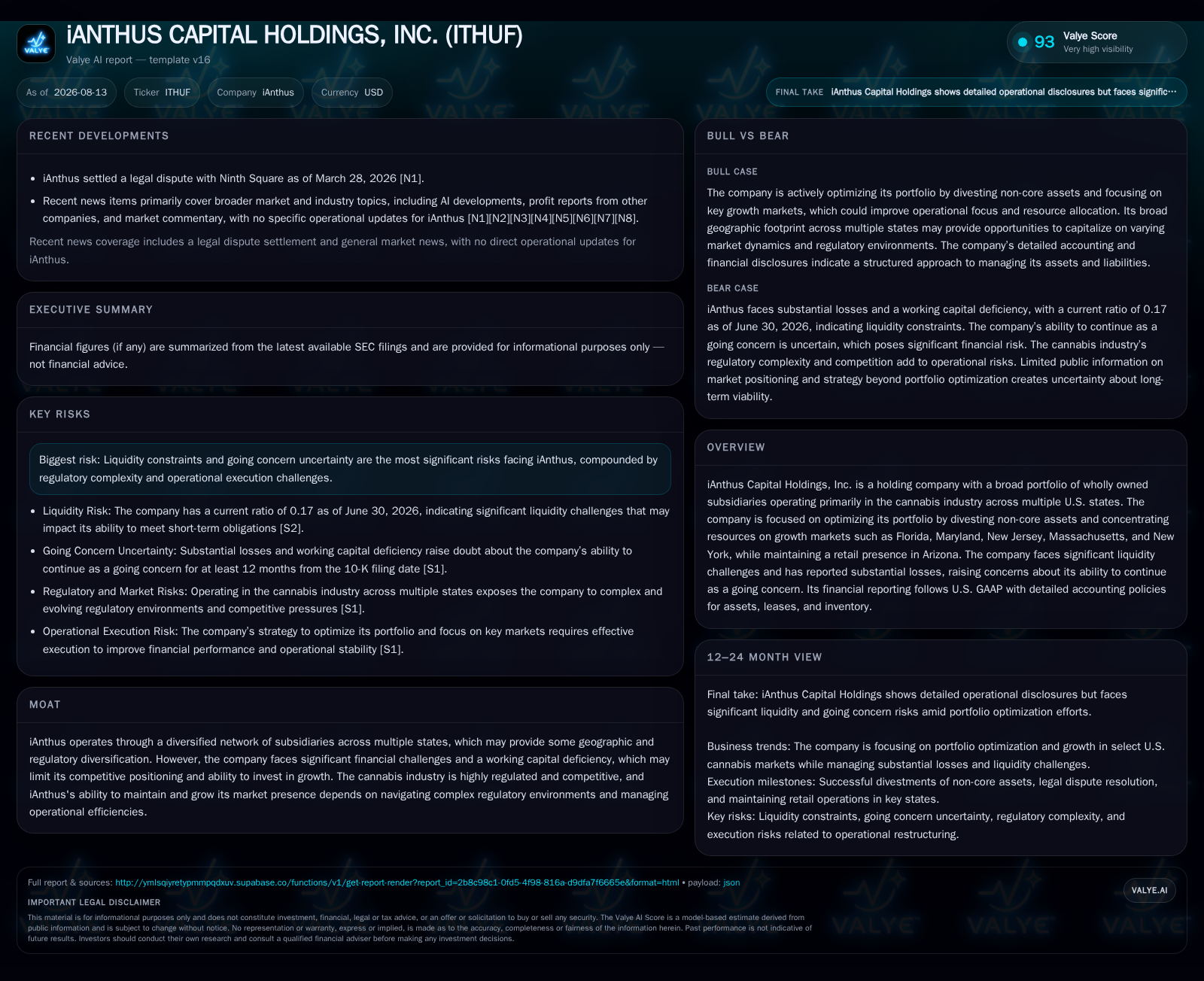
iAnthus Capital Holdings operates as a vertically integrated multi-state cannabis operator navigating complex regulatory regimes through a portfolio of subsidiaries focused on cultivation, processing, and retail. The company is divesting non-core assets to prioritize expansion in high-growth states such as Florida, Maryland, and New York, while maintaining minimal retail presence in Arizona. However, persistent liquidity constraints and a substantial working capital deficit threaten operational continuity, reflected in its low current ratio and elevated debt levels. Going forward, execution on asset divestitures, cash flow stabilization, and managing regulatory compliance will be critical to sustaining its market position within the competitive cannabis sector.
Recent Operating Update
iAnthus Capital Holdings’ latest quarterly filing reaffirms its strategic emphasis on optimizing the subsidiary portfolio by shedding non-core assets while focusing resources on more promising markets such as Florida, Maryland, New Jersey, Massachusetts, New York, alongside maintaining a limited retail operation in Mesa, Arizona [S2][S1]. This portfolio pruning is designed to both bolster financial flexibility and sharpen operational focus in states exhibiting robust cannabis market expansion due to evolving legalization trends.
However, the quarterly data also highlights pronounced liquidity challenges underpinning iAnthus’s financials. As of June 30, 2026, total debt approximates $203.5 million against only $46.4 million in current assets versus $279.2 million in current liabilities—translating into a critically low current ratio around 0.17 (current assets divided by current liabilities), which signifies an acute working capital deficiency raising substantial doubt about going concern status [F1]. This disparity exposes susceptibility to imminent funding shortfalls absent successful asset divestitures or capital injections.
The company’s concurrent disclosures do not indicate any material change in previously disclosed risk factors but underscore continuing uncertainties related to regulatory compliance costs inherent in operating across multiple jurisdictions with divergent state laws [S2][S3].
Business Model Analysis
iAnthus operates as a vertically integrated cannabis multi-state operator (MSO), controlling key elements of the value chain that encompass cultivation facilities producing cannabis flower and extracts; processing plants manufacturing edibles and concentrates; wholesale distribution channels; and retail dispensaries selling direct-to-consumer [S1]. Such vertical integration intends to capture higher margin layers within the product lifecycle but introduces complexity in inventory management and regulatory adherence.
The company's revenue is principally driven by product sales from its subsidiaries located mainly in regulated states with legalized medical or adult-use markets. Revenues derive from a mix of wholesale supply agreements with other licensees as well as retail sales through owned dispensaries—with margins varying significantly across these channels depending on product mix (flower vs. edibles), pricing dynamics dictated by local competition, tax regimes, and excise duties.
However, iAnthus’s strategic pivot away from less profitable or non-core jurisdictions aims to recalibrate its footprint toward states displaying greater legalization momentum and consumer demand growth potential—Florida being notable given its expanding medical cannabis program; similarly Maryland and New York offer sizable market upside prospects [S1]. The retention of just a single retail dispensary location in Mesa reflects an intent to maintain an operational foothold without extensive deployment of capital-intensive retail expansion in Arizona.
From a monetization standpoint, iAnthus faces typical MSO revenue mechanics constraints: pricing pressure from mature state operators or illicit markets suppresses average selling prices per gram/unit; volatile product sales volumes can emerge from fluctuating consumer foot traffic; inventory turnover is linked tightly to cultivation yields and supply chain efficiency; licensing counts directly affect capacity limits; finally, working capital requirements are accentuated due to slow receivables collection under challenging banking conditions within the sector.
Industry Structure & Competitive Position
iAnthus competes within the populous cohort of MSOs contrasted against larger peers such as Curaleaf Holdings or Green Thumb Industries that have established sizable retail dispenser networks combining cultivated branded products with wholesale distribution capabilities. These rivals typically benefit from superior scale economies enabling more robust operating margins and greater cross-state brand recognition.
In contrast, iAnthus’s financial constraints limit investment ability for scaling dispensary counts or building substantial cultivation square footage necessary for competitive cost structures. Its presence remains somewhat fragmented with heavier concentration on emerging eastern U.S. markets rather than strongest wholesale hubs like California or Colorado where some peers dominate.
Moreover, pervasive regulatory compliance burdens—ranging from stringent seed-to-sale tracking requirements to licensing renewals—and patchwork state rules exacerbate operational complexity for MSOs juggling multi-state portfolios. These factors yield elevated fixed costs that strain margin potential unless offset by strong volume growth or premium pricing power.
Growth Drivers
Growth catalysts for iAnthus principally hinge on successful execution of its ongoing portfolio rationalization strategy designed to unlock capital through divestitures of underperforming or non-strategic assets [S1]. Redeploying proceeds into markets with clearer legalization trajectories allows targeting expanding patient/member bases—particularly medical programs—as well as increasing recreational adult-use adoption where legal.
Product innovation toward higher-margin segments like extracts and edibles may also foster incremental gains if supported by efficient production processes and effective branding. Geographic expansion remains predicated upon securing requisite licenses amid evolving cannabis regulations; therefore maintaining strong regulatory compliance frameworks constitutes essential groundwork for scaling operations.
Improvements in operational KPIs such as same-store sales growth at dispensaries indicate customer traction gains; increased cultivation efficiency could enhance inventory turnover rates; better working capital management improves cash flow conversion—all pivotal metrics for sustainable progress.
Consolidation trends within the cannabis industry also present potential M&A avenues either for acquiring complementary assets or achieving cost synergies.
Risks & Constraints
iAnthus faces several material risks constraining growth prospects. Paramount among these is its liquidity profile: heavy debt load coupled with low cash reserves strains all operating activities given hefty interest expense obligations compounded by ongoing net losses reported at over $40 million annually [F1]. Failure to monetize non-core holdings rapidly increases going concern probabilities.
Regulatory uncertainty looms large given disparate state-level legislation juxtaposed against enduring federal prohibition creating banking access limitations that hamper smooth capital flow cycles. Also inherent are compliance risks tied to license maintenance requirements which if breached could trigger fines or forced closures severely disrupting revenue streams.
Operationally, managing geographically scattered subsidiaries involves heightened complexity around workforce hiring/training plus product quality oversight amidst fierce pricing competition driven by other MSOs intent on capturing market share.
Inventory obsolescence or shrinkage represents additional margin erosion risks especially when consumer tastes shift unexpectedly towards novel delivery formats or wellness-oriented products outside iAnthus’s existing portfolio scope.
Finally legal proceedings related to legacy disputes add another layer of contingent liability considerations even if historically deemed immaterial currently [S18][S19].
What To Watch Next
Critical near-term milestones include closing announced asset sales enabling deleveraging progress alongside evidence of positive operating cash flows from core state operations—a crucial inflection needed to alleviate liquidity pressures [S2][S3]. Monitoring shifts in gross margins within primary markets will illuminate whether product mix changes are effectively enhancing profitability.
Regulatory developments especially regarding banking reform or new state legalization statutes impacting iAnthus’s footprint warrant close attention since they directly affect access to capital and market size expansion potential respectively.
Operational KPIs such as same-store sales comparable growth percentages at retained dispensaries plus inventory turnover ratios should be tracked quarterly for indication of improving portfolio health. Lastly management commentary during earnings releases offers insight into execution confidence around divestiture strategies and future capital allocation plans.
Financial Profile Discussion
iAnthus exhibits considerable financial stress as reflected by its balance sheet snapshot at mid-2026: total debt outstanding hovers near $203.5 million while current liabilities outweigh current assets dramatically ($279.2 million vs. $46.4 million), producing an acute current ratio near 0.17 signaling severe short-term liquidity risk [F1]. This imbalance necessitates urgent refinancing access or asset monetization achievements lest operational continuity deteriorates further.
Operating losses persist with net income deficits exceeding $40 million annually indicating negative earnings leverage despite revenue generation approximately $144 million annually as last reported [F1]. Interest accruals using paid-in-kind structures inflate principal balances exacerbating leverage escalation over time.
Restrictive covenants embedded within secured debenture agreements limit flexibility around new indebtedness or asset dispositions constraining agility during this turnaround phase [S4][S7]. Management’s stated goal involves redirecting proceeds from divestitures primarily toward debt reduction while channeling focused investment into high-growth state subsidiaries aiming for positive cash generation in coming periods [S1][S2].
Controlling refinancing risks along with stabilizing EBITDA through cost rationalization efforts will be essential indicators confirming trajectory toward sustainable corporate health.
This analysis synthesizes iAnthus Capital Holdings’ recent SEC disclosures combined with industry context framing the company’s status as a beleaguered multi-state cannabis operator endeavoring to reconcile growth ambitions against daunting financial headwinds within an inherently complex regulatory environment.
Disclaimer: This report is for informational purposes only. It does not constitute investment advice or research views regarding securities of iAnthus Capital Holdings or any other entity.
Disclaimer: This is research-only, informational analysis and not investment advice. It may include AI-generated interpretation and general industry context. Always verify important details using primary sources.

Comments