
BioStem Technologies Surpasses Revenue Estimates Despite Ongoing Operating Losses
Q2 results reveal revenue exceeding forecasts amid substantial operating losses and tight liquidity pressures, highlighting early-stage biotech challenges.
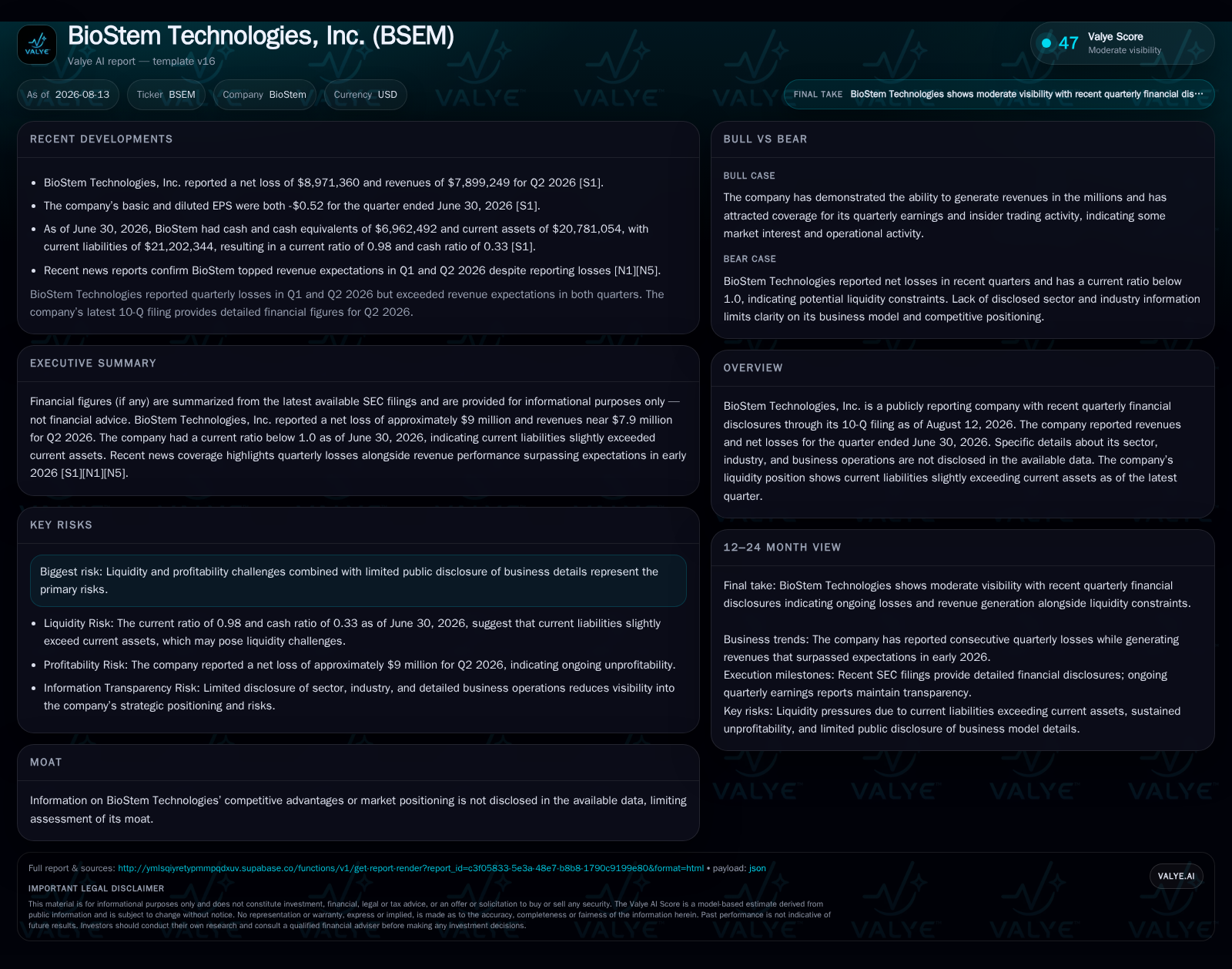
BioStem Technologies reported second-quarter 2026 revenue of $7.9 million, surpassing analyst expectations primarily driven by licensing and milestone payments rather than product sales. Despite this top-line strength, the company recorded an $8.4 million operating loss reflecting heavy research and development (R&D) expenses typical of clinical-stage biotechnology firms. BioStem’s recent Nasdaq listing marks a strategic move to enhance capital market access, though near-parity between current assets and liabilities signals constrained liquidity. Ongoing dependency on milestone-triggered inflows and the timing of clinical milestones will be critical to extending operational runway and supporting growth prospects.
Latest Quarterly Performance Highlights: Revenue Beat Amid Losses
BioStem Technologies’ Q2 2026 financials illustrate the classic dichotomy in early-stage biotechnology firms: revenue performance outpaced expectations while operating profitability remained elusive. The company reported total revenues of approximately $7.9 million for the quarter ended June 30, 2026 [F1], surpassing consensus estimates primarily through licensing fees and milestone payments tied to drug discovery progress rather than established product sales. This revenue composition underscores BioStem’s reliance on partnerships structured around clinical advancement triggers instead of volume-based or subscription revenue models.
However, these top-line gains did little to offset ongoing research and development (R&D) expenses, culminating in an operating loss of $8.4 million [F1]. This sustained deficit reflects the high fixed-cost nature of clinical trial execution and pre-commercial research activities intrinsic to biotechnology enterprises striving for regulatory approvals and eventual market authorization. Such results confirm that BioStem remains firmly committed to capital-intensive pipeline development in lieu of near-term product monetization.
Nasdaq Transition and Its Capital Market Significance
A material event coinciding with this quarter was BioStem’s uplisting from the OTC Markets to the Nasdaq Capital Market effective August 7, 2026 [S6]. This transition presents a strategic inflection point designed to enhance transactional liquidity and broaden investor access by positioning shares within a more visible exchange ecosystem. While this listing upgrade may bolster institutional interest and improve stock market dynamics, it does not inherently reduce execution risk related to pipeline development or alter the company’s cash burn profile.
Nonetheless, appearing on Nasdaq better aligns BioStem with peer companies exhibiting greater capital market sophistication and may facilitate more efficient equity financing or structured partnership arrangements critical for sustaining long R&D cycles.
Biotechnology Business Model Underpinning BioStem’s Economics
BioStem exemplifies a conventional biopharmaceutical business archetype focused on translating scientific innovation into therapeutics through lengthy clinical validation stages. Revenue streams are predominantly licensing-generated—reflecting milestone payments upon achieving predefined clinical endpoints or regulatory submissions—rather than derived from commercial biologic sales [S2]. This monetization approach is especially prevalent among early-stage developers seeking non-dilutive capital alongside raising equity rounds.
The intensive R&D expenditure maintained during this period underpins essential activities ranging from preclinical studies through Phase I/II trials aimed at advancing the therapeutic pipeline closer to FDA approval thresholds. Given that BioStem carries no recognized product revenues at scale yet realizes positive inflows from licensing agreements suggests the company effectively leverages partnering deals to fund costly trial phases while preserving upside through eventual commercial participation.
Peer Comparisons Illuminate Operational Context in Early-Stage Biotech Arena
Against publicly traded peers such as Codexis (CDXS), Novavax (NVAX), and Cytek Biosciences (CTKB), BioStem’s quarterly results align with typical patterns where operating losses persist despite incremental top-line improvements driven by milestone achievements [N2][N3][N4]. For instance, Codexis and Novavax also report revenue beats hinged on partnership fee structures amid ongoing R&D expense absorption.
This peer context affirms that BioStem faces the standard sector challenge: balancing costly innovation timing with liquidity sufficiency until pipeline assets reach commercial viability or can be out-licensed more extensively. These analogues help frame BioStem’s financial trajectory as consistent with early clinical-stage biotechnology firms managing extended investment horizons in return for potential future therapeutic breakthroughs.
Pathways for Growth: Clinical Milestones and Partnership Catalysts
Looking ahead, BioStem’s most tangible growth drivers will revolve around progressing its clinical trial pipeline toward significant regulatory milestones including investigational new drug (IND) applications, Phase advancements, or potential biologics license applications (BLA). Each successful step typically triggers corresponding milestone payments or strengthens negotiating leverage for broader licensing agreements.
Strategic partnering remains a core enabler—collaborations with larger pharmaceutical companies or specialized contract research organizations (CROs) can facilitate resource sharing, risk mitigation, and access to expanded distribution networks upon product market authorization. Furthermore, advancements in proprietary biologic platforms or novel biomarkers could open additional licensing channels or therapeutic niches enhancing competitive differentiation.
Risks Amplified by Liquidity Constraints and Clinical Uncertainty
Despite zero reported debt as of June 30, 2026 [F1], BioStem operates within a precarious liquidity window marked by a current ratio below one (0.98) owing to current liabilities ($21.2 million) marginally exceeding current assets ($20.8 million) [F1]. This near-parity necessitates vigilant working capital management to avoid operational disruptions.
Compounding liquidity risks are intrinsic sector uncertainties including possible failures or delays in clinical trials that may defer milestone recognition timelines or diminish licensing income projections [S2]. Additionally, dependence on external partnerships introduces counterpart risk; unsuccessful collaborations could constrain cash inflows simultaneously increasing capital requirements. The competitive environment also pressures continual scientific innovation while pricing and reimbursement landscapes remain variable post-approval.
Near-Term Indicators to Monitor: Milestones, Cash Flow, and Market Access
For stakeholders tracking BioStem’s progress beyond financial releases, key indicators include updates regarding clinical trial enrollment rates, mid-phase data readouts validating efficacy/safety profiles, regulatory filing submissions conducted within expected windows, and newly signed licensing agreements enhancing recurring milestone revenue streams [S3]
Additionally, post-Nasdaq trading volume trends may signal improved institutional engagement affecting future financing capacity. Monitoring quarterly cash flow statements for signs of burn rate stabilization or acceleration will further clarify runway duration before incremental funding events are necessary.
Financial Profile Discussion: Liquidity Pressure Meets Zero Debt
At June quarter-end 2026, BioStem held approximately $7 million in cash equivalents while carrying no outstanding debt obligations [F1]. This positions the company with a clean balance sheet absent leverage but frames its liquidity position as notably tight due to nearly matching current assets against $21.2 million in short-term liabilities [F1].
Given sustained operating losses exceeding $8 million each quarter [F1], cash burn represents a critical constraint shaping corporate strategy around milestone pacing and partnership monetization timing. In sum, while absence of debt affords financial flexibility absent interest burdens, management must secure consistent funding sources aligned with timely clinical progress to sustain operations through protracted developmental cycles typical across early-stage biotech pathways.
Disclosure: This analysis is based exclusively on publicly available filings dated through August 12–13, 2026 ([S2], [S3], [F1]) combined with validated industry knowledge frameworks. It is intended solely as an informative synthesis without investment research views.
Disclaimer: This is research-only, informational analysis and not investment advice. It may include AI-generated interpretation and general industry context. Always verify important details using primary sources.

Comments