
AleAnna Advances Italian Gas Production With Dual Conventional and Renewable Strategy
AleAnna’s latest quarterly results confirm progress in establishing production at Longanesi and expanding renewable biomethane capacity, supported by strategic gas sale agreements and government incentives.
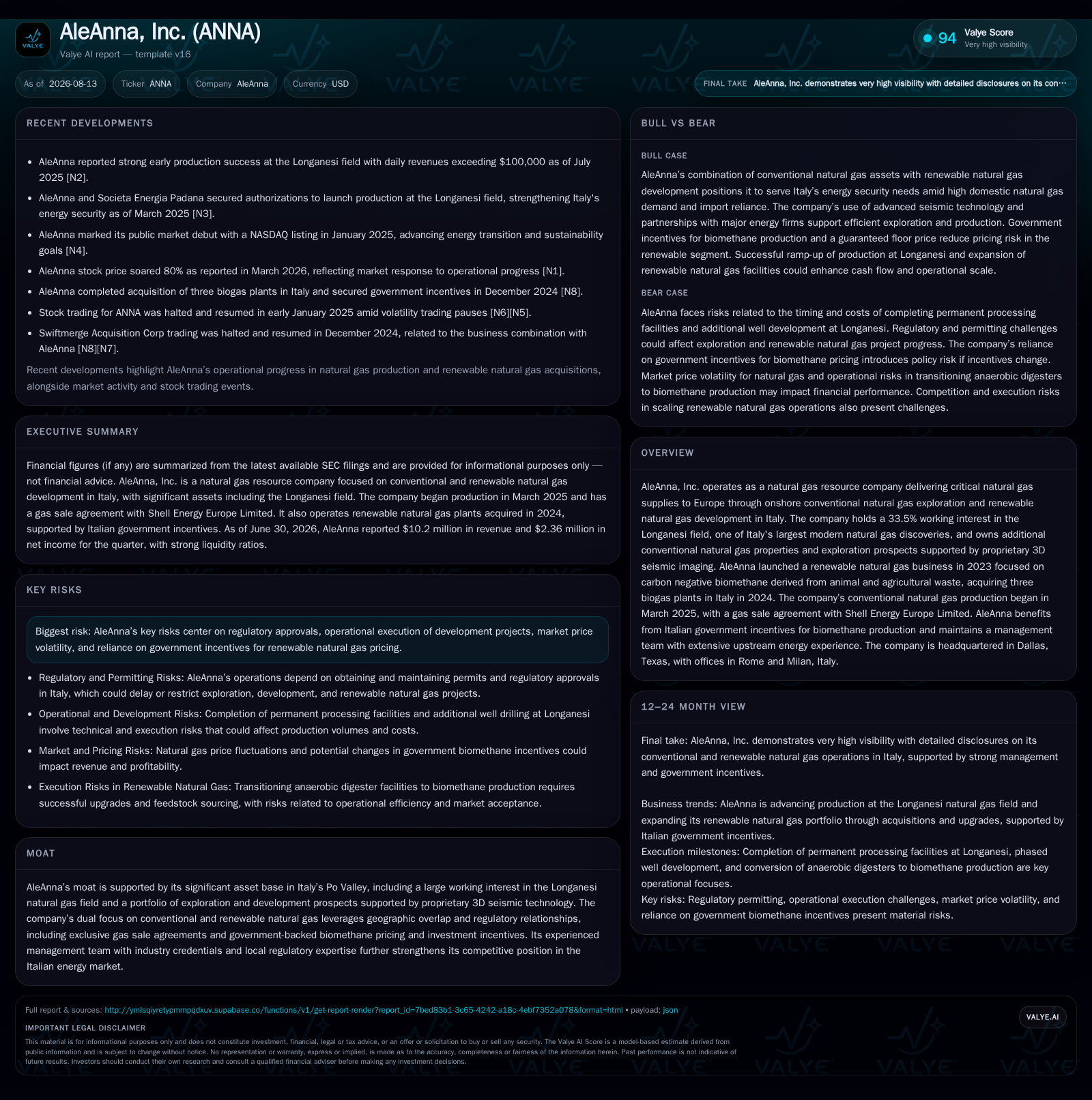
AleAnna, Inc. completed first-quarter production from its Longanesi onshore natural gas field in March 2025, ramping output via a temporary processing facility while its permanent plant is under construction for commissioning in 2027. Concurrently, it has expanded into renewable natural gas with three biogas plant acquisitions in Italy, aiming to leverage government incentives for carbon-negative biomethane. The company relies on a firm gas sale agreement with Shell Energy Europe Limited, underscoring the commercial viability of its production. Key risks remain related to regulatory approvals, midstream connections, commodity price exposure, and operational execution.
Recent Operating Update
AleAnna reported key operational milestones in its latest quarterly filing ending June 30, 2026. The company achieved first production from its five wells in the Longanesi conventional natural gas field starting March 2025 through a temporary processing facility [S2]. While this initial output validates the exploration and development efforts, AleAnna is advancing construction of its permanent processing facility during 2026 with commissioning planned for early 2027 [S1]. This phase completion is crucial since it should enable stable and increased throughput capacity beyond temporary arrangements.
On the renewable side, AleAnna successfully closed acquisitions of three biogas plants in Italy throughout early to mid-2024 for approximately €9 million, targeting carbon-negative biomethane production from agricultural waste sources [S1]. These facilities are strategically located within Italy's Po Valley region—coinciding geographically with their conventional assets—allowing potential cost efficiencies and regulatory leverage
AleAnna also maintains an exclusive gas sale agreement (GSA) with Shell Energy Europe Limited executed in late 2024 which underpins contracted revenues from their conventional gas production volume [S1]. Such contract structures mitigate market price risk associated with spot sales and support cash flow predictability.
Business Model Analysis
AleAnna operates within the upstream segment of the natural gas value chain focusing on onshore exploration and development of conventional natural gas reserves coupled with renewable natural gas (RNG) production through anaerobic digestion facilities converting animal and agricultural waste into biomethane.
Revenue generation stems primarily from sales of produced natural gas under long-term agreements like the GSA with Shell Energy Europe. Production volumes depend on reservoir performance at Longanesi where AleAnna holds a material 33.5% working interest alongside partner Padana who operators the field [S1]. Reserve certification by DeGolyer & MacNaughton affirms approximately 25.8 billion cubic feet (Bcf) net recoverable proved reserves underpinning asset value.
Renewable revenues are anticipated to derive from biomethane sales incentivized by Italian government policies promoting carbon-negative gases. Biomethane prices often include premiums supported by subsidies or tax incentives enhancing RNG project economics versus unregulated fossil fuels.
Monetization mechanics differ distinctly between conventional and renewable segments: conventional relies on physical volume sold under established GSAs generating steady cash inflows constrained by midstream takeaway capacity; RNG hinges on plant uptime, feedstock availability, government incentive utilization rates, and product pricing nuances tied to carbon credits or environmental attributes.
Operational metrics critical to AleAnna include drilling success rates for future wells to expand reserves; efficiency and uptime levels of both processing facilities; government incentive uptake ratios for RNG plants; and realized average gas prices affecting revenue per unit volume sold.
Industry Structure and Competitive Context
The European natural gas supply landscape is shaped by increasing demand heterogeneity driven by energy security concerns alongside aggressive climate targets proposing gradual fuel shifts. Italy’s energy policy promotes domestically sourced natural gas inclusive of RNG as part of decarbonization strategies.
Within this environment, AleAnna is positioned as an independent upstream producer distinct from integrated majors like Eni S.p.A., yet sharing similarities in pivoting toward renewable gases seen at companies like Snam S.p.A., which operates prominent midstream infrastructure supportive of gas flows across Italy. AleAnna’s development-stage status contrasts with larger producers such as Cheniere Energy focused on LNG exports but aligns closer with smaller pure-play European independents embracing dual conventional/renewables models.
Competitive moats arise mainly from secured working interests in prolific producing fields such as Longanesi—one of Italy's largest recent finds—and proprietary technical resources like modern 3D seismic imaging underpinning exploration success prospects. The complementary overlaps between conventional wells and RNG assets facilitate leveraging shared regulatory knowledge and administrative relationships, potentially lowering barrier costs for permits issuance.
Risks endemic to this industry include volatility in commodity markets which directly affect revenue predictability since price shifts alter investment returns; significant capital demand typical for ongoing drilling campaigns; dependence on third-party midstream pipeline availability particularly pronounced for undeveloped properties; plus regulatory uncertainties encompassing permitting delays or incentive program modifications impacting renewable project economics.
Growth Drivers
AleAnna’s growth path stems from several converging factors: First, ramping production at Longanesi via completion of permanents processing infrastructure can increase net daily output volumes reliably sold under existing contracts thus scaling revenue base.
Secondly, expansion into RNG via acquired biogas plants taps into growing governmental subsidy schemes favoring carbon emission reductions incentivizing market adoption of biomethane over fossil-derived gas. This creates structural tailwinds given stringent European climate mandates demanding substitution fuels.
Thirdly, deployment of proprietary advanced seismic imaging technology promises enhanced exploration hit rates increasing inventory of developed reserves—a key long-term lever given limited mature fields in Italy’s basin.
Furthermore, the integrated approach combining conventional resource exploitation with renewable biomethane production creates potential operational synergies such as shared land use rights management and combined logistical frameworks improving overall capital efficiency.
Lastly strategic partnerships exemplified by the Shell GSA secure committed customers anchoring off-take volumes reducing exposure to spot market fluctuations facilitating financial planning.
Risks and Watchpoints
Key risks revolve around execution challenges in connecting undeveloped fields to midstream infrastructure economically—isolation or delayed access may restrict scaling production despite existing discoveries [S1]. Uncertainties persist regarding timing and conditions for regulatory approvals essential for drilling permits or plant expansions affecting project realization schedules.
Price sensitivity remains material; declines in European natural gas prices would compress margins given ongoing fixed operating costs tied to field development or plant maintenance activities. Conversely higher prices improve cash flow but may intensify competitive bidding among producers limiting contract longevity or volumes.
Renewable natural gas ventures incur dependence on continuation of government incentives. If policy frameworks change abruptly reducing biomethane price support or imposing new compliance burdens this could weaken project economics significantly.
Operational risks include typical upstream issues such as well performance below expectations lowering output forecasts; plant downtime diminishing RNG volumes compromising contracted delivery commitments; feedstock supply variability impacting anaerobic digester utilization rates.
Capital intensity necessitates sustained access to financing sources amid fluctuating commodity cycles—failure securing adequate capital may delay growth initiatives.
What To Watch Next
Milestones critical for monitoring include completion updates on the permanent processing facility installation at Longanesi scheduled for phased rollout during calendar year 2026 with commissioning expected early 2027 providing clearer visibility on sustained full-field production capabilities [S1]
Tracking incremental monthly production volumes post-commissioning will indicate reservoir performance trends validating reserve quality assumptions or signaling need for revised development plans.
Progress reports on renewables segment should address plant capacity utilization improvements reflecting successful retrofit efforts converting acquired biogas sites into fully operational RNG producers leveraging incentive schemes efficiently.
Financial quarters ahead will likely unveil revenue trajectory alignment with increased volumes alongside cost structure evolution reflecting maturation beyond exploratory phases toward steady-state operations.
Additionally, regulatory developments within Italy impacting permitting or subsidy frameworks warrant close attention as they could materially influence project pipelines.
Financial Profile Discussion
As of June 30, 2026, AleAnna holds about $32.6 million in cash and equivalents against modest current liabilities approximating $22 million resulting in a current ratio around 1.9 indicating reasonable short-term liquidity cushioning operating needs [F1]. Total debt remains minimal at roughly $600,000 last reported as of March 31, 2024 implying low leveraging though current debt figures beyond that date are undisclosed requiring watching financing changes moving forward [F1].
Although top-line revenue noted was approximately $25 million ending December 31, 2025 coinciding with ramp-up phases reflecting nascent commercial production stages [F1], operating income above $2.9 million signals emerging profitability trends attributable partially to execution of GSAs anchoring sales volume gains despite ongoing capital investment requirements supporting expansion projects [F1].
Continuous capital expenditures remain essential to sustain growth especially given expected costs related to permanent plant commissioning plus planned investments into expanding renewable gas footprint via acquisitions or greenfield developments outlined previously [S1].
The relatively healthy liquidity position combined with low leverage affords some financial flexibility navigating sector volatility though sustaining positive operating cash flow metrics through scaling production will be critical for longer-term self-sufficiency without external capital injections.
This analysis synthesizes AleAnna’s recent disclosures emphasizing operational progress at Longanesi conventional field complemented by strategic renewable investments advancing prospective dual-growth avenues pivotal amid evolving European energy dynamics. While near-term infrastructural buildouts introduce typical upstream risks mitigated partially via contractual safeguards like the Shell GSA, continued monitoring of regulatory developments along with commodity price movements remains essential. AleAnna’s firm liquidity posture supports ongoing capital needs but prudent financial stewardship will be necessary given industry cyclicality inherent volatility.
Disclaimer: This is research-only, informational analysis and not investment advice. It may include AI-generated interpretation and general industry context. Always verify important details using primary sources.

Comments