
VenHub Global Advances Autonomous Retail with Modular Smart Stores Amid Financial Sustainability Challenges
VenHub Global focuses on AI-driven, fully autonomous retail stores with a modular owner-operator model, though faces early-stage financial hurdles as it scales.
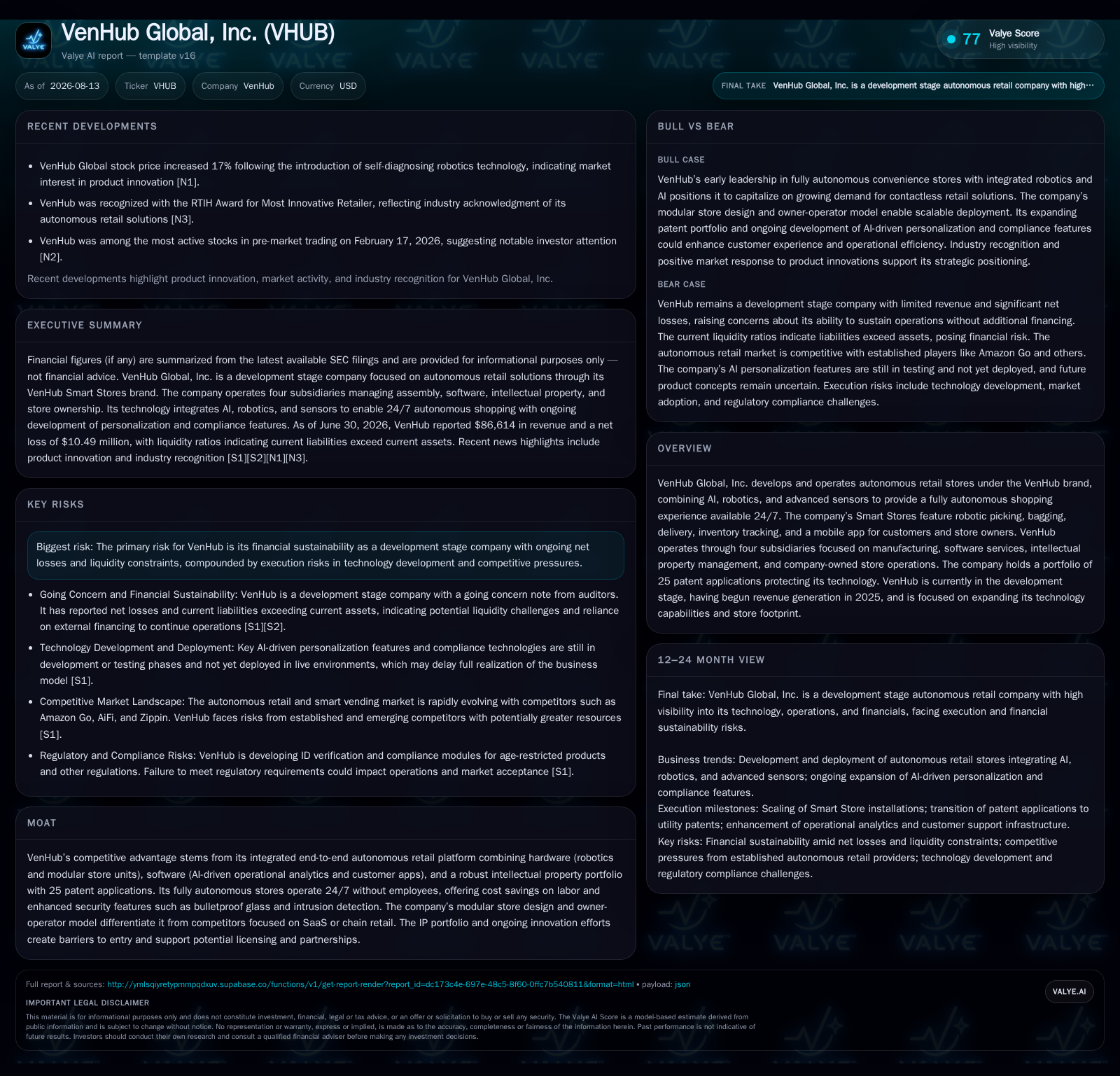
VenHub Global, Inc. operates in the emerging autonomous retail industry by deploying robotic and AI-powered smart stores designed for 24/7 operation without staff. The company’s integrated hardware-software platform and patent portfolio anchor its technological moat, while its unique owner-operator modular store model differentiates it from peers mainly focused on chain stores or SaaS. Having commenced revenue generation in 2025, VenHub remains a development stage company facing significant net losses and liquidity constraints as it works to scale store deployments and expand AI capabilities. Execution risks around operational scaling, technology refinement, and financial sustainability are key watchpoints over the near term.
Recent Operating Update
VenHub Global's most recent quarterly report dated August 12, 2026 [S2] confirms the company remains in its development stage despite having begun revenue generation in 2025 [S1]. The company reported year-end 2025 revenue of approximately $864K but incurred a substantial operating loss nearing $39.4 million [F1]. This continued loss underscores the sizeable investments VenHub is making to refine its autonomous retail technology platform and scale operations.
Liquidity measures reveal notable caution: as of June 30, 2026, VenHub held just over $2.56 million in cash and equivalents against current liabilities exceeding $7.55 million, resulting in a current ratio of only 0.77 [F1]. This liquidity gap corroborates risk disclosures emphasizing the need for additional equity or debt capital to sustain growth and meet operational needs [S1], while potential financing terms may cause dilution or unfavorable covenants [S27].
Additionally, a July 29 event filing details a corporate structure change increasing authorized common stock shares to 300 million [S3], likely positioning the company for future equity raises crucial for funding its expansion plans.
Business Model: Integrated Autonomous Retail Platform
VenHub operates under the "VenHub" brand deploying smart stores that integrate hardware (autonomous robotic picking/bagging/delivery systems), advanced sensor networks for inventory tracking, and proprietary AI software providing operational analytics through the VenHub Owners App [S1][S6]. These stores function continuously without employees—operating 24/7—and are accessible via seamless mobile app ordering interfaces that allow customers to browse and checkout independently.
Distinctively, VenHub’s business is organized through four wholly owned subsidiaries: VenHub LLC (manufacturing & assembly of smart stores), VenHub Services LLC (software-as-a-service platform management), VenHub IP LLC (patent portfolio administration), and VenHub Stores LLC (ownership/operation of company stores) [S6][S21]. This structure supports vertical integration across the value chain—a potentially durable moat given significant R&D investment alongside a portfolio of 25 patent applications protecting components from robot navigation algorithms to system integration designs.
Revenue is recognized partially through direct retail sales at company-owned stores (currently two locations: Los Angeles Airport and Union Station) while also preparing scalable owner-operator models that license smart stores coupled with SaaS subscriptions for software tools managing real-time data analytics and forecasting tools [S6]
The monetization mechanics hinge on a combination of hardware sales/leasing (modular store units with robotic fulfillment capability), recurring software licensing fees tied to AI-driven analytics platforms, and potentially future licensing of patented technologies enabling third parties to deploy VenHub’s solutions [S1][S6]. As automation replaces labor-intensive practices traditionally seen in convenience retail formats, cost-per-transaction economics can improve dramatically with robotic reliability metrics such as system uptime representing key margin levers.
Current AI deployments emphasize operational effectiveness—product verification reduces errors; robot navigation improves fulfillment speed; predictive maintenance lowers downtime—all contributing toward an improved order accuracy rate critical for customer satisfaction. Personalization features designed to recommend products based on purchase patterns remain under development at this time [S1][S16], representing a medium-term growth lever aligned with broader industry trends towards customer customization.
Industry Structure & Competitive Positioning
The autonomous retail sector is nascent but rapidly evolving as innovations from robotics firms merge with AI software capabilities. Major players like Amazon Go have established cashierless technology standards using computer vision and sensor fusion but often operate within vertically integrated chain models rather than modular owner-operated units.
VenHub differentiates itself through:
- A modular store architecture allowing rapid deployment across diverse urban venues operated by independent owners or franchises.
- An integrated ownership structure maintaining control over hardware manufacturing, software development, IP management, and retail operation segments.
- A robust intellectual property portfolio safeguarding proprietary robotics designs, AI algorithms for operational control, and mobile integration—a barrier that could enable licensing deals or strategic partnerships down the line.
This mid-sized industrial-player positioning navigates between large tech incumbents dominating urban flagship concepts versus pure SaaS providers offering only backend analytics. Success depends on executing scalable rollouts while maintaining system reliability—robotic uptime benchmarks will be a critical peer-comparative KPI alongside per-store revenue growth.
Growth Drivers
Several structural trends underpin VenHub’s long-term growth outlook:
- Consumer preference shifts toward contactless shopping experiences post-pandemic favor expanding automated retail footprints.
- Technological advances lowering production costs for robotics systems enable more economically viable modular unit deployments.
- Urban centers expanding demand for late-hour convenience retail options create high-footfall sites conducive to smart store footprints.
- Owner-operator adoption models reduce capital intensity borne by VenHub relative to wholly owned chains while leveraging local market expertise.
- Development of AI personalization features promises higher transaction volumes via tailored research view engines—as testing matures into deployment these add-on services could elevate average revenue per customer.
- Potential licensing partnerships leveraging patent portfolios open secondary revenue streams distinct from direct retail sales.
KPIs such as number of deployed autonomous stores beyond the current two locations will be the foremost demand marker alongside improvements in order accuracy rates driven by AI optimization phases now underway.
Risks & Constraints
Key risks reflective of typical early-stage companies intersect with unique autonomous retail challenges:
- Ongoing operating losses underscore current scale inefficiencies; the $39 million operating loss recorded by end-2025 exemplifies heavy R&D front-loading without substantial EBITDA contribution yet [F1].
- Liquidity constraints represent immediate threats if financing markets tighten or dilution aversion limits capital access; current working capital ratios indicate pressure points needing resolution within upcoming quarters [F1][S27].
- Execution risk remains elevated as simultaneous scaling of hardware manufacturing capacity, software platform stability, AI feature rollout timelines, and owner-operator onboarding requires complex coordination across subsidiaries.[S23][S14]
- Competitive threats from well-funded incumbents or tech firms entering adjacent automated fulfillment spaces could pressure pricing power or slow market penetration.[S1]
- Regulatory environment uncertainties surrounding AI applications in customer data handling or robotic safety compliance may impose procedural delays or additional costs.[S1]
- Customer behavioral adoption risks remain; broader public comfort with fully automated shopping alternatives affects transaction volume ramp rates.[S1]
- Intellectual property litigation exposure could emerge given 25 pending patents remain largely untested defensively.[S1]
- Operational risks tied to robotic system failures impact uptime metrics directly affecting customer satisfaction and retention.[S16]
What to Watch Next
Investors should track several milestones demonstrating execution progress:
- Expansion beyond the initial two company-owned smart stores toward wider commercial availability either directly or through owner-operated franchise models.
- Introduction of advanced AI personalization features transitioning from testing into live environments enhancing shopper engagement metrics.
- Improvements in robotic system uptime benchmarks reflecting reliability gains critical to reducing operational cost per transaction.
- Evidence of growing app engagement rates validating user acceptance.
- Refinements in forecasting tools that enhance inventory turnover efficiency.
- Any announcements regarding additional financing rounds or strategic partnerships that alleviate liquidity stress while advancing technology roadmaps.
Financial Profile Discussion
Despite initiating revenue generation in 2025 totaling approximately $864K [F1], VenHub Global recorded an operating loss around $39.4 million for the full year ending December 31, 2025 [F1], highlighting the developmental nature of its current business phase. Net losses exceeded $62 million during the same period [F1], emphasizing sustained negative cash flow requiring ongoing capital injections.
The balance sheet at June 30, 2026 shows cash reserves at roughly $2.56 million against current liabilities exceeding $7.55 million leading to a current ratio under one at approximately 0.77 [F1], reflecting short-term liquidity tension consistent with disclosed going concern considerations [S1]. Management intends to pursue equity or debt financing as necessary but acknowledges possible dilution impacts on existing shareholders [S27].
Capital expenditures are intensive given simultaneous R&D investments across robotics manufacturing capabilities and software platform developments alongside operational costs tied to rolling out Company-owned physical stores [S1][S6]. Cost control amid scaling efforts will be imperative to move toward sustainable gross margins typical within mature autonomous retail deployments seen peer-wise.
Overall financial metrics reinforce VenHub’s profile as an early-stage technology innovator focusing on proving product-market fit while managing pressing capital requirements inherent in pioneering automated retail concepts at scale.
Disclaimer: This is research-only, informational analysis and not investment advice. It may include AI-generated interpretation and general industry context. Always verify important details using primary sources.

Comments