
Maitong Sunshine Cultural Development Strengthens Integrated Cultural Tourism and Product Sales Amid Market Fragmentation
MGSD reports operational advances in its diversified cultural tourism and product offerings while grappling with liquidity constraints in a competitive Chinese market.
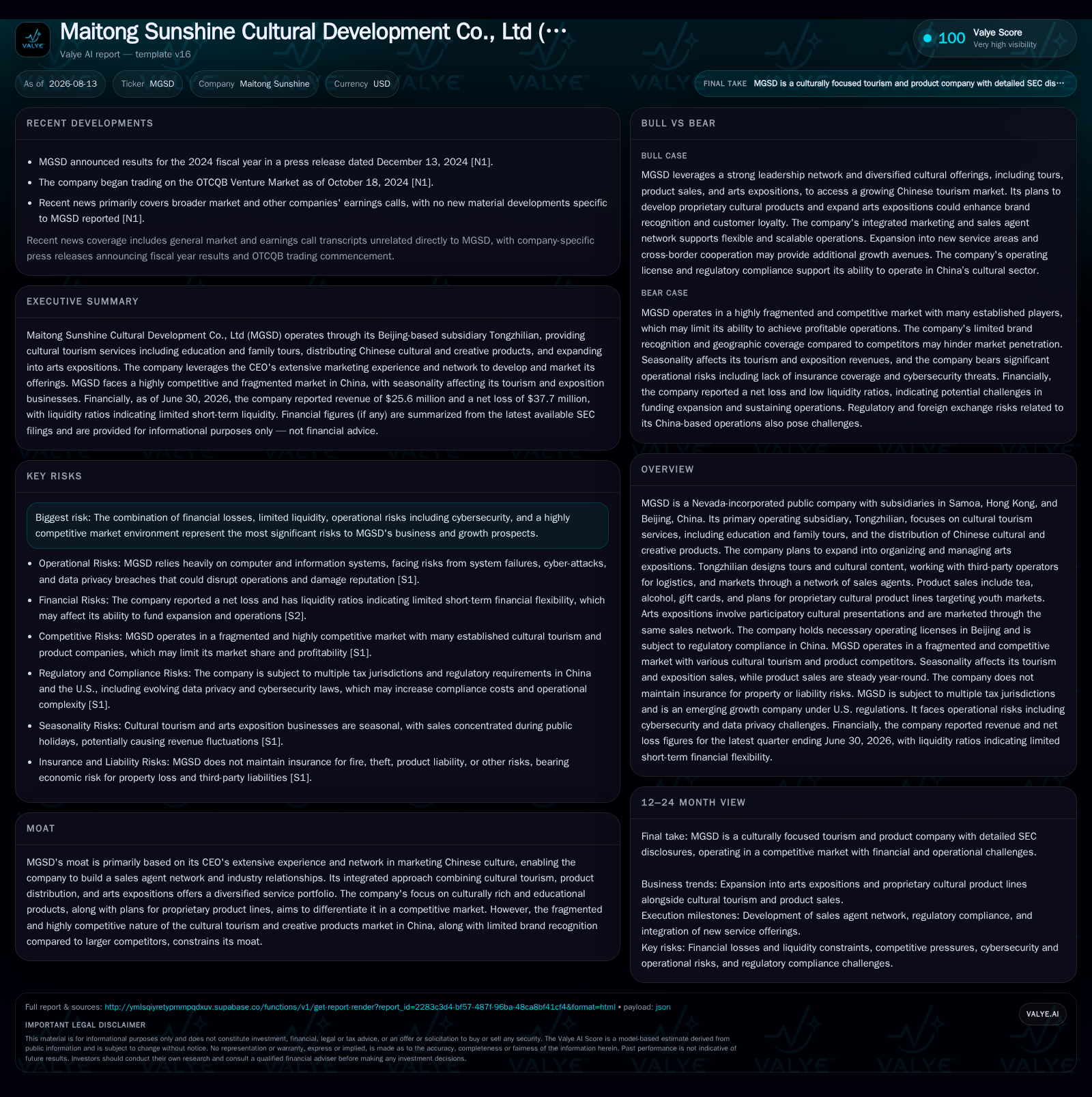
In its August 2026 quarterly report, Maitong Sunshine Cultural Development Co., Ltd (MGSD) showcased progress in expanding its integrated cultural tourism services, creative product distribution, and preliminary arts exposition activities. Despite registering positive operating income previously, the company continues to post net losses and faces significant liquidity pressure with a current ratio of 0.31 as of June 2026. MGSD’s CEO-driven sales agent network and plans for proprietary youth-focused products illustrate strategic moves to offset challenges from brand visibility and market fragmentation in China’s highly competitive cultural tourism sector.
Latest Quarterly Update Highlights Mixed Operational Signals during Expansion Plans
Maitong Sunshine Cultural Development Co., Ltd (MGSD) released its latest quarterly report on August 13, 2026 [S2], revealing nuanced progress within its business operations during notable liquidity challenges. While the company continues cultivating revenue streams across its tour design services and creative product distribution channels, financial statements disclose constrained cash balances of roughly $15,000 alongside a critically low current ratio of 0.31 as of June 30, 2026 [F1]. This liquidity state signals substantial short-term funding pressure that could impact investment in growth initiatives.
Historically, MGSD achieved positive operating income ($86,790 as of September 30, 2025) although it has yet to translate this into net profitability, posting net losses ($21,229) during the same period [F1]. The persistence of net losses despite operational gains underscores either elevated non-operating expenses or early-stage scaling costs. This snapshot illustrates an emerging growth company actively balancing expansion efforts with financial sustainability concerns.
The quarter also included indications of preparatory steps toward developing arts exposition capabilities beyond MGSD’s existing focus on cultural tourism and product sales. Such diversification may provide incremental margin uplift but requires upfront managerial focus and resources.
Integrated Business Model: Combining Tour Design, Product Distribution, and Arts Expositions for Revenue Diversification
MGSD’s core business leverages an integrated model combining tailored cultural tourism offerings with creative product sales and plans for arts exposition events [S1]. Under its Beijing-based subsidiary Tongzhilian Cultural Development Co., the company designs culturally rich tours emphasizing education and family-oriented experiences. These tours are exclusively crafted by MGSD’s team to determine authentic cultural content while outsourcing logistics—such as accommodations and local services—to established third-party operators. This structure allows MGSD to retain intellectual property over tour design while mitigating fixed asset costs related to infrastructure.
A critical monetization vector is the deployment of a layered sales agent network that markets both tours and cultural products directly to end customers. The product mix includes traditional Chinese consumables like tea and alcohol, gift cards, alongside announced intentions to develop proprietary cultural items aimed particularly at the youth demographic—a segment often underserved by conventional offerings [S1]. This approach reflects attempts to counterbalance industry commoditization by enriching product diversity and exclusivity.
The planned inclusion of participatory arts expositions represents a further diversification pillar designed to deepen customer engagement via immersive cultural events. These expositions are marketed through the same agent network, synergizing cross-selling opportunities across the tour-product-event spectrum.
Fragmented Market Dynamics Shaping Competitive Pressures and Brand Awareness Challenges
Operating within China’s cultural tourism and creative products industry situates MGSD amid intense fragmentation marked by numerous small- to mid-sized players competing across regions [S1]. The private cultural tourism segment itself ranges from entrenched large franchise companies with substantial brand power to myriad regional providers focusing on price sensitivity or specific niches.
Prices remain under pressure given abundant alternatives for consumers prioritizing cost or convenience over authentic experience quality. MGSD distinguishes itself through curated content reflecting genuine Chinese heritage backed by its CEO’s extensive marketing relationships; nevertheless, its overall brand recognition lags behind well-funded franchises or government-backed cultural entities.
Regulatory compliance is a dual-edged sword: it imposes operational rigor but simultaneously erects barriers deterring unlicensed entrants—affording some defensive moat for MGSD in licensed markets such as Beijing [S1]. However, sustaining compliance demands continuous resource allocation impacting margins.
Leadership Networks Driving Sales Agent Development But Testing Scalability Limits
Central to MGSD’s distribution strategy is CEO Huang Fang’s two-decade tenure marketing Chinese culture which has enabled the rapid assembly of a geographically dispersed sales agent network [S1]. These agents perform critical functions in culturally contextualizing offerings and converting local demand into bookings or product sales. Given China’s vast territory and diverse consumer preferences, leveraging localized agents reduces dependence on expensive mass marketing channels.
Despite these advantages, the model reveals scalability constraints. Personal networks driving initial recruitment may exhaust reach beyond certain geographic or demographic boundaries without systematic incentives or technology-enabled supervision. Ensuring consistent quality control across independent agents remains an ongoing operational challenge affecting customer experience KPIs such as satisfaction scores or repeat buyer rates.
Emerging Growth Vectors: Proprietary Cultural Products and Arts Expositions as Future Catalysts
Recognizing the limits of pure tour-based revenue amid commoditized landscapes, MGSD aims to innovate via proprietary cultural product development targeting youth markets—a demographic sensitive to unique branding and experiential storytelling [S1]. Offering exclusive products can improve gross margins relative to third-party distributed items while enhancing brand differentiation.
Meanwhile, MGSD’s expansion into organizing arts expositions positions it at the intersection of event management and cultural tourism—a higher complexity segment potentially delivering better margins through ticket sales, sponsorships, or value-added services. Successful rollout depends on execution discipline reflected by attendance metrics and participant engagement levels measurable over upcoming quarters.
Cross-promotional synergy between tours supporting exposition attendance could expand average revenue per customer if properly activated via integrated marketing campaigns employing existing sales agent infrastructure.
Risks Constraining Trajectory: Liquidity, Competition, Regulatory Compliance, and Operational Vulnerabilities
MGSD faces multifaceted risks encompassing significant financial fragility alongside competitive headwinds [S1][S2][F1].
Competition remains fierce across all verticals with price wars common among regional operators diminishing margin potential. Brand-building efforts must surmount entrenched recognition disparities against large franchises or quasi-government entities wielding deeper pockets.
Regulatory adherence entails constant monitoring especially regarding cross-border product distribution or data privacy rules embedded in event promotions; lapses could precipitate fines or reputational harm jeopardizing fragile trust among customers.
Cybersecurity issues flagged relate to both internal systems vulnerability and dependence on third-party partners whose controls affect MGSD’s risk exposure profile. Mitigating these technical risks without overburdening limited resources demands strategic prioritization.
What to Monitor: High-Impact Execution Milestones for Sales Expansion and Expo Rollouts
Key execution indicators will provide clarity on whether MGSD can convert potential into performance. Growth in active sales agent numbers alongside improved tour design volumes or occupancy rates would signal reinforcing demand traction.
Similarly, timely launches coupled with strong uptake of proprietary youth-oriented products corroborate effective differentiation strategy execution. Early attendance figures from pilot arts expositions will gauge feasibility of scaling this complex line.
Stakeholders should also track any regulatory updates affecting licensing or data requirements influencing operating scope plus announcements regarding new capital funding addressing liquidity gaps critical for sustained expansion.
Financial Profile Discussion: Evaluating Current Liquidity Constraints Within Operating Cash Flow Context
Financially, MGSD confronts acute liquidity stress as evidenced by a cash balance lingering near $15,000 complemented by current assets totaling $134,319 against liabilities exceeding $438,835 as of mid-2026 [F1]. This yields a current ratio near 0.31x for 2026-06-30 [F1].
Despite earlier signs of positive operating income reaching nearly $87,000 (September 2025), continued net losses attest to burdens beyond core operations—potentially interest expense or one-time charges—which depress retained earnings available for reinvestment [F1]. Absent meaningful inflows from financing activity or improved cash conversion cycles from expanding sales channels, the runway for funding growth initiatives appears limited.
Addressing this gap will likely necessitate capital injections or strategic partnerships capable of providing both resources and stability during scale-up phases. Effective working capital management coupled with focused spending on high-return marketing channels would be essential interim measures helping mitigate risk until profitability materializes sustainably.
This analysis integrates MGSD’s recent disclosures within sector frameworks highlighting the interplay between operational progressions and financial constraints typical among emerging cultural tourism enterprises striving for niche differentiation amid fragmented competitive landscapes.
Disclaimer: This report does not constitute investment advice or research views but aims to provide an informed analytic perspective based solely on publicly available company filings and relevant industry contexts.
Disclaimer: This is research-only, informational analysis and not investment advice. It may include AI-generated interpretation and general industry context. Always verify important details using primary sources.

Comments