
Aimei Health Technology's SPAC Journey Hindered by Business Combination Setback and Liquidity Strains
Termination of its United Hydrogen deal intensifies liquidity challenges and operational risks ahead of alternative business combination pursuits.
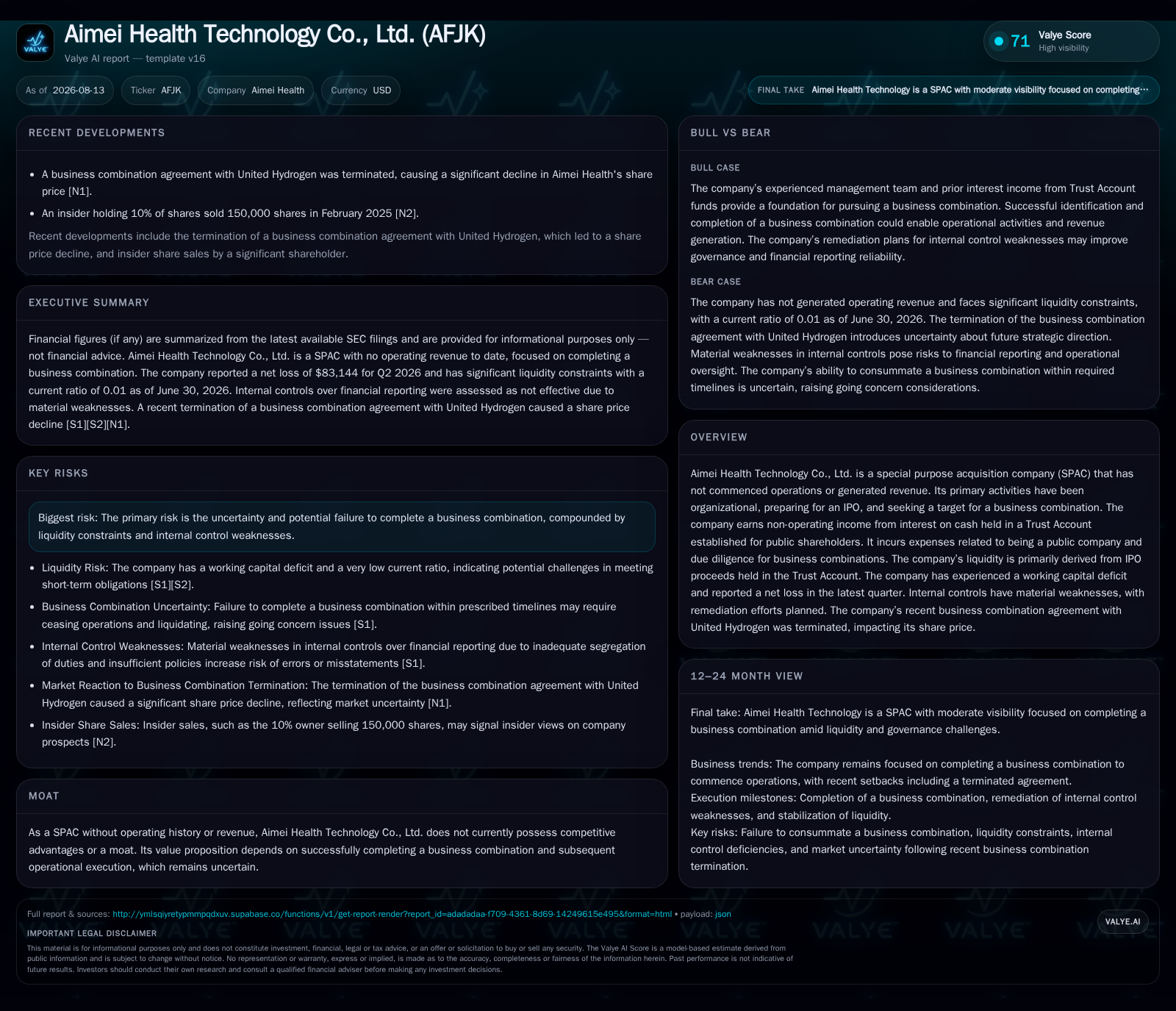
Aimei Health Technology, a blank check company operating as a SPAC, reported the termination of its previously planned business combination with United Hydrogen, which has triggered a sharp reassessment of its liquidity position and strategic outlook. The latest quarterly filings reveal an acute working capital deficit and material internal control weaknesses, underscoring elevated execution risk before securing a new acquisition target. As a pre-combination entity with no operating revenue, Aimei depends entirely on trust account interest and sponsor support to sustain operations while pursuing a viable deal pipeline within regulatory constraints.
Termination of United Hydrogen Deal Sharpens Liquidity Risks Pre-Combination
Aimei Health Technology Co., Ltd. (AFJK) disclosed in its August 2026 10-Q filing that its previously announced business combination agreement with United Hydrogen was terminated as of early August 2026 [S2], [S3]. This development marks a pivotal shift for the SPAC, removing what had been its primary path to operationalization and value creation. The termination followed protracted delays caused mainly by pending approvals from China’s CSRC—an obstacle that had already extended the timeline beyond initial expectations set at the November 2025 extraordinary shareholder meeting approving the combo [S1]. Market reaction was swift as the share price plunged following the announcement reflecting increased investor uncertainty about Aimei’s ability to source an alternative target swiftly and sustain operations while doing so [N1].
With the original deal off the table, Aimei faces urgency to identify new acquisition candidates or risk diluting public shareholders’ IPO proceeds through premature liquidation. The termination triggers standard contractual termination rights but also raises questions about capital adequacy given ongoing costs related to being a public entity and pursuing mergers.
SPAC Business Model Constraints: Funding Cold War Between Interest Income and Administrative Expenses
As a SPAC without operating subsidiaries or revenues before closing an initial business combination, Aimei’s only income source is interest earned on cash proceeds held in a Trust Account established at IPO. At December 31, 2025, Aimei reported $12.1 million in this Trust Account from net IPO proceeds plus private placement contributions from its Sponsor ([F1]). The interest income derived therefrom constituted all non-operating earnings recorded to date. However, general administrative expenses including legal fees, accounting compliance costs, audit expenses, corporate governance expenditures, travel for due diligence, and ongoing SEC reporting obligations are steadily depleting these earnings coverage margins [S1], [S2].
No operating revenue or profit generation will occur until after completing a qualifying business combination. The deferred underwriting fee liability of approximately $690,000 owing upon closing further constrains financial planning by earmarking part of the cash raised for payment directly from the Trust Account reserves. Thus, maintaining sufficient liquidity during this acquisition phase is challenged by fixed public company cost burdens against limited interest income yields.
Latest Operating Metrics Amplify Working Capital Deficit Amid Trust Account Reserve Pressures
More concerningly for short-term solvency is Aimei’s stark balance sheet composition as of June 30, 2026: current assets totaled just $43,966 versus current liabilities reaching $3.84 million ([F1]). This reflects a severe working capital deficit and acute liquidity stress. While much of the liabilities reflect accounts payable tied to administrative obligations necessary in pursuit of new deals or maintaining listing status ([S2]), such an imbalance signals significant funding challenges.
To address immediate funding needs for transaction expenses post-termination, Aimei has entered monthly extension loans with both its Sponsor and formerly with United Hydrogen amounting to $17,165 each month deposited into the Trust Account ([S3], [S6]). These working capital loans illustrate reliance on sponsor support outside typical operating cash flows. It signals vulnerability should agreement terms or sponsor willingness shift adversely before securing another merger.
Complex Industry Backdrop: Peer SPAC Pace and Sponsor Networks Frame Competitive Acquisition Race
Within the broader SPAC industry context characterized by vigorous competition among blank check vehicles to source attractive targets quickly post-IPO, Aimei’s progress aligns with common challenges faced by peers such as Pershing Square Tontine Holdings and Churchill Capital. These comparators show that cycles from IPO raise through shareholder vote approval commonly span multiple quarters with strict timelines often limited around two years.
A critical differentiator is sponsor experience and market network strength enabling rapid identification of appropriate private targets in specialized sectors like healthcare innovation—the focal point identified by Aimei’s strategic intent targeting small-cap biopharma and medtech firms across global regions ([S5]). Furthermore, deferred underwriting fee arrangements typical in these deals link significant compensation incentives directly to successful business combination closings ([S7]), reinforcing alignment but also exerting additional cash demands when timing falters.
Critical Risk Triggers from Governance Shortfalls and Shareholder Approval Dependence
Management has outlined remediation plans involving board expansion post-combination closing alongside hiring external advisors specialized in complex accounting issues ([S16]). Nevertheless, any material control lapses could undermine investor confidence or delay regulatory clearances crucial for deal execution—especially since shareholder approvals remain mandatory for combination ratification ([S1]). Failure to achieve required voting thresholds or delays tied to cross-border regulatory bottlenecks (such as prolonged CSRC review seen before) could further derail prospects.
Growth Prospects Hinged on Target Pipeline Strength, Sponsor Support, and Market Conditions
Although the setback represented by United Hydrogen’s withdrawal dampens immediate growth catalysts, Aimei maintains strategic focus on healthcare innovation segments aligned with sponsor expertise ([S5]). Success hinges heavily on reactivating its pipeline with promising small-cap biopharma or medical devices candidates poised for scalable growth after going public via merger.
Sponsor credibility plays an outsized role at this juncture in attracting quality targets and facilitating potential PIPE financing rounds necessary for augmenting transaction size and smoothing valuation negotiations.
What Investors Should Monitor Next: Deal Announcements, Regulatory Milestones, Liquidity Infusions
Stakeholders should closely track several near-term developments as indicators of operational viability:
- Announcement of new potential business combination targets signifying recovery of deal sourcing momentum;
- Updates regarding regulatory approval status particularly any renewed interactions with foreign authorities akin to prior CSRC reviews;
- Reports detailing further sponsor loans or external capital injections (PIPEs) which would alleviate pressing liquidity deficits;
- Shareholder voting outcomes concerning upcoming transaction proposals or extensions affecting redemption rights dynamics. These events will be decisive checkpoints reflecting whether Aimei can overcome recent setbacks or faces intensifying survival threats.
Financial Profile Discussion: Balancing Deficits Against Trust Account Reserves in Uncertain Environment
As of mid-2026 quarter end ([F1]), Aimei's financial footing reveals acute working capital imbalances highlighted by current liabilities roughly 87 times greater than current assets (around $3.8 million versus under $44 thousand). This pronounced deficit underscores liquidity challenges inherent in SPACs operating without self-generated cash flow streams prior to combination closure.
Net losses stem primarily from unavoidable general administrative expenses offsetting sparse interest income accrued from Trust Account holdings linked directly to IPO proceeds ([F1], [S1]). The deferred underwriting fees of roughly $690k remain payable only upon consummation but represent contingent claims any future transaction must address ([S7], [S13]). In parallel, reliance on sponsor-provided working capital loans exemplifies the precarious balance between maintaining minimum operational funding versus extended timeframes needed for deal announcements amid uncertain market conditions ([S3], [S6]).
Collectively these financial dynamics position Aimei at a critical juncture: careful expense oversight coupled with effective restructuring of acquisition efforts will dictate whether it transforms into an operational combined entity or triggers liquidation procedures consequent upon failure within mandated windows.
Disclaimer: This analysis is informational only and does not constitute investment advice or research views regarding Aimei Health Technology Co., Ltd. or any securities discussed herein.
Disclaimer: This is research-only, informational analysis and not investment advice. It may include AI-generated interpretation and general industry context. Always verify important details using primary sources.

Comments