
MeiraGTx's Integrated Manufacturing and Riboswitch Platform Underpin Broad Gene Therapy Pipeline
Latest quarterly disclosures highlight MeiraGTx’s operational execution amid strategic collaborations and financial discipline.
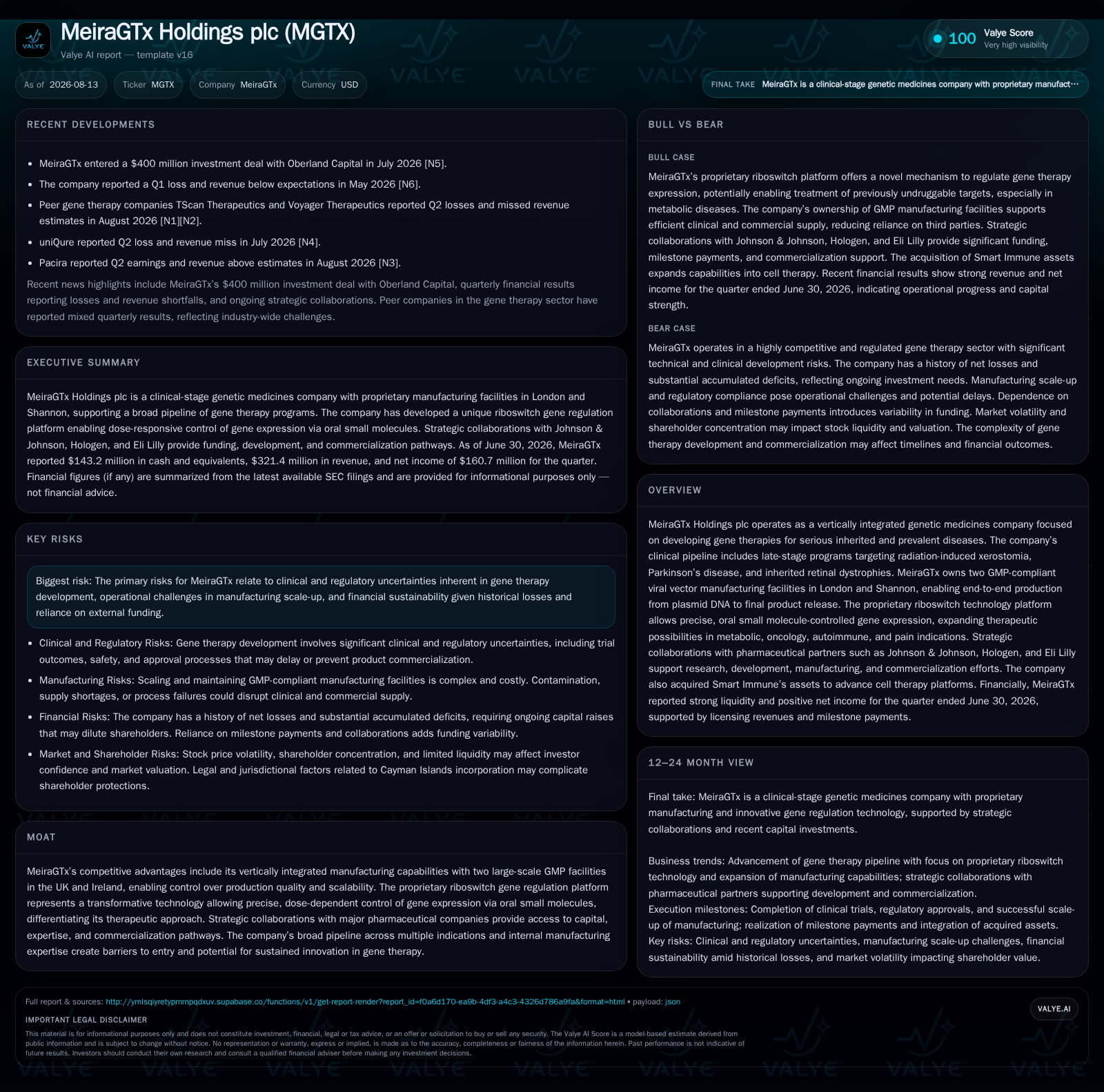
MeiraGTx Holdings plc remains anchored by its vertically integrated gene therapy platform, combining proprietary riboswitch technology with in-house GMP viral vector manufacturing across London and Shannon. Its late-stage pipeline targets both inherited retinal dystrophies and prevalent conditions such as Parkinson’s disease and radiation-induced xerostomia. The August 2026 quarter confirmed sustained investment in manufacturing capacity and progression of strategic pharma collaborations, notably with Eli Lilly. While clinical and regulatory risks persist, along with significant operating losses, the company’s capital structure and liquidity position as of mid-2026 provide a runway for advancing clinical programs and commercial readiness.
Recent Operating Update
MeiraGTx Holdings plc’s latest quarterly filing from August 13, 2026 confirms ongoing progress along its integrated gene therapy development trajectory. The company reiterated active advancement of its late-stage clinical pipeline covering radiation-induced xerostomia, Parkinson’s disease (via AAV-GAD), and inherited retinal dystrophies linked to AIPL1 mutations [S2][S3]. Key strategic collaborations underpinning these efforts include exclusive licensing agreements with Eli Lilly—who holds rights to MeiraGTx’s AAV-AIPL1 product candidate—and Johnson & Johnson Innovative Medicine for RPGR-related retinal gene therapies [S12]. Operationally significant is the maintenance of GMP-compliant viral vector manufacturing certifications by the UK Medicines and Healthcare products Regulatory Agency (MHRA) including the newly acquired Manufacturer’s and Importer’s Authorization for advanced therapy medicinal products obtained late 2025. This authorization validates readiness not only for clinical supply but potentially commercial production through their London facility; a comparable scale GMP vector production site operates at Shannon campus in Ireland [S1].
In financial terms, MeiraGTx reported holding approximately $143 million in cash and cash equivalents as of June 30, 2026, with a current ratio near 3.8x supported by over $218 million in current assets versus approximately $58 million in current liabilities [F1]. The company raised incremental capital via equity offerings under an ATM facility in recent quarters to sustain R&D expenditure stretching across multiple therapeutic domains [S2].
Business Model: Integrated Gene Therapy from Discovery to Manufacturing
MeiraGTx pursues a vertically integrated model uncommon among many gene therapy companies that outsource manufacturing. The firm owns and operates two large-scale GMP viral vector facilities—the London site spanning roughly 29,000 square feet designed specifically for flexible multi-product viral vector manufacture since early 2018, plus the larger Shannon campus incorporating their plasmid DNA production capabilities [S1]. This integration supports stringent quality control over supply for Investigational New Drug (IND) applications through potential commercialization phases
This end-to-end control addresses a critical industry challenge: viral vector yield variability and high cost of goods sold (COGS). MeiraGTx enhances yields via proprietary capsid engineering optimizing potency per vector dose while lowering required vector quantities [S1]. Such efficiency gains can materially impact pricing strategies crucial for patient access given third-party payor scrutiny.
Revenue streams currently hinge on upfront payments plus milestone-based contingent revenues from partner pharma collaborations rather than direct product sales due to the clinical-stage nature. The Eli Lilly ophthalmology collaboration alone included a $75 million upfront payment with potential milestones exceeding $400 million based on achievement of development, regulatory approval, and commercialization targets [S12]. Johnson & Johnson also exercises broad exclusivity control over RPGR retinal dystrophy assets previously assigned by MeiraGTx.
A distinctive technological differentiator is their proprietary riboswitch gene regulation platform—synthetic RNA elements embedded within the transgene construct that enable precise dose-dependent transgene expression modulation triggered by orally bioavailable small molecules. This innovation extends therapeutic applicability into systemic metabolic diseases (e.g., GLP-1 analog delivery), oncology cell therapy controls, autoimmune indications, and long-term pain management ideally enabling safer regulated gene expression profiles versus constitutive promoters widely used today [S1].
Industry Structure and Competitive Position
In the broader genetic medicines sector—a high fixed-cost environment marked by capital-intensive R&D coupled with stringent regulatory oversight—control over vector manufacture is a strong moat. Many competitors depend on external CDMOs introducing supply chain bottlenecks or quality inconsistency risks that can delay program timelines.
Peers like uniQure NV also maintain internal viral vector manufacture but differ in therapeutic area focus; Spark Therapeutics gained early U.S. FDA approvals but relies more extensively on third-party manufacturing scale-ups; Sangamo Therapeutics emphasizes gene editing with few internal production assets. MeiraGTx's combination of capsid optimization technology alongside multi-site GMP viral vector manufacture places it competitively in a segment analogous to REGENXBIO who license capsids but also scale manufacturing.
Strategic pharma partnerships function not only as revenue sources but also validation vehicles reducing program risk by sharing development costs—essential in this expensive space where trial failures or delays can be very costly. Accessing partners like Eli Lilly broadens global commercial capabilities particularly important given the complex reimbursement landscape governing novel ATMPs.
Growth Drivers
Key growth catalysts emerge from both technological advancements and market dynamics:
- Pipeline Expansion: Late-stage trials in Parkinson’s disease (AAV-GAD) targeting a prevalent neurodegenerative condition alongside inherited retinal dystrophies increase addressable patient populations beyond rare diseases classic to gene therapy.
- Manufacturing Scale: Capacity utilization ramp-up driven by internal programs plus third-party contract production obligations enhances economies of scale reducing per-batch costs.
- Riboswitch Platform Adoption: Potential licensing or internal program expansion into systemic biologic delivery could monetize this platform across lucrative metabolic or immuno-oncology indications.
- Regulatory Milestones: Achieving IND filings followed by Phase III success triggers milestone revenue inflections.
- Pricing & Reimbursement Innovation: Demonstration of dosing efficiency paired with safety benefits from regulated expression may aid market access negotiations.
Risks / Watchpoints / Growth Constraints
Despite promising positioning several risks warrant monitoring:
- Clinical Uncertainties: Timing of patient enrollment, trial execution challenges or lack of efficacy/safety signals could delay or derail pipelines.
- Regulatory Complexity: FDA/EMA/MHRA approval processes remain inherently uncertain especially for novel platforms like riboswitches; unexpected requirements could extend development timelines or costs.
- Manufacturing Scale-Up Risks: Expansion from clinical scale to commercial batch sizes often introduces technical hurdles impacting batch release success rates.
- Financial Sustainability: High burn rate relative to limited revenues increases dependence on capital markets; potential dilution from equity raises could impact shareholder value perception.
- Intellectual Property Challenges: Significant spend defending patent portfolios essential against competitor encroachment especially on capsids or riboswitch technologies.
- Dependency on Strategic Partners: Loss or weakening of collaboration terms can diminish resource availability or commercialization progress.
What to Watch Next
Upcoming operating milestones critical to validating MeiraGTx’s value proposition include:
- Clinical data readouts or progression announcements from Parkinson’s disease AAV-GAD program assessing efficacy/safety endpoints.
- Regulatory filings or feedback related to riboswitch-enabled systemic therapies expanding platform utility beyond ophthalmology.
- Operational metrics around scaling batch release success rates at London/Shannon facilities reflecting manufacturing robustness.
- Updates on milestone payments realization under Eli Lilly ophthalmology collaboration tied to regulatory submissions or approvals.
- Capital raise activities or shifts in debt covenants indicating financing flexibility amid R&D spending pressures.
Financial Profile Discussion
As of June 30, 2026, MeiraGTx reported cash & equivalents totaling approximately $143 million, with current assets of $218 million and current liabilities of $58 million implying a current ratio near 3.76x [F1]. Total outstanding debt was approximately $25 million as of March 31, 2026, resulting in a net cash position of about $118 million [F1]. This liquidity backdrop provides meaningful runway extension while pursuing costly clinical trials and manufacturing expansions.
Revenue recognized remains modest ($81 million reported for full year ending December 2025), primarily derived from upfronts/milestones within strategic collaborations rather than product sales since no marketed therapies exist currently. Operating results continue at a loss magnitude exceeding $105 million pressured by substantial R&D investments in pipeline expansion plus fixed cost absorption tied to GMP facility operations [F1]. Managing this cash burn remains essential pending regulatory approvals enabling revenue diversification via product commercialization or augmented royalty streams.
MeiraGTx has prioritized balance sheet strength through controlled capital deployment alongside selective equity raises under ATM programs observed during Q2 raising approximately $28 million gross proceeds recently [S2]
This analysis synthesizes latest publicly filed information without extrapolating unsupported forecasts. Market reception will hinge materially on upcoming clinical data readouts and regulatory interactions defining the path toward commercial success within the evolving genetic medicine ecosystem.
Disclaimer: This is research-only, informational analysis and not investment advice. It may include AI-generated interpretation and general industry context. Always verify important details using primary sources.

Comments