
Candel Therapeutics Reinforces Clinical and Financial Position on Path to Viral Immunotherapy Milestones
August 2026 filings reflect advancing pivotal trials for Candel’s viral immunotherapies alongside a robust cash position supporting ongoing development.
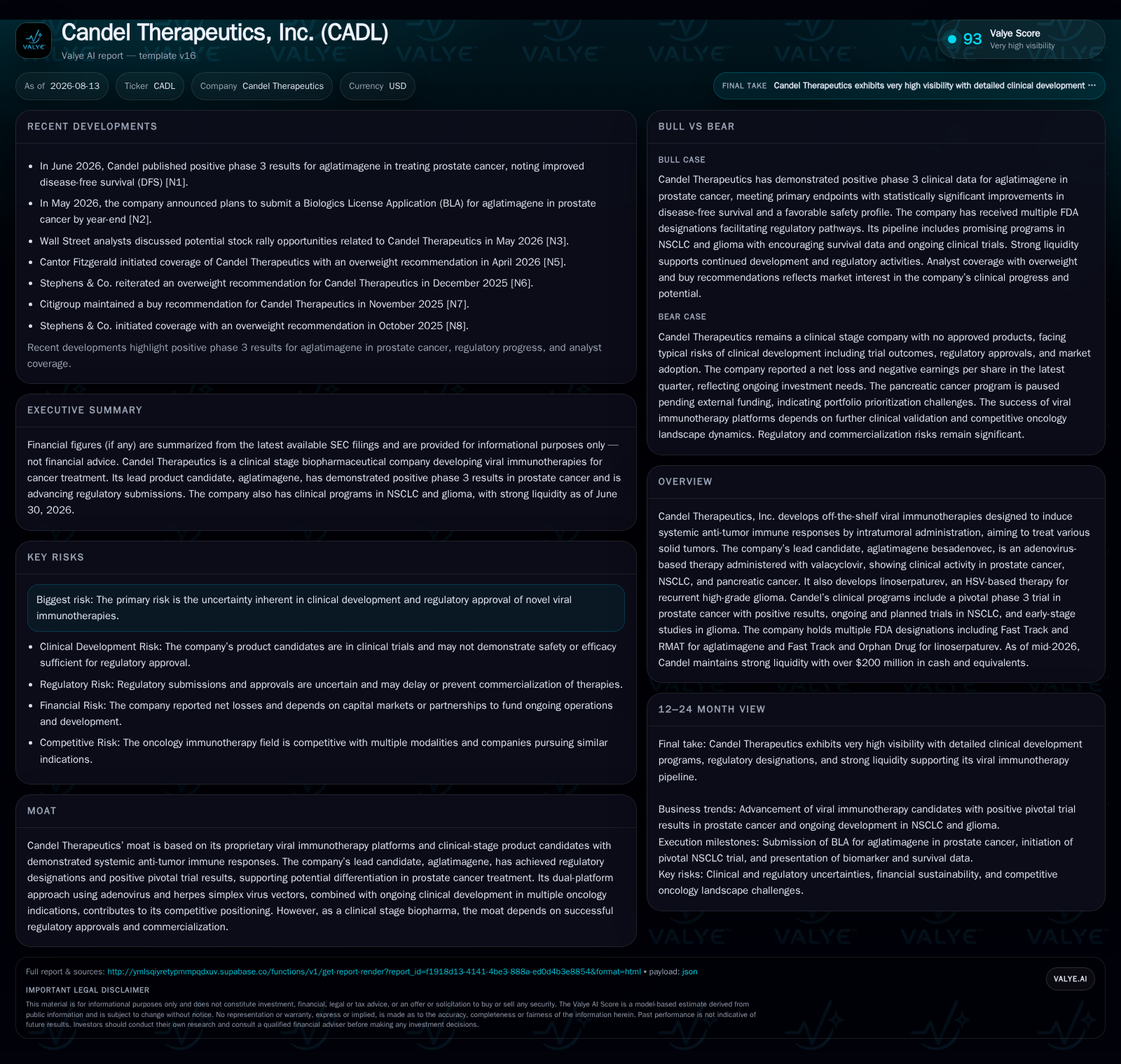
Candel Therapeutics’ latest quarterly disclosure underscores meaningful momentum in its Phase 3 pivotal trial for aglatimagene besadenovec targeting localized prostate cancer, supported by multiple FDA designations accelerating regulatory engagement. The company’s dual viral immunotherapy platforms—adenovirus and herpes simplex virus vectors—enable intratumoral administration designed to generate systemic anti-tumor immune responses with clinical activity shown across solid tumors including NSCLC and glioma. Backed by a strong liquidity base exceeding $200 million and low debt, Candel is positioned to sustain its capital-intensive R&D pathway through near-term catalysts. However, the firm remains exposed to typical clinical-stage biotech risks related to trial outcomes, regulatory hurdles, and financing needs.
Quarterly Operating Momentum: Progress in Phase 3 and Ongoing Trials
In its August 2026 10-Q filing, Candel Therapeutics reaffirmed active advancement of its lead viral immunotherapy candidate aglatimagene besadenovec in a pivotal Phase 3 randomized controlled trial (RCT) focused on localized prostate cancer patients at intermediate to high risk of progression [S2]. This study is conducted under a Special Protocol Assessment (SPA) agreement with the FDA—a procedural endorsement of trial design that reduces regulatory uncertainty while bolstering investor confidence. The close monitoring of patient enrollment rates and adherence to protocol milestones evidences operational execution conducive to generating the efficacy data needed for potential marketing authorization.
Further enhancing this momentum are several regulatory incentives awarded to aglatimagene such as Fast Track Designation enabling rolling submission opportunities and Regenerative Medicine Advanced Therapy (RMAT) status that potentially accelerates review timelines based on mechanistic rationale and preliminary evidence of benefit [S1]. Complementary programs like the adenoviral platform study in non-small cell lung cancer (NSCLC) and investigational use of linoserpaturev—a herpes simplex virus (HSV)-based candidate—for recurrent high-grade glioma expand Candel’s clinical footprint beyond prostate cancer [S1]. Early signals of systemic immune activation observed in these trials suggest potential cross-tumor applicability that could drive future pipeline diversification.
Leveraging Proprietary Dual Viral Platforms: Business Model Realities
Candel’s business model centers around proprietary off-the-shelf viral immunotherapy platforms employing genetically modified adenovirus (aglatimagene) and HSV vectors (linoserpaturev) engineered for intratumoral injection [S1]. This mode of delivery focuses therapeutic activity within the tumor microenvironment to initiate immunogenic cell death—a process that releases tumor neo-antigens fostering systemic anti-tumor immunity. Intratumoral administration offers a strategic advantage in minimizing systemic exposure thus reducing off-target toxicity while exploiting localized viral replication dynamics for maximal immune engagement.
Distinct from autologous cell therapies or personalized biologics requiring individualized manufacturing logistics, Candel’s 'off-the-shelf' approach facilitates standardized production runs enabling scalable supply chains [S1]. Nonetheless, manufacturing viral vectors involves complex biological processes subject to yield variability and capacity constraints which remain an operational challenge impacting cost structures and commercialization feasibility. The combination of adenovirus vector administration alongside prodrug valacyclovir synergistically induces cytotoxicity selectively within infected tumor cells enhancing therapeutic potency
The company’s strategy positions it within the early-to-mid stages of the biotech value chain primarily focused on accelerated R&D efforts rather than revenue generation—as no products have received approval or launched commercially yet. Validation derives from advancing clinical assets through regulatory milestones such as SPAs and orphan drug designations which convey competitive differentiation compared to single-platform rivals lacking these endorsements.
Competitive Dynamics: Positioned Among Viral Immunotherapy Peers
Within the clinical-stage viral immunotherapy sector—which includes peers like Oncolytics Biotech (focused on reovirus-based therapies) or BioNTech's expanding oncology pipeline—Candel distinguishes itself through a dual-platform strategy spanning adenovirus and HSV vectors coupled with pivotal Phase 3 activity. Regulatory Fast Track and RMAT designations serve as markers of advanced development status which generally correlate with enhanced valuation multiples relative to earlier-stage developers absent such designations.
While many competitors navigate extended Phase 1/2 windows addressing safety and preliminary efficacy questions, Candel’s transition into confirmatory studies reflects maturation that could expedite commercialization readiness upon positive outcomes. However, differentiation will ultimately hinge on demonstrating both durable patient response rates across diverse tumor types and operational capacity to manufacture complex biologics at scale—factors routinely scrutinized by large pharma partners who may serve as commercialization allies post-approval.
Expanding the Pipeline: Potential Growth Drivers Across Indications
Beyond prostate cancer—the initial focus area accounting for significant unmet need given relapse rates despite conventional therapy—Candel pursues pipeline expansion via ongoing NSCLC trials leveraging the adenovirus platform and early clinical investigations in recurrent high-grade glioma with its HSV candidate [S1]. These indications represent high incidence or orphan-designated cancers with distinct immunological landscapes—the latter notoriously resistant to standard treatments creating a compelling market opportunity if systemic anti-tumor immunity can be reliably induced.
Advances in viral vector engineering—including high-titer formulation improvements—and intratumoral delivery techniques may enhance product candidate attributes such as tissue penetration or immune milieu modulation. Strategic partnerships remain an untapped avenue fostering access to expanded intellectual property rights or co-development capabilities. Regulatory incentives like orphan drug status for linoserpaturev further underscore potential exclusivity windows enabling premium pricing strategies upon approval.
Risks Highlighted: Clinical, Regulatory, and Capital Constraints
Consistent with biotech norms, Candel faces significant risk from clinical trial volatility where positive pivotal data are not guaranteed despite encouraging preliminary signals [S1],[S2]. FDA approval depends not only on efficacy proof but also on safety profiles acceptable relative to existing standards of care. Any adverse findings could delay timelines or necessitate additional studies increasing cash consumption.
Regulatory environment flux presents another variable; while Fast Track and RMAT designations signify collaborative agency relationships today, future policy reinterpretations might alter requirements adding complexity or cost burdens. Capital intensity inherent in manufacturing biologic viral therapies coupled with ongoing losses mandates disciplined financing strategies—raising dilution risk if equity issuance becomes necessary absent commercial revenues.
Growing competition from alternative immunotherapy modalities including checkpoint inhibitors or CAR-T cell therapies imposes market adoption pressures even if Candel secures approval. Reimbursement dynamics further complicate commercial projections emphasizing the need for robust real-world evidence post-launch.
What Investors Should Monitor Next: Milestones and Cash Flow
Critical forward-looking indicators include interim analyses or data readouts from the Phase 3 prostate cancer trial expected over the next 12-18 months following continued patient accrual benchmarks [S2]. Enrollment pace metrics serve as a bellwether for execution risk; delays would prolong developmental timelines increasing cash burn.
Engagements with FDA concerning regulatory submissions—including companion diagnostics development or label expansions—will provide insight into approval probability trajectories. Expansion updates regarding NSCLC studies or glioma trials reflecting patient response durability would also be material given pipeline breadth implications.
Operational cash flow trends warrant close attention; ongoing R&D expenditure relative to cash reserves dictates liquidity runway. Management guidance anchored around sustained funding through projected catalyst events forms part of this assessment.
Financial Profile Discussion: Capital Adequacy Supports Clinical Execution
As of June 30, 2026, Candel held approximately $201.6 million in cash and equivalents against $46.7 million in total debt resulting in a net cash position exceeding $154 million—a strong liquidity buffer for a clinical-stage biotech [F1]. Current assets stood at $204.2 million with current liabilities limited to $12.7 million yielding a high current ratio above 16x which signals low near-term solvency risk [F1].
The company reported operating losses consistent with capital-intensive R&D investment typical at this development stage (-$48 million operating loss year-end 2025), fueled by increased clinical trial activities [F1],[S2]. No revenue generation from product sales has occurred reflecting absence of approvals but given positive trial developments combined with ample cash runway extending possibly into early 2028 per management estimates, Candel’s financial profile currently supports uninterrupted advancement towards critical proof-of-concept endpoints [S3].
Effective expenditure control balanced with strategic clinical acceleration will be decisive for sustaining growth prospects.
This analysis synthesizes recent SEC disclosures through August 2026 along with biotech sector context surrounding clinical-stage viral immunotherapies without providing investment advice. The operating narrative emphasizes transparency around development progress paired with financial strength while candidly assessing risks endemic to emerging oncology biologics enterprises pursuing multi-indication viral therapeutics.
Disclaimer: This is research-only, informational analysis and not investment advice. It may include AI-generated interpretation and general industry context. Always verify important details using primary sources.

Comments