
UTime Ltd Restructures Capital Amid VIE Regulatory Risks in Emerging Market Mobile Manufacturing
UTime’s 2026 share consolidation and director equity grants reflect strategic capital actions against a backdrop of moderate liquidity and industry complexity.
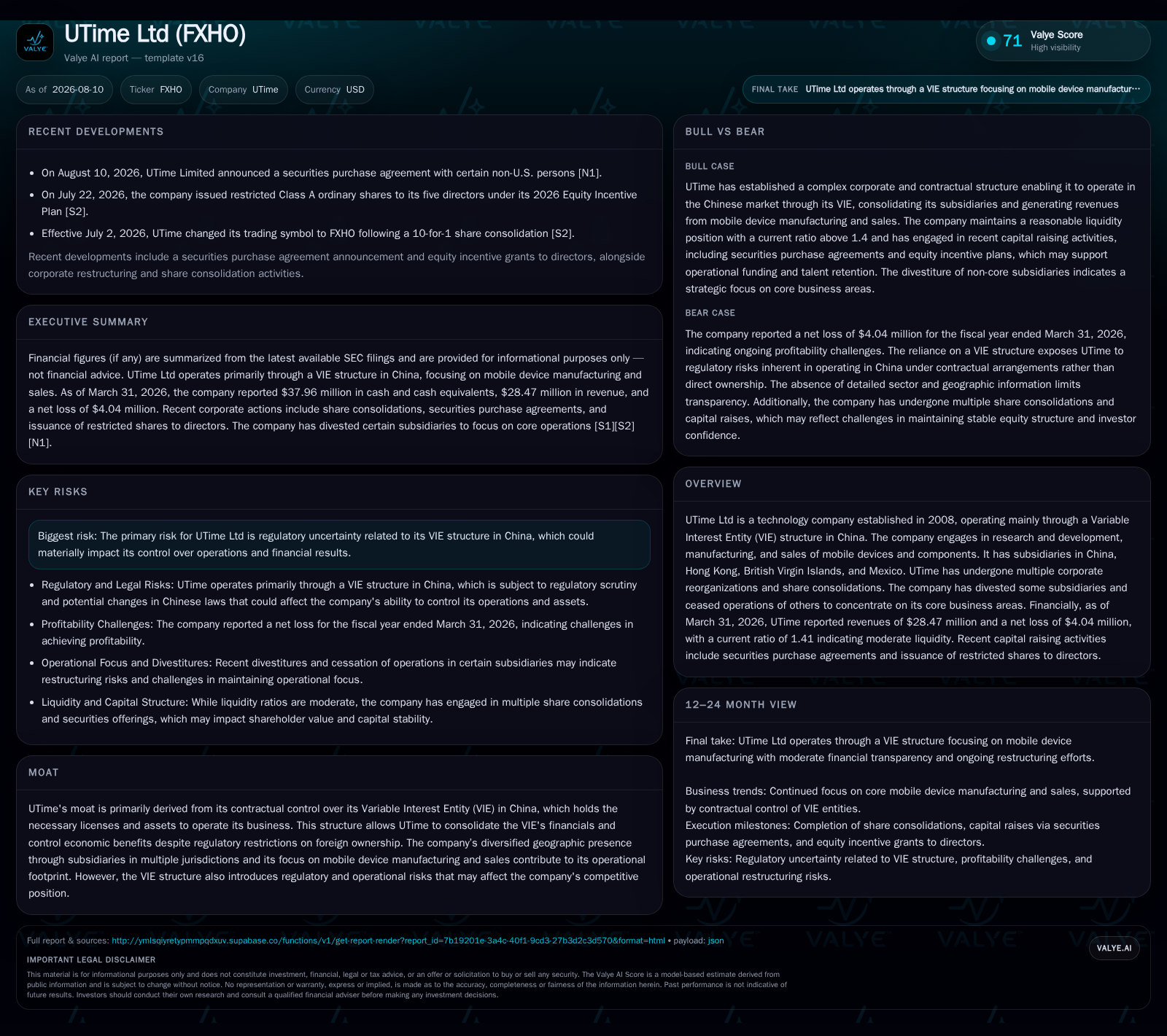
UTime Ltd, operating through a Variable Interest Entity (VIE) structure in China, reported $28.5 million revenue and a net loss of $4 million for the fiscal year ending March 2026, reflecting ongoing investment amid operational challenges. The company recently implemented a 10-for-1 share consolidation and issued restricted shares to directors as part of equity incentivization efforts. UTime’s business centers on designing and manufacturing mobile devices and components for emerging markets through its two brands targeting price-sensitive and quasi-middle-class consumers. While its core EMS services and overseas sales underpin revenue, regulatory uncertainty tied to its VIE limits long-term visibility. The firm’s moderate liquidity with a current ratio of 1.41 supports near-term operations but capital raising remains critical to fund growth initiatives.
Recent Operating Update
UTime Ltd’s latest filing reports critical near-term corporate actions executed during H1 2026 that bear on its market positioning and capital structure. Most notably, on June 22, 2026, the company implemented a 10-for-1 share consolidation designed to reduce share count ambiguity following extensive private placements since 2025. Further reinforcing alignment between management and investors, UTime granted each of its five directors 180,000 restricted Class A ordinary shares under its equity incentive plan by late July 2026 [S2]. This series of equity adjustments follows multiple rounds of private placements raising over $25 million in gross proceeds during late 2025 and early 2026 aimed at supporting working capital needs [S1].
Business Model Overview
UTime operates principally as a technology-driven mobile device manufacturer leveraging a Variable Interest Entity (VIE) model domiciled in China to embed foreign economic benefits despite constraints on direct foreign ownership [S1]. Through this VIE arrangement centered on UTime SZ in China—effectively controlled via contractual agreements by the offshore holding entity—the company consolidates the Chinese operating results while mitigating some regulatory restrictions.
The business bifurcates along two revenue streams: first as an Electronics Manufacturing Services (EMS) provider offering Original Equipment Manufacturer (OEM) and Original Design Manufacturer (ODM) solutions predominantly for recognized third-party brands like TCL Communication Technology Holdings; second as a branded device vendor selling under two proprietary labels—"UTime," addressing middle-to-upper consumer segments mainly among emerging market quasi-middle-class clients; and "Do," targeting cost-conscious grassroots buyers demanding affordable smartphones leveraging recent communication tech advances [S1]
Revenue derives mainly from product sales — encompassing mobile phones, accessories, and related consumer electronics — distributed through various emerging international markets including India, Brazil, South Asia, Africa, Europe, and the US. OEM/ODM contracts contribute production volume stability but are subject to client demand variability largely influenced by global supply chain conditions [S1]. The company maintains an emphasis on Printed Circuit Board Assembly (PCBA) quality standards within manufacturing services to differentiate itself in cost control and responsiveness.
Margins are sensitive to component sourcing costs and production capacity utilization rates typical of industrial hardware firms focused on mobile devices. Price competition both within the EMS market segment and own-brand retail necessitates efficient supply chain management alongside innovation investment. UTime’s brand segmentation strategy reflects industry dynamics where emerging middle-class customers seek advanced yet affordable devices while more price-sensitive consumers gravitate towards no-frills connectivity solutions.
Industry Structure And Competitive Positioning
UTime operates in the intensely competitive mobile devices and consumer electronics manufacturing sector dominated globally by large integrated players such as Apple (premium brand ecosystem), Huawei (R&D-heavy manufacturer), Xiaomi (cost-focused emerging market leader), TCL Communication (EMS plus branded devices), Samsung Electronics (diverse portfolio), and Foxconn (leading contract manufacturer). By comparison, UTime occupies a niche strategy focused disproportionately on emerging markets through mid- to low-end devices targeting specific socio-economic consumer tiers.
The industry is highly capital-intensive with razor-thin margins typical in EMS/OEM segments due to bargaining power exerted by large clients and rapid technology transitions necessitating continuous R&D investments. Supply chain disruptions — particularly component shortages seen broadly since post-pandemic recovery periods — add volatility to production schedules and cost bases.
Further structural complexity arises from UTime’s reliance on the VIE framework which permits foreign-listed entities indirect consolidation of PRC operating subsidiaries hosting essential licenses or intellectual property. However, regulatory uncertainties around VIE continuation post-China's tighter enforcement increase operational risks contrasting with peers domiciled fully within Hong Kong or other less constrained jurisdictions.
Growth Drivers
Despite headwinds from regulatory uncertainties and competitive pressures, UTime benefits structurally from key growth vectors consistent with broader industry trends:
- Emerging Market Penetration: Rising disposable incomes among expanding quasi-middle-class populations drive demand for mid-range smartphones featuring modern connectivity technologies.
- Dual Brand Segmentation Strategy: Leveraging separate brands "Do" for value seekers and "UTime" for upgraded buyers allows tailored marketing approaches optimizing customer acquisition costs across segments.
- New Product Focus: The global wearable device market growth projected beyond $8 billion by 2025 with health applications leading adoption complements UTime’s product pipeline restructuring toward AR/VR headsets and wearable biosensor tech integration [S1].
- OEM/ODM Outsourcing Trends: Global brand holders increasingly outsource design/manufacturing functions to capable providers like UTime benefiting from established PCBA expertise.
- After-Sales Service Expansion: Enhancing user experience through localized service offerings boosts brand loyalty especially within geographically dispersed emerging markets.
Execution against these drivers depends substantially on sustaining efficient production capacity utilization minimizing inventory obsolescence amidst fast product lifecycles while navigating periodic currency fluctuations affecting cost base impressions.
Risks And Watchpoints
Leading risk stems from the VIE ownership model's exposure to potential changes in Chinese government regulations restricting or invalidating contractual control mechanisms over domestic subsidiaries—an outcome capable of materially impairing UTime's consolidated financials or operational command [S1]. This theoretical risk shapes investor sentiment given evolving PRC stances toward foreign listings employing similar structures.
Operationally significant risks include:
- Supply Chain Volatility: Component shortages or price hikes can compress gross margins or delay product launches impacting revenue timing.
- Intense Pricing Competition: Peer feature parity forces continuous cost reductions offsetting increased R&D spending required for technological parity or differentiation.
- Foreign Exchange Controls: Limitations on cross-border cash repatriations can restrict dividend payments affecting liquidity flexibility despite offshore holding entities’ ability to transfer funds more freely via Hong Kong subsidiaries [S1].
- Dependence On Key Clients: Concentration risk from major ODM/OEM customers could disrupt volume predictability if contracts lapse unexpectedly.
- Capital Funding Needs: Continued net losses indicate dependence on external capital raising to sustain operational expansion limiting near-term profitability outlooks.
Indicators suggesting mitigation include broadening order backlogs if disclosed in future reports, gradual improvement in gross margin percentage as manufacturing scale increases or technological innovation occurs, plus successfully integrating new products aligned with wearable device market expansions.
What To Watch Next
lion suggesting moderate short-term coverage at March fiscal year-end [F1].
- Regulatory environment updates specific to China’s stance on VIE structures or broader export/import policies potentially impacting manufacturing geography or end market access.
Financial Profile Discussion
Capital raisings since mid-2025 cumulatively exceed $25 million gross via private placements accompanied by public offerings inclusive of warrants structured for upside participation though dilutive if exercised extensively [S1]. These funding rounds primarily intend for general working capital purposes rather than targeted acquisitions signaling cautious financial stewardship amidst exploitable market opportunity windows.
Ultimately, maintaining sufficient runway financed through equity injections will be pivotal until sustainable positive EBITDA trajectories materialize driven by enhanced brand penetration combined with steady OEM/ODM contract expansions supported by optimized supply chains.
This analysis integrates disclosures from UTime Ltd’s latest quarterly (Form 6-K July 2026), annual report (Form 20-F August 2026), with contemporaneous financial snapshots highlighting operating context within the complex mobile device manufacturing sector dominated by evolving regulatory frameworks associated with VIE structures in China.
Disclaimer: This is research-only, informational analysis and not investment advice. It may include AI-generated interpretation and general industry context. Always verify important details using primary sources.

Comments