
Gulf Coast Ultra Deep Royalty Trust Faces Uncertain Outlook After Well Abandonment
The trust’s income prospects hinge on the uncertain commercial viability of a newly drilled well after abandonment of its sole producing asset.
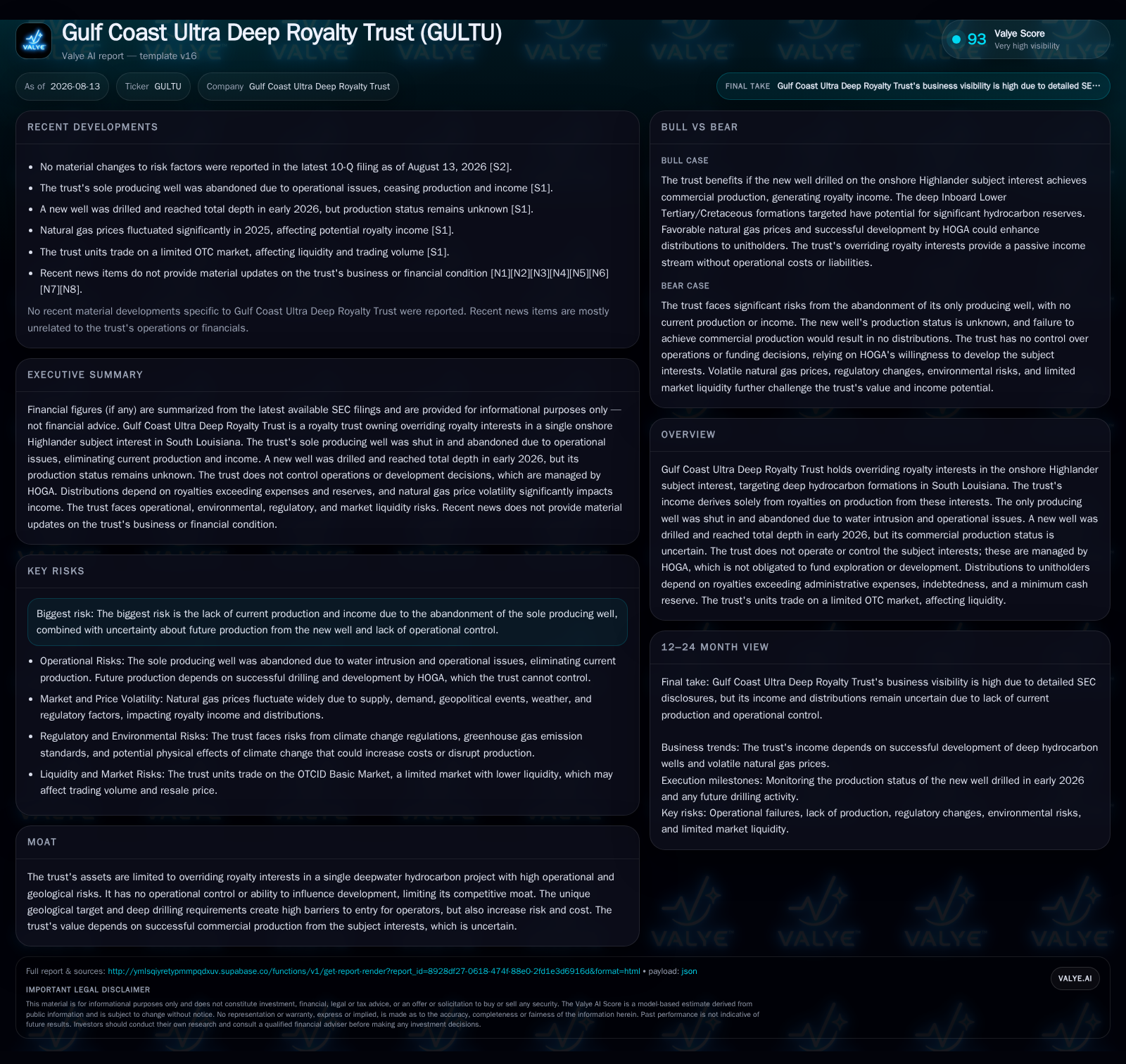
Gulf Coast Ultra Deep Royalty Trust’s only producing well was abandoned following operational failures, eliminating current royalty income and halting distributions. A new well has been drilled to total depth, but its commercial production status remains unknown, leaving the trust reliant on the operator HOGA's future development decisions over which it has no control. This deepwater-focused royalty trust faces elevated risks from production interruption, commodity price volatility, and liquidity constraints given its single-asset concentration and OTC trading status. Investors should monitor milestones around the new well's production approval and operator capital allocation to gauge prospects for restored cash flow.
Latest Operating Update: Well Abandonment Ends Current Royalty Income
The Gulf Coast Ultra Deep Royalty Trust’s recent quarterly filing confirms that its only producing well within the onshore Highlander subject interest was permanently abandoned in early 2024 [S1]. The well had experienced substantial water intrusion starting in January 2023 that forced an extended shut-in period. Despite intermittent attempts to restore flow, by March 31, 2023, production effectively ceased. The operator, HOGA, after thorough evaluation determined that underground fluid influx made salvage impossible and commenced plug-and-abandon operations in March 2024
This event critically halted all royalty income for the trust as it holds overriding royalty interests solely tied to this property. Without commercial production from this well or another successful producer in the area, there are no revenues available for distribution to unitholders going forward [S1],[S2].
Business Model: Passive Overriding Royalty Interests with No Operational Control
Gulf Coast Ultra Deep Royalty Trust’s business model centers on passive ownership of overriding royalty interests (ORIs) in deep hydrocarbon formations located onshore in South Louisiana. The trust does not operate wells nor fund exploration or development activities. Instead, it receives a percentage of gross proceeds from hydrocarbons produced by operators—in this case primarily HOGA—who control drilling, completion, and production decisions.
Critically, the trust has no ability to influence or compel operator activity or capital deployment. It bears no operational costs but also has no say over timing or success of exploration and production efforts [S1]. This lack of control magnifies execution risk since all cash flows depend on a third party’s business judgments.
Industry Context: Single-Asset Exposure Heightens Risk Relative to Peers
Within the oil and gas royalty trust sector, Gulf Coast Ultra Deep stands out for its concentrated exposure to one ultra-deep asset with exploratory characteristics. By contrast, peers such as Sabine Royalty Trust benefit from diversified portfolios spanning multiple basins and producing wells that provide more stable cash flows.
Mature trusts like Permian Basin Royalty Trust draw on established fields with consistent output supporting regular distributions. Upstream MLPs like Viper Energy Partners often maintain mineral interests combined with operational insights or influence enhancing their ability to anticipate or affect cash flows.
This concentrated asset base combined with OTC listing limits liquidity relative to exchange-traded peers and increases investor risk stemming from narrow revenue sources and limited market access [S1],[S27].
Key Risks: Production Disruption, Commodity Price Volatility, and Limited Distributions
The permanent abandonment of the sole producer creates a fundamental risk of prolonged revenue absence until new commercial production is established. The newly drilled well reaching total depth by February 2026 represents a potential but unproven revenue source [S1]. Without confirmation of commercial flows, income remains speculative.
Royalty payments are inherently sensitive to commodity prices since they derive as a fraction of sales proceeds. Natural gas prices have historically fluctuated widely due to supply-demand imbalances, geopolitical tensions, regulatory changes affecting emissions standards, weather events, and alternative energy developments—all factors beyond operator or trust control [S14],[S18],[S19].
Moreover, administrative expenses continue regardless of income levels. The trust maintains minimum cash reserves which must be met before distributions can resume, further constraining cash flow availability [S15]. The reliance on HOGA’s financial contributions through loans or expense payments during low-income periods introduces counterparty risk.
Growth Drivers: New Well Success Hinges on Operator Decisions and Technical Outcomes
The primary growth driver is successful completion and commercialization of the recently drilled exploratory well. Technical challenges inherent in ultra-deep formations—such as extreme temperatures and pressures—make drilling complex and costly.
Operator HOGA’s willingness to invest in completion work, infrastructure buildout (e.g., gathering lines), testing phases, and timing for bringing production online will determine if royalties resume [S1]. Without transparency into capital expenditure plans or test results from HOGA, predicting recovery timelines remains challenging.
What Investors Should Monitor Going Forward
Investors should closely track several key indicators:
- Confirmation of commercial production status including initial test rates from the new well.
- Disclosures from HOGA regarding capital spending priorities related to completing infrastructure supporting new production.
- Commodity price trends impacting prospective royalty revenues.
- Administrative cost management versus limited inflows affecting net distributable amounts.
- Any changes in trust governance or financial arrangements that could alter risk profile.
Regular updates on these fronts will be essential for assessing whether Gulf Coast Ultra Deep can restore meaningful distributions after its prolonged dry spell marked by abandonment events [S1],[S2].
In sum, Gulf Coast Ultra Deep Royalty Trust exemplifies a highly leveraged passive investment exposed to significant operational risks due to dependence on a single ultra-deep project operated independently by HOGA. The abandonment of its sole producing well has eliminated current royalties while a recently drilled exploratory well offers uncertain upside contingent on technical success and operator capital commitment. Commodity price volatility further complicates revenue visibility. The trust’s OTC listing adds liquidity challenges relative to diversified peers with broader asset bases or greater operational involvement. Ultimately, value realization depends critically on exploration outcomes within challenging formations coupled with prudent cost controls limiting erosion of any limited income when present.
Disclaimer: This analysis is for informational purposes only and does not constitute investment advice or research views.
Disclaimer: This is research-only, informational analysis and not investment advice. It may include AI-generated interpretation and general industry context. Always verify important details using primary sources.

Comments