
F&M Bank Strengthens Virginia Footprint with Loan Growth and Diversified Income in Q2 2026
Loan growth, improved net interest margin, and gains from investment sales drive F&M Bank’s strong quarterly income, amid cautious liquidity management and modest branch expansion.
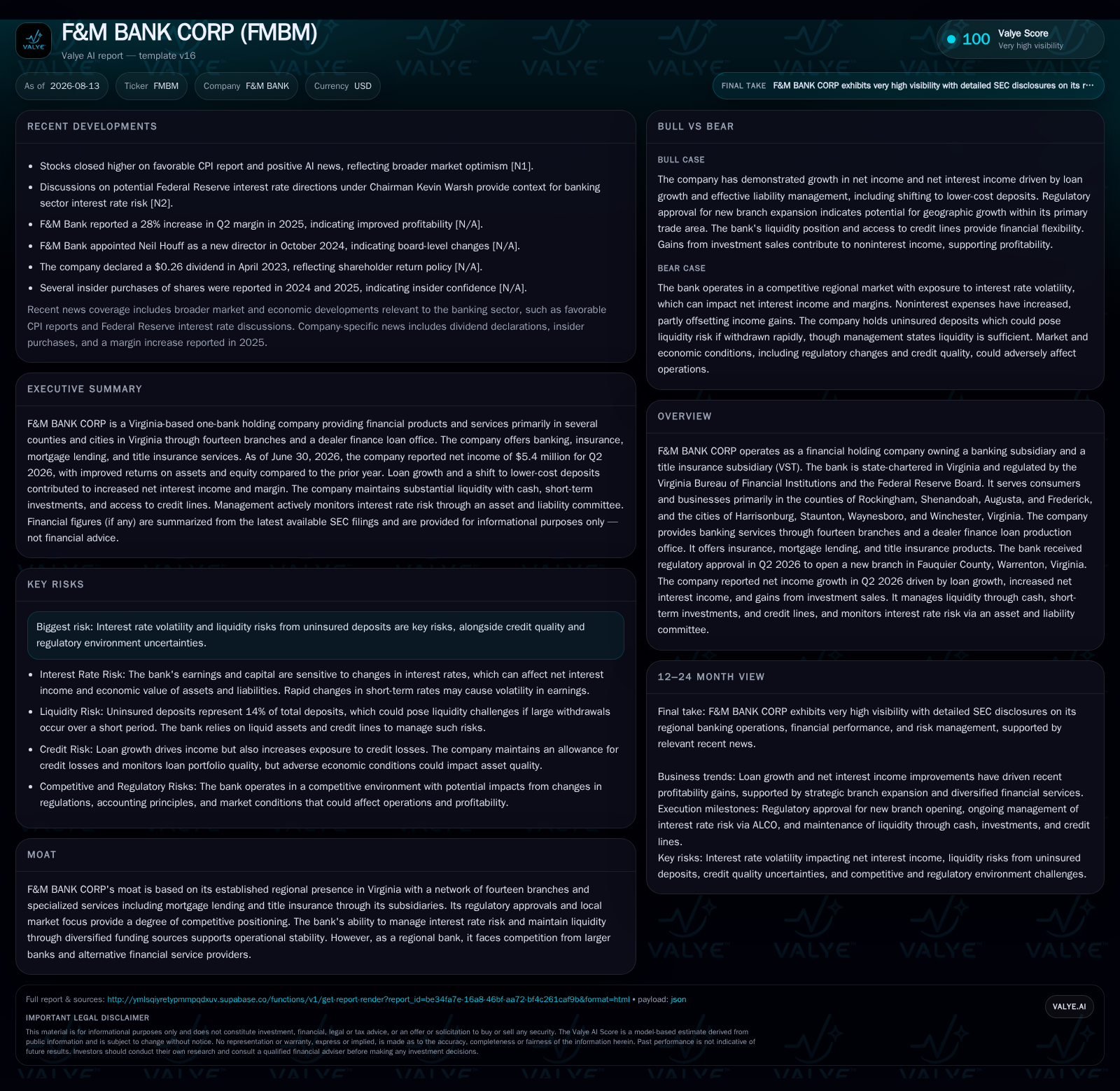
F&M Bank Corp reported a robust second quarter in 2026, powered by $39 million loan growth and a net interest margin increase to 3.79%, supported by a strategic shift from time deposits to lower-cost transaction accounts. Noninterest income benefited from a one-time $4.8 million gain on the sale of Bearing Insurance, partially offset by a $3.5 million investment securities loss. The bank maintains strong liquidity with $92.9 million in liquid assets and significant borrowing capacity. Regulatory approval for a new branch in Fauquier County encapsulates its measured regional expansion strategy within a competitive Virginia banking landscape.
Recent Operating Update: Loan Growth and Margin Expansion Anchor Q2 2026
Noninterest income advanced by $2.1 million largely due to the one-time pre-tax gain of $4.8 million from selling its interest in Bearing Insurance earlier in April 2026; this was partly offset by a restructuring loss of $3.5 million related to available-for-sale investment securities [S25, S18]. Additional noninterest income drivers included increased service charges on deposits, mortgage banking activities, title insurance via its subsidiary VST, and card services interchange revenue, indicating successful diversification beyond traditional banking revenue streams.
Business Model: Regional Banking with Mortgage and Insurance Integration
F&M Bank is structured as a financial holding company overseeing a state-chartered bank and title insurance subsidiary VST operating primarily across seven counties and cities in Virginia including Rockingham, Shenandoah, Augusta, Frederick counties plus Harrisonburg and Winchester cities [S2]. The bank’s business model centers around generating net interest income via lending—across residential mortgages, commercial real estate, agricultural loans—and attracting deposits diversified between noninterest-bearing accounts and lower-cost savings and money market deposits that help manage funding costs effectively.
Mortgage lending remains critical not just on direct lending front but also through ancillary title insurance products offered via VST subsidiary—capturing incremental value within real estate transactions local to their footprint [S2]. Additionally, dealer finance through a specialized loan production office adds targeted exposure to auto financing demand.
Revenue mechanics hinge on balancing loan growth against deposit acquisition while managing prevailing interest rates impacting yields on earning assets versus costs of liabilities [S1]. Pricing power appears durable given NIM expansion despite flat earning asset yields; this suggests effective liability repricing strategies such as replacing costly time deposits with cheaper core deposits enhance net interest income sustainability.
Industry Structure and Competitive Positioning
As a regional bank embedded in the Virginia mid-Atlantic market with fourteen physical branches plus specialized lending offices, F&M faces competition both from larger national banks like Wells Fargo or Bank of America offering digital scale advantages as well as emerging fintech disruptors targeting niche credit segments or deposit-taking innovations [S1]. Yet F&M differentiates through localized market knowledge, personal service embedded in branch networks spanning multiple rural and urban counties, and vertically integrated mortgage-title services enhancing customer retention.
Peer-reference points include other regional players such as Regions Financial Corporation or M&T Bank Corporation serving multi-county markets with diversified commercial/residential lending portfolios coupled with fee-based products like mortgage origination and insurance solutions—areas where cost efficiency and regulatory agility also impact competitive positioning.
Regulatory compliance remains tightly overseen by the Virginia Bureau of Financial Institutions alongside Federal Reserve Board supervision given its status as state-chartered bank under financial holding company designation; maintaining capital ratios above minimums allows operational flexibility while adhering to evolving banking regulations that could constrain rapid expansion or require enhanced credit risk provisions.
Growth Drivers: Loan Portfolio Expansion Supported by Branch Growth and Diversification
Loan portfolio growth remains central to F&M’s earnings growth trajectory illustrated by healthy increases across residential mortgage ($21.7M), farmland ($11.9M), commercial real estate ($5.6M nonowner-occupied), multifamily loans ($7M), home equity ($5.8M), and construction lending albeit partly offset by declines in automobile financing [$39M total increment] during Q2 2026 [S10]. This mix shift may reflect changing local economic conditions favoring real estate secured lending over vehicle financing whose returns tend to be more cyclical.
Branch network expansion catalyzes deposit base growth essential for funding this loan book; regulatory clearance for adding a new branch in Fauquier County (city of Warrenton) broadens geographic reach into potentially underserved markets within northern Virginia [S2], enabling incremental deposit gathering closer to expanding population centers.
Diversification via the title insurance subsidiary and expanded mortgage-related fee income reflects management’s intent to capture cross-selling opportunities within the same customer relationships driving loan volume enhancements.
Risks and Watchpoints: Interest Rate Volatility and Liquidity Amid Competitive Pressures
Interest rate risk poses ongoing challenges given the volatility in short-term rates impacting portfolio yields; rapid rate changes can compress net interest income if asset-liability repricing is imbalanced [S14]. The company’s asset-liability committee (ALCO) employs simulation models evaluating sensitivities but assumes assumptions underlying projections remain stable—recognizing imperfect predictability.
Liquidity management is prudent yet sensitive due to sizable uninsured deposits approximating 14% of total deposits ($179 million), which could trigger rapid outflows under stress scenarios; however, liquid assets totaling nearly $93 million (6.7% of assets) complemented by sizeable unused lines at the Federal Home Loan Bank ($205 million) provide adequate backstops currently [S2]
Credit quality trends warrant monitoring especially amid modest shifts away from indirect auto loans toward more real estate-related collateral; real estate prices change regionally affecting borrower repayment capability.
Operational expenses increased driven by headcount additions, legal/professional services fees, ATM/check card expenses—reflecting investments into infrastructure but also pressuring efficiency ratios temporarily [S25]. Competition intensifying from national banks leveraging economies of scale alongside fintech innovations targeting consumer convenience remains another structural threat requiring continued technological investments.
What To Watch Next
Key milestones include tracking loan growth sustainability across primary segments—specifically farmland/commercial real estate—as well as deposit acquisition trends particularly shifts between noninterest bearing vs time deposits influencing cost of funds dynamics [S10,S25].
Monitoring extension progress of the new Fauquier County branch will indicate management’s commitment level towards geographic expansion beyond core markets.
Noninterest income development beyond one-time gains through organic improvements in mortgage banking commissions or title fees will validate diversification success into fee-generating adjunct services.
Changes in net interest margin influenced by central bank policy shifts or competitive deposit pricing pressure will serve as early indicators of earnings resilience.
Capital adequacy metrics alongside allowance adequacy for credit losses should be reviewed quarterly given ongoing lending expansion.
Financial Profile Discussion
As of June 30, 2026, liquid assets totaled $92.9 million, or 6.7% of total assets, and liquid earning assets totaled $71.9 million, or 5.5% of total earning assets [S2]. The bank has access to off-balance sheet liquidity through unsecured Federal funds lines totaling $90.0 million, and a secured line of credit with the Federal Home Loan Bank with $205.2 million in available credit at June 30, 2026, providing contingency funding options
The Notes bear interest at 7.55% per annum from November 1, 2025 to November 1, 2030, payable semi-annually, then reset quarterly to three-month SOFR plus 424.5 basis points from November 1, 2030 to maturity [S2]
Cash and equivalents were approximately $23.7 million as of December 31, 2023 [F1]. No current total debt is reported on the balance sheet as of the latest available data [F1].
Disclaimer: This analysis is based solely on publicly available SEC filings and industry data without provision or solicitation of investment advice.
Disclaimer: This is research-only, informational analysis and not investment advice. It may include AI-generated interpretation and general industry context. Always verify important details using primary sources.

Comments