
Sativus Tech's Automated Vertical Farming Transforms Saffron Cultivation but Faces Capital Limits
Latest quarterly results showcase Sativus Tech’s significant operational progress in automated saffron cultivation while financial challenges persist.
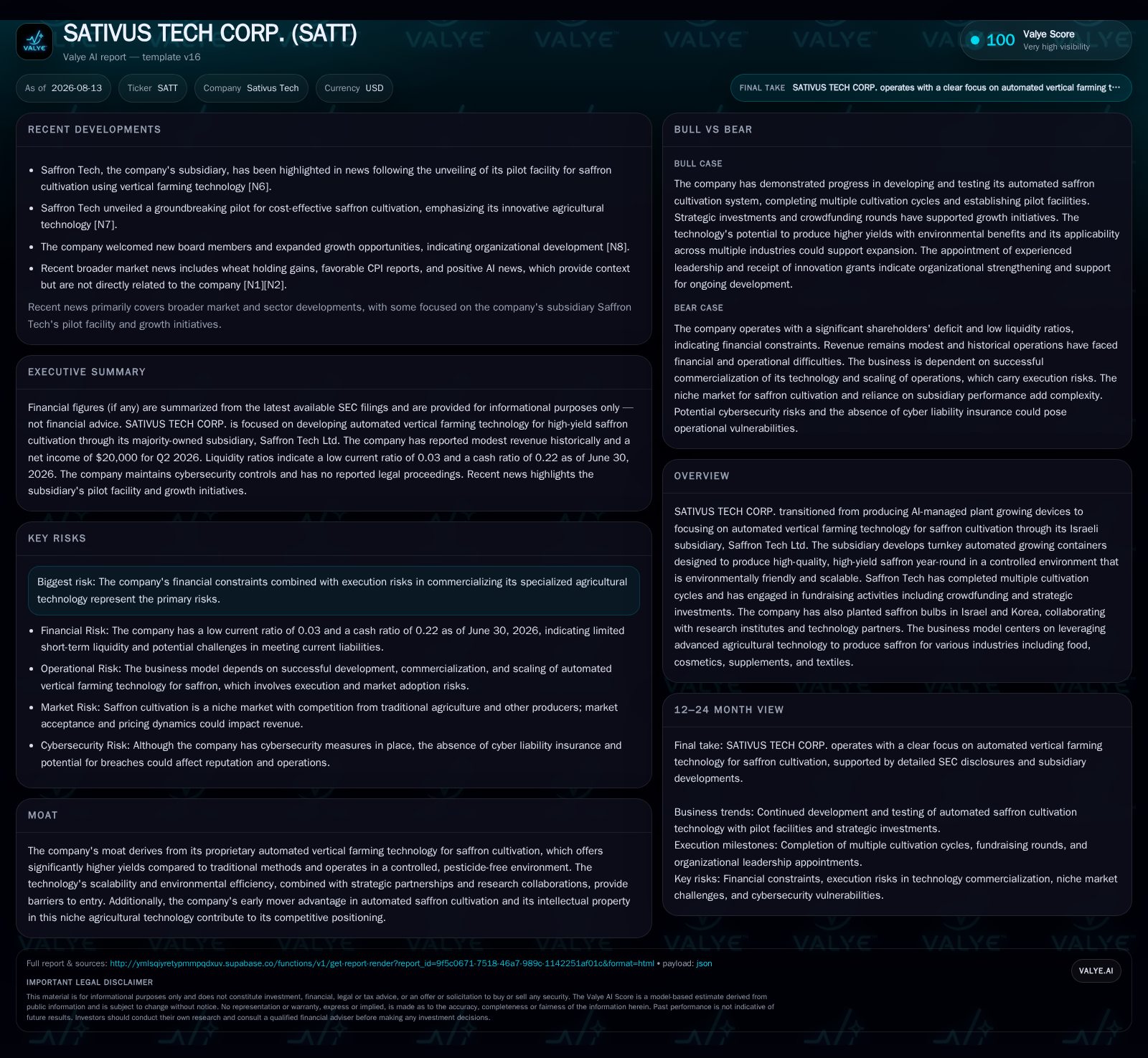
Sativus Tech's August 2026 quarterly filing reveals that its proprietary automated vertical farming technology yields up to ten times more saffron per land area than traditional methods, underscoring notable advancements in production efficiency and sustainability. The company’s Israeli subsidiary, Saffron Tech Ltd., has successfully completed multiple cultivation cycles and developed turnkey growing containers that enable scalable, pesticide-free saffron production serving niche markets such as food, cosmetics, supplements, and textiles. Despite these technological strides, significant financial constraints with an accumulated deficit exceeding $24 million and recurring negative cash flow cast doubt on near-term scalability. Execution risks associated with commercializing highly specialized agtech further complicate the growth outlook, highlighting capital raising and operational milestones as critical upcoming watchpoints.
Q2 2026 Operational Progress: Yield Breakthroughs in Automated Saffron Cultivation
Sativus Tech Corp.'s August 2026 10-Q presents compelling evidence that the company’s pivot to proprietary automated vertical farming technology has materially enhanced saffron production efficiency. The firm reports that its controlled indoor growing systems produce roughly ten times the saffron yield per land area compared to traditional outdoor agricultural methods [S2]. This leap is attributable to precise environmental controls eliminating pest exposure and optimizing growth parameters year-round in sealed environments powered by advanced IoT-enabled automation.
Through its Israeli subsidiary Saffron Tech Ltd., SATIVUS has completed multiple full cultivation cycles—signaling operational maturity in producing specialty crops under controlled environment agriculture (CEA) principles [S1],[S2]. These achievements are vital given saffron’s traditional reliance on seasonal harvests limited by geographic and climatic constraints. The company's ability to deliver continuous high-quality cultivation bolsters product consistency and supply reliability—key drivers for food industry buyers, cosmetics formulators, supplement producers, and textile dyers.
Notably, this closed-loop pesticide-free model also supports superior product purity—a critical attribute for marketing in premium niche categories where contamination concerns influence buying decisions. The environmental benefits are twofold: reduced chemical inputs lower downstream regulatory compliance burdens while tight resource utilization economizes water and energy consumption [S2]. The Company highlights easy remote monitoring capabilities that promise rapid scaling potential through turnkey system deployment
Business Model Overview: Proprietary Automated Vertical Farming Technology Driving Specialty Crop Production
Financial disclosures confirm the Company generates value chiefly through developing fully automated growing containers engineered by Saffron Tech. These turnkey units incorporate IoT sensors, hydroponic/aeroponic systems, LED grow lighting, and advanced software enabling real-time crop management with minimal human intervention [S1],[S2]. Such systems are sold or deployed primarily towards specialty crop cultivation focusing on high-margin crops like saffron rather than commodity produce.
Revenue mechanics likely comprise sales or leases of these automated container units plus downstream revenues from the harvest of cultivated saffron bulbs. This arrangement blends product sales with recurring revenue tied to horticultural output—aligning incentives for continual system improvement. Target markets—food service (notably high-end culinary), natural cosmetics, dietary supplements, and textiles—feature growing demand for pesticide-residue free and sustainably sourced inputs enhancing pricing power.
The environmental sustainability dimension embodies a strategic moat by addressing rising regulatory pressures favoring reduced agro-chemical usage alongside consumer preference shifts toward eco-friendly sourcing. Scalability is enhanced by pre-designed modularized containers facilitating quicker rollout compared with custom-built facilities common among conventional CEA operators [S1],[S2].
Competitive Landscape: Positioning Amid Vertical Farming and AgTech Peers
Within the broader automated vertical farming segment populated by players such as AeroFarms (vertical farming tech/operations) and Freight Farms (containerized solutions), Sativus Tech distinguishes itself via a focused application to saffron—a globally scarce yet exceptionally high-value spice commodity. This early mover advantage serves as a partial barrier against broader leafy green-focused competitors who face more commoditized market dynamics.
Strategic partnerships with research institutes in Israel and Korea reinforce the company's R&D capabilities essential for refining automation uptime, yield optimization KPIs like growth cycle duration, and resource efficiency benchmarks [S1],[S2]. Unlike generalist vertical farms emphasizing volume crops requiring less exacting conditions, Sativus leverages IP rooted in specialty crop physiological demands.
However, commercializing niche agtech carries inherent technology adoption risks heightened by capital intensity—a shared challenge among agtech innovators seeking scalability while mitigating operational complexity. Continuous validation of automation reliability alongside product quality metrics will be critical for defense against emerging competition.
Growth Catalysts: Scalability, Market Demand for Sustainable Specialty Crops, And Strategic Collaborations
The global pivot towards sustainably grown pesticide-free specialty crops like saffron underpins robust fundamental demand growth driving Sativus' market opportunity [S1],. Combined with its demonstrated capability to run multiple sequential cultivation cycles successfully indicates a shortening growth cycle timeline compared to traditional annual harvests—enhancing output cadence.
Containerized designs afford modular scalability reducing time-to-market progressively relative to site-built farms or open fields susceptible to climate variability [S2]. Moreover, ongoing collaborations with regional research entities facilitate continuous improvement of hydroponic nutrient delivery systems and LED spectra fine-tuning—efforts that could reduce operating cost per unit output over time.
Investment activity including crowdfunding efforts supplemented by strategic injections into Saffron Tech signals external validation of growth prospects despite inherent nascent-stage risks [S1].
Execution Risks and Financial Constraints Shadow Scaling Ambitions
Despite optimistic operational developments, financial disclosures expose pressing liquidity difficulties jeopardizing sustained expansion. As of June 30, 2026, accumulated deficit stands at approximately $24.7 million driven by continued net losses [S2],[F1]. Operating cash flow remains negative ($173k for H1 2026), reflecting continued burn characteristic of early-stage agtech firms attempting capital-intensive scaling.
Convertible loans at 10% interest maturing or callable within short windows introduce refinancing pressures amplified by suboptimal current asset coverage against liabilities (current ratio approx. 0.03) [S2],[F1]. Going concern statements explicitly warn of substantial doubt absent successful capital raises [S2]. This finance-driven constraint is emblematic of industry peers wrestling with sizable upfront investments in facility build-outs paired with elongated customer adoption curves.
Execution risk extends beyond finance into technology commercialization given the complexity of automating sensitive crops like saffron which demands rigorous system uptime reliability benchmarks as well as maintaining product quality consistency across scaled operations.
Key Milestones Ahead: Financing Needs, Cultivation Expansion Plans, Technology Deployment
Near-term monitoring should focus keenly on successful completion of financing rounds designed to alleviate liquidity strain—particularly extensions or conversions related to existing convertible debentures extended through March 2027 [S2],[S3]. Achievement would materially reduce immediate solvency risk enabling operational continuity.
Further advancements include ramping deployment of automated growing containers across new geographies leveraging modularity advantages while validating scalability KPIs like number of active units operational simultaneously without management overhead breakdowns [S2]. Market penetration efforts into targeted end-user segments remain critical milestones given the nascent stage of specialty crop vertical farming commercialization.
Technological progress can be gauged via cycle times per harvest iteration plus energy/water use intensity metrics reflecting productivity improvements essential for long-term margin expansion.
Financial Profile Discussion: Runway Concerns Temper Growth Potential
At June 30, 2026 SATIVUS TECH CORP. held $85k in cash equivalents contrasted with total debt approximating $483k as per latest available data from September 2022—with net debt accordingly around $398k though more current detailed debt figures are limited [F1],[S2]. Convertible loans totaling several hundred thousand dollars attract 10% interest rates with instruments callable if equity price thresholds are unmet—heightening refinancing urgency [S2].
The accumulated deficit nearing $24.7 million underscores persistent operating losses commensurate with early development phase agtech firms prioritizing R&D over profitability [F1],[S2]. Operating cash flow outflows persisted at $173k during first half calendar year 2026 reflecting ongoing investment into product development and pilot expansions [S2].
Going concern disclosure flags these financial headwinds as material uncertainties hinging company's survival on securing new financing—consistent with capital-intensive vertical farming peers who typically experience extended burn before scalable revenue generation.
This financial backdrop tempers near-term optimism despite promising technology progress; execution success is tightly coupled with improved funding access. Cash conservation measures or strategic partnerships could mitigate downside if timely negotiated.
This analysis integrates recent quarter data to illuminate how Sativus Tech’s proprietary automated vertical farming approach advances specialty saffron production economics within the evolving controlled environment agriculture landscape. While technological achievements provide tangible yield moats relative to legacy cultivation methods or peer agritech companies focused on more commoditized crops, significant financial vulnerabilities pose non-trivial execution challenges. Future operational milestones linked to expanded cultivation cycles deployed via scalable cookware units alongside capital structure stabilization efforts will critically influence whether the emerging business model transitions toward sustainable commercial footing.
Disclaimer: This report is for informational purposes only and does not constitute investment advice or a research view to buy or sell securities.
Disclaimer: This is research-only, informational analysis and not investment advice. It may include AI-generated interpretation and general industry context. Always verify important details using primary sources.

Comments