
Wolverine World Wide Elevates Profitability with Strategic Channel and Inventory Management in Q2 2026
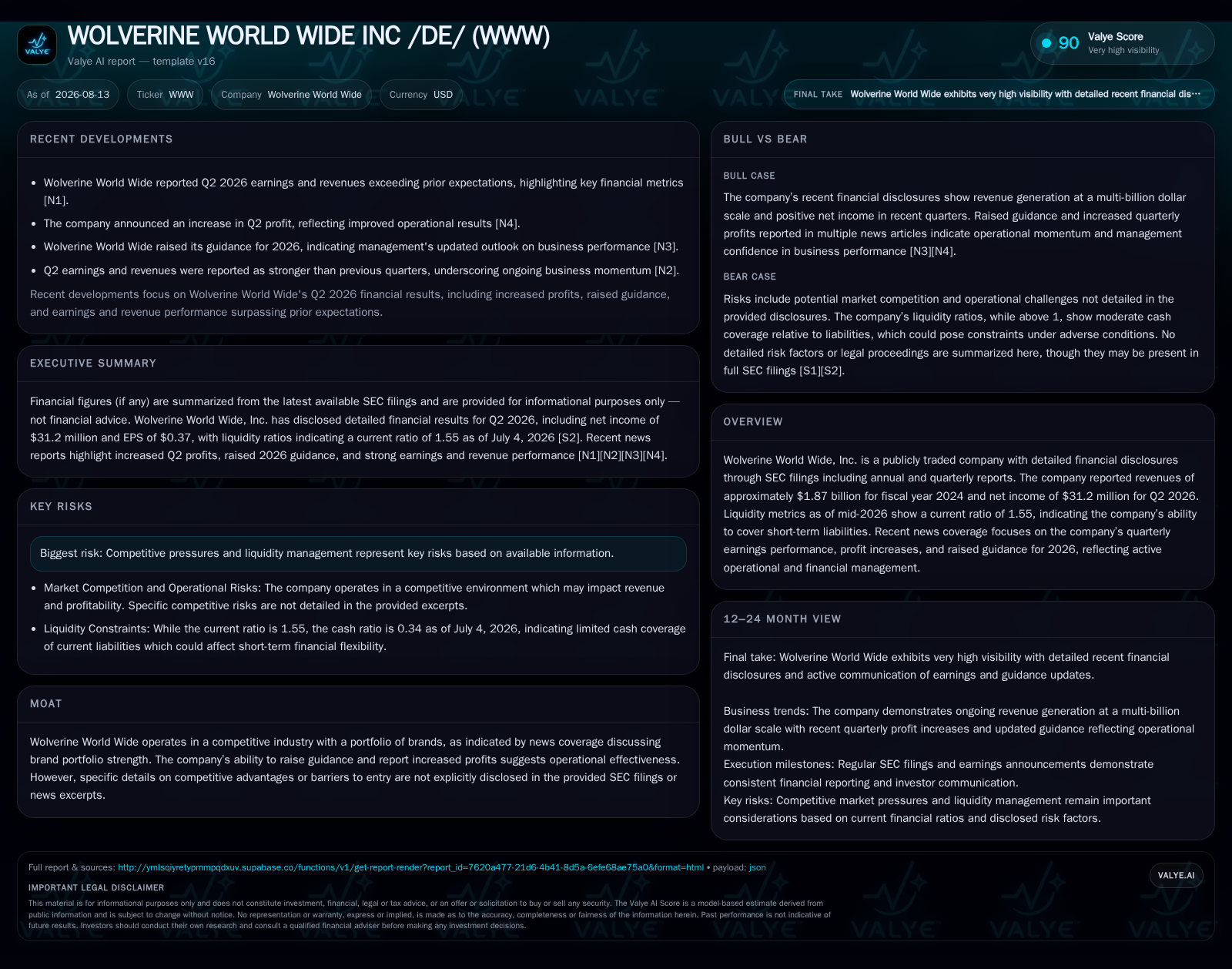
Q2 earnings exceed expectations, driven by improved gross margins and inventory efficiency, prompting a raised full-year guidance from Wolverine World Wide.
Wolverine World Wide’s second quarter of 2026 demonstrated a notable rise in profitability supported by a favorable shift toward higher-margin direct-to-consumer sales and improved inventory turnover that reduced markdown pressure. The company’s robust brand portfolio underpinned sustained customer engagement and pricing power amid competitive apparel and footwear markets. Raised guidance for the 2026 fiscal year reflects confidence in operational execution and growth levers such as e-commerce expansion and enhanced product lifecycle management. Key risks include ongoing retail competition and the need to maintain inventory freshness to avoid margin erosion.
Q2 Results Spotlight: Earnings Beat Fueled by Margin Expansion and Operational Discipline
Early indicators suggest these enhancements are structural rather than transient seasonal effects. For instance, the improved margin achievement was not accompanied by disproportionate promotional expense growth, pointing instead to effective promotional cadence optimization aimed at balancing sell-through velocity with price integrity [N7][S2]. The result was a more efficient revenue composition that leveraged Wolverine’s capacity as a branded intermediary aligning contemporary consumer preferences with strategic channel development.
Brand Portfolio Strength Anchoring Competitive Positioning in Footwear and Apparel Markets
Wolverine’s business model centers on a multi-brand portfolio strategy featuring recognizable labels such as Merrell and Saucony alongside other niche offerings catering to differentiated consumer segments within footwear and apparel categories [S1]. This diversification equips the company with pricing power resilience amid competitive pressures by mitigating reliance on any single brand or trend cycle [N12]. A well-curated brand suite also facilitates cross-channel deployment—balancing premium DTC experiences with broad wholesale access—thereby capturing a wider demographic spectrum.
Importantly, these brands possess strong consumer loyalty characteristics which contribute to lower customer acquisition costs relative to less established peers. As indicated in the latest annual disclosures and supported by third-party media analysis, Merrell's reputation for durable outdoor footwear alongside Saucony's position in performance running provide a stable foundation for sustainable demand even amidst fluctuations in fashion-driven segments [S1][N12]. This brand equity creates an entry barrier against commodity footwear competitors and reduces vulnerability to pure price competition.
Channel Mix Dynamics: Direct-to-Consumer Growth Offsetting Wholesale Challenges
The shift towards direct-to-consumer sales represents a pivotal margin lever for Wolverine. Latest figures reveal an increasing proportion of revenue generated through DTC channels—including proprietary retail stores and e-commerce platforms—with this segment growing faster than wholesale distributor revenue streams during Q2 2026 [S2]. This rebalancing is financially significant given DTC sales’ higher gross margin profiles driven by elimination of distributor markups, stronger control over promotional activities, and richer customer data enabling targeted marketing spend efficiency.
Moreover, digital marketing investments have been calibrated more precisely, enhancing return on advertising spend (ROAS), thus contributing to improved profitability despite broader market volatility affecting discretionary apparel spending [N1][S1]. While wholesale remains indispensable for scale reach especially internationally or in tier-two markets, Wolverine’s ability to progressively migrate sales mix toward DTC forms part of its strategic pathway toward stabilized margin expansion—a tactic shared among industry leaders like Deckers but differentiated here by the company’s emphasis on brand-specific consumer engagement models [S1][S2].
Inventory Turnover Gains Reflect Sharper Product Lifecycle Management Tactics
An area directly impacting cash flow conversion and cost control has been Wolverine’s success raising its inventory turnover ratio during the quarter. By aligning product lifecycle management more closely with sell-through analytics, the company reduced excess stock accumulation that often precipitates discount-driven clearance events [S2]. This dynamic mitigated markdown pressure—a critical margin eroding factor prevalent across footwear retail—thereby bolstering gross margin percentages without sacrificing overall volume pacing.
These gains reflect proactive assortment planning based on predictive demand modeling as well as tighter synchronization with supply chain partners to minimize lead times amidst fluctuating raw material costs [N1]. The benefits extend beyond immediate cost savings; healthier inventory turnover cycles improve working capital efficiency allowing reinvestment into innovation or channel development initiatives supporting longer-term growth agendas.
Promotional Strategy Effects on Margins & Sell-Through Performance
In managing trade-off tensions inherent between promotional intensity and full-price sell-through rates, Wolverine demonstrated measured restraint during Q2 2026. The company maintained promotional discount rates at levels supportive of sustaining positive sell-through velocity but avoided escalation that would depress average selling prices significantly [S2][N7]. Maintaining this balance is paramount—not only does it preserve brand value perceptions but also protects gross profit dollars essential for funding marketing innovation or enhancing e-commerce capabilities.
While aggressive promotions are occasionally unavoidable due to seasonality or inventory reset needs, Wolverines' disciplined approach aligns well with broader sector trends emphasizing quality over quantity of discounts—a tactic differentiating them from peer companies suffering from elevated markdown-related margin compression [N7]. Monitoring future quarters will be important as continued demand normalization could tempt increased promotional spend; however, early indications point toward sustained controlled discounting underpinning profitability levers.
Growth Outlook Supported by Expanding E-Commerce & Brand Engagement
Growth catalysts identified in recent filings emphasize increasing e-commerce penetration within Wolverine’s DTC framework coupled with enhanced customer loyalty initiatives designed to drive repeat purchase frequency [S2][N3]. E-commerce offers several advantages including superior data capture enabling personalized marketing targeting while allowing scale without proportional brick-and-mortar capital expenditure burdens.
These digital investments dovetail with rising consumer affinities for active casual wear styles fueling demand tailwinds across categories where Wolverine operates. Complementary loyalty programs enhance customer lifetime value metrics by reinforcing brand attachment beyond initial acquisition, effectively lowering ongoing customer acquisition costs despite competitive noise prevalent in digital marketplaces [N3][S1]. This combination of technology-enabled marketing precision plus diversified product offering embedded within vibrant lifestyle trends should support durable revenue growth trajectories.
Risks From Intensifying Competition & Inventory Obsolescence
Despite positive indicators, Wolverine faces notable headwinds common throughout branded apparel sectors. Intense competition from global incumbents such as Nike or Adidas exerts continuous pricing pressure which can erode margins if not offset through differentiation strategies or cost efficiencies [S1],[S2]. Moreover, dependence on timely new product introductions necessitates rigorous inventory risk management; slow-selling lines risk obsolescence particularly given fashion seasonality effects that can suddenly shift consumer preferences away from current assortments causing markdown spikes.
Supply chain uncertainties—including raw materials cost fluctuations—and regulatory tariffs add external risks that can compound operational challenges if not effectively hedged or absorbed via pricing power gains [S1],[S2]. Managing these elements prudently remains essential for sustaining margin improvement evidenced this quarter.
Near-Term Execution Watchlist: Guidance Drivers & KPI Milestones
Key performance markers will be critical barometers of Wolverine’s trajectory as it executes its refreshed strategy post-Q2 results. Among these are quarterly sell-through rates which must maintain or improve to signal continued inventory management success; secondly, the proportion of sales attributed to direct-to-consumer channels should grow steadily confirming progress on channel mix optimization; finally, promotional discount magnitude relative to historical baselines will reflect whether pricing discipline endures amidst competitive pressures [S3],[N3].
Tracking these KPIs alongside management commentary around supply chain adaptability or new product pipeline replenishment will further illuminate whether raised 2026 guidance levels are achievable or subject to adjustment.
Financial Profile Discussion: Liquidity Position & Balance Sheet Context
As of July 4, 2026, Wolverine reported current assets of approximately $736 million against current liabilities near $475 million, yielding a current ratio of about 1.55—a credible buffer for operational contingencies [F1]. Total debt stood near $601 million with net debt around $439 million, indicating moderate leverage consistent with sector norms given scale and cash flow generation capacity [F1].
This financial footing supports flexible capital deployment towards e-commerce expansion and selective brand investments without immediate liquidity stress signals noted in recent filings [F1]. Nonetheless, prudent monitoring remains warranted given market volatility and industry cyclicality impacting cash flow variability.
Disclaimer: This is research-only, informational analysis and not investment advice. It may include AI-generated interpretation and general industry context. Always verify important details using primary sources.

Comments