
Yellowstone Group’s Niche Focus on Small OTC-Listed Firms Faces Scalability and Profitability Hurdles
Specializing in SEC-compliant financial reporting for small Australian and NZ companies, Yellowstone reports growing revenue but widening losses amid limited staff and client concentration.
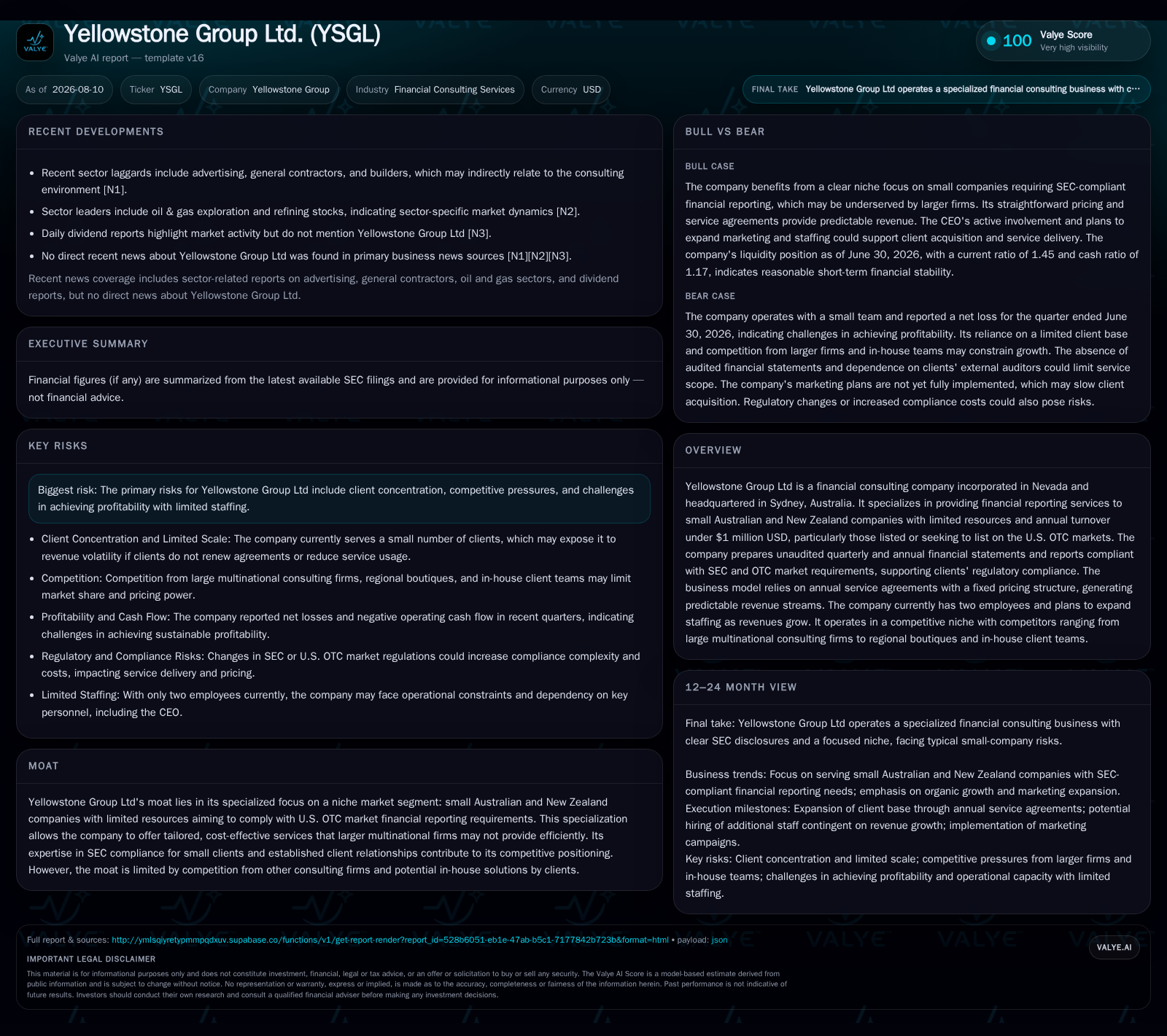
Yellowstone Group Ltd operates in a narrow yet competitive consulting niche, providing annual and quarterly SEC-compliant financial statements to small public companies from Australia and New Zealand listed or aiming to list on U.S. OTC markets. Its recurring revenue model hinges on fixed-price, annual service agreements with a very limited client base. Latest quarterly results show a 33% revenue increase driven by expanded services but also highlight operating losses due to rising professional fees and depreciation. The firm’s two-employee structure constrains scalability and exposes it to client concentration risks. Going forward, growth depends on expanding the client base, managing operating expenses, and addressing identified material weaknesses in internal controls.
Recent Operating Update
Yellowstone Group Ltd’s latest quarterly filing for Q2 ended June 30, 2026 reveals notable operational developments that set the tone for near-term business prospects [S2]. The company reported a 33% increase in revenue compared to the prior period, reaching approximately $10,166 USD primarily due to providing additional financial consulting services within its specialized niche. This growth reflects an ability to deepen engagement with its existing small public company clients servicing their SEC and OTC compliance requirements.
However, this topline progress came alongside a significant rise in operating expenses—especially professional fees and depreciation—which pushed the company into a net loss position. Operating income for the quarter stood at -$10,827 USD [F1]. Increased spending on external professional service providers likely signals efforts to maintain or improve report quality or address regulatory complexities but currently outpaces revenue gains. Cash used in operating activities amounted to $12,810 USD during the quarter [S3], evidencing continued negative cash flow from core operations.
This quarter’s results accentuate the delicate balance Yellowstone must maintain between expanding service delivery scope and controlling costs within a lean operational setup.
Business Model Fundamentals
Yellowstone functions as a boutique financial consulting firm tailored exclusively to Australian and New Zealand companies with limited resources—specifically those earning under $1 million USD annually—and listed or aspiring to list on U.S. OTC markets [S1]. The firm's core offering comprises the preparation of unaudited quarterly financial statements plus an annual report compliant with SEC regulations applicable to OTC-listed entities.
Revenue is generated through fixed-price annual service agreements that bundle all reporting obligations into predictable fees. This model ensures stable recurring revenue streams but inherently caps upside from volume or variable pricing changes given the tight focus on very small companies. The company’s value proposition rests on expertise navigating the often complex SEC reporting landscape for these clients who typically lack internal finance teams or sufficient regulatory know-how.
Importantly, this business relies heavily on maintaining strong client relationships—it currently serves just three primary customers who accounted for all Q2 revenues [S17]. Such concentration heightens risks around client retention but also reflects the niche nature of Yellowstone’s market segment.
With only two employees onboard as of mid-2026 [S1], operations depend largely on the principal’s expertise supplemented by outsourced professional fees. This limits capacity relative to peers capable of scaling more rapidly through larger teams or technology deployment.
Industry Structure and Competition
Yellowstone operates within a fiercely competitive sector that includes global multinational consulting firms like RSM US LLP or BDO International serving broad audiences including large-cap clients; regional boutique firms specializing in small-cap SEC reporting; accounting/audit firms overlapping partly on compliance work; as well as growing in-house corporate finance teams at issuers themselves.
The firm's moat is narrowly defined: deep specialization in a sub-$1 million-turnover segment of Australasian OTC-listed companies needing cost-conscious yet comprehensive SEC-compliant reporting support. Larger players may struggle to serve this cohort efficiently due to scale economics or higher fee structures whereas non-specialized smaller players may lack domain expertise.
Technology providers offering regulatory compliance software pose another indirect competitive force through potential automation replacing manual consulting tasks over time.
Yellowstone's competitive edge thus hinges critically on trusted advisory relationships combined with tailored service delivery absent from one-size-fits-all alternatives.
Growth Drivers
Several forces underpin potential growth avenues:
- Regulatory Complexity: Increasing SEC scrutiny and evolving OTC rules escalate compliance burdens for small public companies, potentiating demand for expert outsourcing partners like Yellowstone.
- Small-Cap Market Expansion: More Australasian ventures are listing on U.S. OTC markets seeking capital access; these companies often require affordable financial consulting assistance.
- Outsourcing Trends: Small issuers typically lack internal finance bandwidth; outsourcing recurring reporting duty remains attractive compared to hiring permanent staff.
- Service Portfolio Expansion: Services can extend beyond baseline statement preparation into advisory roles around disclosures, MD&A narratives, or broader compliance consulting.
- Geographic Reach: While currently focused on Australia/New Zealand clients, adjacent emerging markets could offer new client acquisition opportunities if execution allows.
- Partnerships: Collaborating with legal counsel or accounting firms servicing similar clients can create referral pipelines enhancing client acquisition efficiency.
Each driver is contingent upon maintaining high-quality, timely deliverables measured by KPIs such as report delivery timeliness, contract renewal rates, professional fees billed per client, and compliance success rates.
Risks and Growth Constraints
The company's specialization exposes it to distinct risks:
- Client Concentration: With only three clients responsible for all revenue recently [S17], losing any single customer could substantially impact top-line performance.
- Competition Pressure: Larger consulting firms or boutiques may encroach upon this niche if profitability expands; similarly, clients building in-house capabilities represent substitution threats.
- Scaling Difficulties: Current staffing at two employees restricts capacity expansion; reliance on outsourced professionals inflates operating expenses reducing margins.
- Pricing Sensitivity: Small-cap clients are cost-conscious; significant price increases risk pushing demand toward cheaper alternatives or internalization.
- Regulatory Dependence: Changes reducing reporting complexity or easing requirements could diminish service demand over time.
- Operational Risks: Persistent material weaknesses identified in internal financial controls indicate vulnerability that might dampen investor confidence or impede efficient scaling [S8],[S21].
- Cash Flow Constraints: Negative cash flow from operations requires vigilant liquidity management given the absence of recent financing inflows [S3].
- Technology Disruption: Advances in automated compliance software may erode portions of manual consulting work unless offset by value-added advisory services.
These will collectively illuminate whether Yellowstone transitions successfully from a handful of consultancy contracts into a more diversified provider poised for scalable profits in its specialized segment.
Financial Profile Discussion
As of June 30, 2026, Yellowstone held $44,126 USD in cash and equivalents against current liabilities of $37,600 USD resulting in a current ratio of approximately 1.45 [F1]. This indicates modest short-term liquidity coverage but limited cushion against unexpected cash demands given ongoing net losses reported earlier this year [-$10,827 USD operating/net loss at March 31] [F1].
The company's capital structure reflects its early-stage nature with no significant debt reported recently nor off-balance-sheet obligations [S3]. Cash outflows primarily relate to operating activities marked by elevated professional fees driving expenses above revenues despite top-line improvements [S3].
Given reliance on just three main clients generating nearly all sales [S17], any volatility there poses direct earnings impact risks without evident alternative cash flow sources currently deployed beyond equity financing completed during IPO phase [S1].
Maintaining balanced expenditure growth—especially controlling external professional service reliance while expanding internal expertise—is critical before profitability inflection becomes feasible with an increased client base.
This analysis synthesizes the latest public filings highlighting Yellowstone Group Ltd's niche positioning within financial consulting services specializing in SEC-compliant reporting for small OTC-listed Australasian companies. The company has demonstrated modest revenue momentum but continues grappling with operational leverage limitations typical for an early-stage consultancy firm dependent on few clients amid competitive pressures. Execution risks center around scaling staff expertise effectively while navigating evolving regulatory demands without sacrificing financial discipline or quality controls essential for long-term trust among small-cap public issuers.
Disclaimer: This is research-only, informational analysis and not investment advice. It may include AI-generated interpretation and general industry context. Always verify important details using primary sources.

Comments