
Isabella Bank Navigates Margin Pressure and Credit Trends in Regional Market
Q2 2026 results highlight evolving net interest margin challenges amid credit quality improvements, shaping Isabella Bank’s strategic outlook.
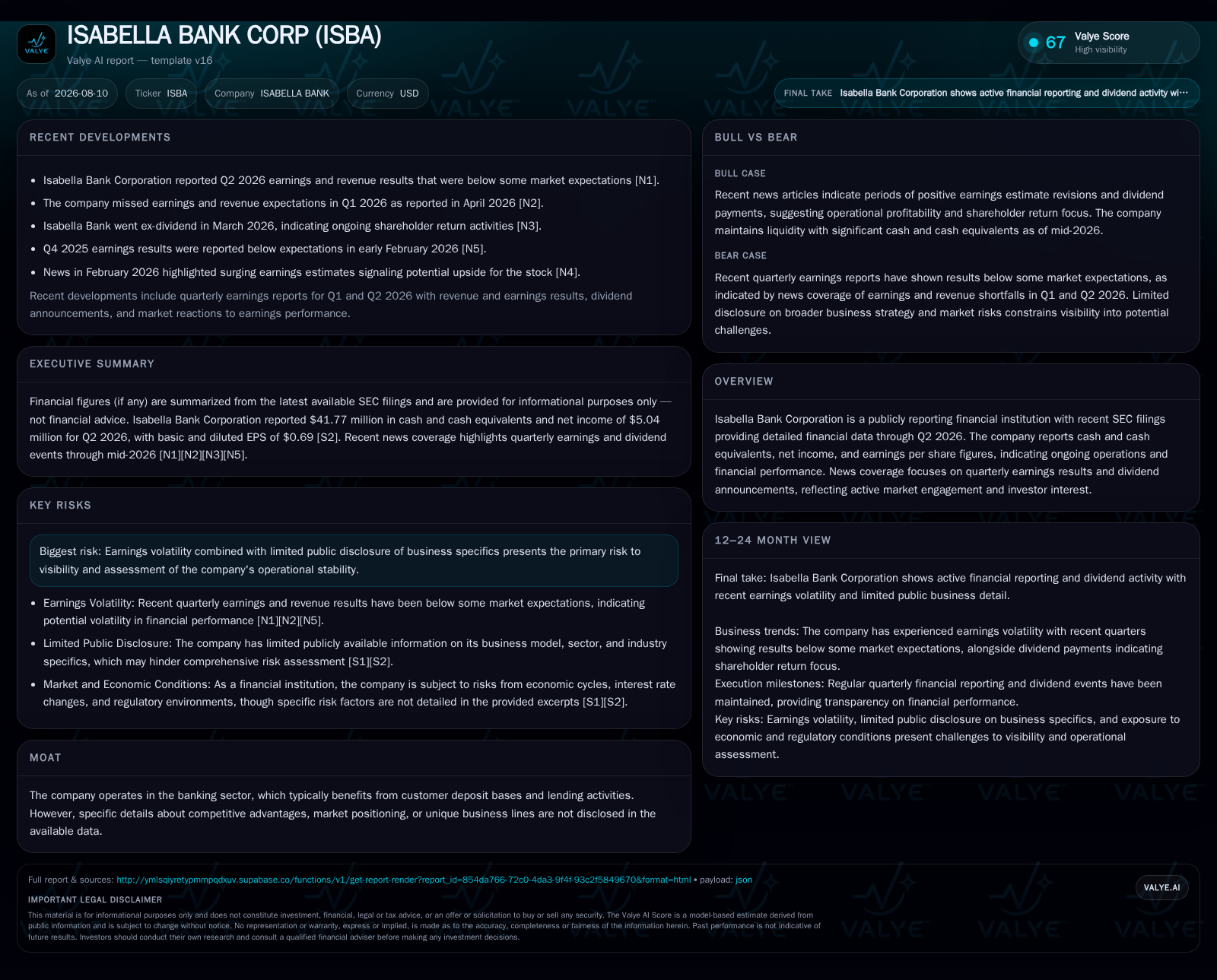
Isabella Bank Corporation’s latest quarterly filing for Q2 2026 reveals compression in net interest margin driven by rising deposit beta and funding costs, coupled with signs of improved credit quality as non-performing assets stabilize. The company operates under a regional banking model heavily reliant on traditional deposit gathering and lending activities, with operational efficiency under pressure from expense growth. Capital adequacy remains solid, supporting the bank’s ongoing merger plans and growth ambitions anchored in local economic demand. Key near-term milestones center on merger integration progress and maintaining profitability amid a competitive regional banking environment.
Q2 Operating Shifts: Margin Compression Amid Evolving Deposit Costs
Isabella Bank’s Q2 2026 results reveal an ongoing challenge common among regional banks navigating today's interest rate environment: net interest margin (NIM) compression. The latest 10-Q discloses that while the bank continues its traditional model of generating revenue through lending activities funded by customer deposits, rising deposit beta — the degree to which deposit rates respond to market rate increases — has elevated funding costs faster than loan yields can adjust [S2]. This dynamic compresses the spread between interest income earned on loans and interest expense paid on deposits.
The impact is a margin squeeze that pressures core net interest income, a critical revenue source intrinsic to Isabella’s community banking focus. The bank's ability to manage this spread hinges on balancing competitive deposit pricing to retain stable funding while optimizing loan portfolio yields in a moderately repricing lending market. Such margin fluctuations are typical in community banks with high reliance on core deposit bases rather than wholesale funding, making deposit mix shifts particularly impactful on earnings quality.
Loan Portfolio and Credit Metric Trajectory Point to Stabilizing Risk
On the credit front, Isabella Bank reports encouraging signs of stabilization. Non-performing assets (NPAs) broadly held steady during Q2, suggesting that credit quality pressures observed earlier in recent cycles may be easing [S2]. Moreover, provision for loan losses did not see significant expansion relative to prior periods, signaling management’s confidence in current underwriting standards and collection prospects.
Stable NPAs reduce earnings volatility associated with unexpected loan loss provisioning — a key concern for regional lenders exposed to local economic cycles and commercial real estate (CRE) markets [S1]. This steadiness positions Isabella relatively well compared to some regional counterparts still digesting credit stresses from sectoral downturns or borrower distress. However, absent more granular disclosures, continued monitoring of delinquency trends remains prudent given typical cyclical vulnerabilities in regional banking portfolios
Deposit Base Composition Tells a Story on Funding Costs and Beta
The bank's funding narrative is underscored by evolving deposit composition reported in recent filings. A shift toward higher-cost deposit categories—reflecting customers requiring increasingly competitive yields—has escalated total funding expenses relative to prior quarters [S2][S3]. Deposit beta rise forces the bank into a challenging position where pricing must keep pace with market rates or risk outflows but doing so compresses net interest margin.
Isabella’s dependency on retail and small business deposits typical of community banks means that sustaining these relationships often requires price responsiveness at odds with stable margin generation. Such dynamics underscore the importance of efficient liability management practices and potential diversification into non-interest-bearing or lower-cost sources where possible.
Operational Efficiency: Pressure Points in Expense Management
Despite revenue headwinds from compressed margins, operating expenses have shown upward trajectories leading to a modest deterioration in Isabella’s efficiency ratio (operating expenses divided by total revenue) [S2][S1]. This rise reflects both investments in infrastructure possibly tied to technology enhancements or branch support as well as inflationary wage pressures common across labor-intensive service sectors.
Compared with larger regional peers such as Fifth Third Bancorp or Huntington Bancshares — which often report more favorable efficiency ratios due to scale economies — Isabella faces typical small-to-mid-sized bank challenges balancing cost discipline against necessary expenditures driving customer experience and regulatory compliance.
Capital Positioning within Regional Banking Peer Framework
Capital ratios reported at quarter-end solidify Isabella Bank’s financial resilience. The Tier 1 capital ratio remains comfortably above regulatory thresholds, supporting both ongoing operations and strategic maneuvers like the announced merger with Grand River Commerce [S2][F1][S1]. Tangible book value trends suggest preservation or modest enhancement year-over-year, important for shareholder equity protection during integration phases.
Healthy capital buffers also provide regulatory flexibility during potential economic shocks or adverse credit events—a crucial factor for community banks facing uncertain macroeconomic conditions or competitive pressures requiring agile responses.
Growth Opportunities Anchored in Local Economic Fundamentals
Regional banks like Isabella thrive when supported by local economic expansion spurring loan demand from small and medium enterprises (SMEs) alongside consumer borrowers. Current SEC disclosures highlight continued emphasis on leveraging community relationships to grow lending volumes organically within Michigan’s regional economies [S1].
Cross-selling additional financial products such as treasury management services or mortgage lending presents further incremental revenue avenues reflective of typical community banking ecosystem strategies aimed at customer retention and lifetime value enhancement.
Strategic acquisitions remain part of growth options; however, integration risks require careful execution.
Risks to Monitor: Interest Rate Volatility and Competitive Pressures
Risk factors outlined in recent filings emphasize industry-wide concerns intensified by evolving macro conditions: pronounced asset sensitivity leading to net interest income volatility; increased competition from larger banks offering broader product suites; regulatory scrutiny relating to capital adequacy; as well as operational threats including cybersecurity challenges [S4][S25]
Deposit outflows prompted by rate shifts or fintech-enabled alternatives add another dimension of uncertainty affecting funding stability. Additionally, cyclicality inherent in commercial real estate exposures common across regional portfolios warrants vigilance given sectoral volatility post-pandemic recovery shifts.
Looking Ahead: Key Milestones from Merger Integration to Earnings Outlook
Isabella Bank’s announced merger agreement with Grand River Commerce marks a pivotal development shaping near-term execution priorities. SEC event filings detail ongoing completion conditions including regulatory approval processes involving the Federal Reserve and state authorities [S3][S6]. Success will depend on smooth integration achieving projected cost synergies and minimizing disruption to customer relationships.
Subsequent earnings reports will be critical gauges of synergy realization timings alongside management commentary clarifying strategic direction post-merger closure.
Financial Profile Discussion: Liquidity, Capital Strength and Profitability Review
At the close of Q2 2026, Isabella Bank maintained $41.8 million in cash and cash equivalents [F1], underpinning strong liquidity without concurrent long-term debt obligations reported through available data—a notable balance sheet strength uncommon at smaller regional banks often burdened by borrowings.
In summary, Isabella Bank stands at an inflection point managing near-term profitability pressures largely driven by deposit cost dynamics while benefiting from measured improvements in credit quality and sustained capital strength. Successful navigation through merger execution will influence the trajectory toward scale economies capable of offsetting systemic margin pressures prevalent within the regional banking sector.
Disclaimer: This is research-only, informational analysis and not investment advice. It may include AI-generated interpretation and general industry context. Always verify important details using primary sources.

Comments