
Heartland Express Confronts Rising Equipment Costs and Regulatory Pressures Amid Fleet Renewal
Heartland Express's latest quarter highlights ongoing challenges in fleet capital investment, regulatory compliance, and financial leverage within the freight trucking sector.
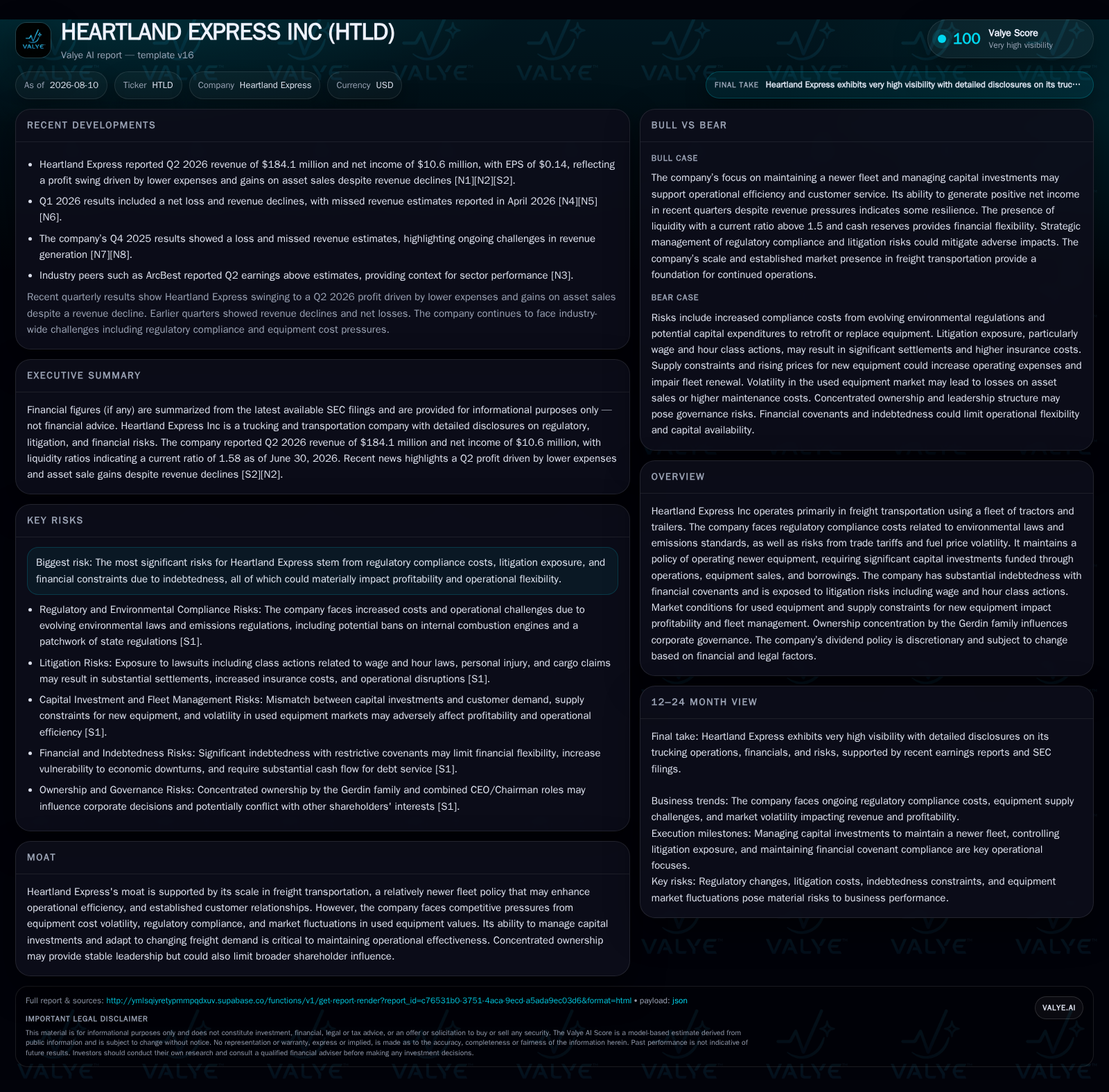
In its Q2 2026 report, Heartland Express revealed pressures from elevated costs for new tractors and trailers driven by environmental regulations and supply constraints, impacting its capital expenditure plans and operational costs [S2][S1]. The company’s policy of maintaining a newer fleet requires significant annual investments funded through operating cash flows and equipment sales, but elevated prices and tougher emissions standards are expected to increase compliance costs and reduce equipment efficiency [S1][S6]. Heartland faces persistent risks from regulatory complexity, litigation exposures, and indebtedness that may constrain operational flexibility [S1][S4]. Its competitive position depends on effectively managing fleet age, asset utilization, and freight contract pricing within a capital-intensive industry sensitive to fuel costs and labor market dynamics. Financially, as of mid-2026, the company maintains a moderate liquidity cushion with a current ratio of 1.58 and net debt near $92 million but remains exposed to leverage covenants under its credit facilities [F1][S4].
Recent Operating Update: Q2 2026 Financials and Strategic Implications
Heartland Express Inc’s Q2 2026 filing underscores ongoing operational challenges accentuated by rising equipment costs tied to new regulatory mandates. The company reported notable gains on asset sales alongside reduced operating expenses, offsetting revenue declines that reveal pressure on freight volumes or pricing [S2][N1][N2]. Management explicitly flagged persistent elevated prices for new tractors and trailers influenced heavily by environmental regulations requiring higher emission standards for diesel engines; these changes reduce fuel efficiency while inflating purchase prices [S1]. This environment has raised capital expenditure needs substantially. The firm continues to finance fleet renewal predominantly through cash flows from operations juxtaposed with proceeds from selling replaced equipment, supplemented by borrowings when necessary to maintain targeted fleet quality [S6].
This quarterly snapshot reaffirms Heartland’s business model reliance on orchestrating capital investments aligned tightly with customer demand forecasts—a mismatch risks depressing profitability because unused fleet capacity typically translates into asset write-downs or forced sales at suboptimal used market prices during downturns [S1][S6]. The company’s operating strategy prioritizes relatively newer tractor-trailers aiming at efficiency improvements in fuel use and lower maintenance overhead; however, the recent EPA regulatory landscape—and emerging patchwork emission laws at both federal repeal efforts paired with disparate state-level standards—creates cost uncertainty with no clear easing visible in near term planning [S1]. This portends durable upward cost pressure on compliance plus possibly reduced overall revenue equipment productivity.
Business Model Fundamentals: Capital Intensity Meets Regulatory Complexity
Heartland Express functions as an asset-based trucking carrier using owned tractor-trailers to transport freight contracted primarily on mileage rates negotiated with shippers or third-party logistics providers. Revenue is concentrated on per-mile payments where average revenue per mile directly affects top-line growth. The company's margins are highly sensitive to fleet utilization rates (miles driven per tractor), load factor (percentage of loaded miles), driver availability affecting deadhead miles (non-revenue travel), maintenance cost efficiencies per mile, fuel price swings moderated partially through fuel surcharges embedded contractually, and leasing versus ownership choices that affect depreciation schedules.
A critical feature of the model is the company’s policy of fleet modernization—regular turnover aiming toward newer generation tractors equipped with emissions-compliant engines designed to meet evolving EPA standards. Such fleets achieve better fuel economy and lower downtime but involve sizeable recurring capital expenditures. Capex is thus intrinsic rather than discretionary in securing competitive positioning amid tightening regulatory landscapes globally emphasizing reduced greenhouse gas emissions from heavy-duty vehicles [S1][S6]. Furthermore, used equipment values—a core source of funding replacement capex—are volatile; pandemic-era supply chain disruptions exacerbated production constraints leading to tight new equipment availability but have recently softened secondhand markets creating valuation challenges. Poor timing in asset disposal can impair returns on investment given this dual pressure on purchase price inflation combined with restrained resale proceeds.
Industry Structure & Competitive Positioning
Operating within the competitive U.S. trucking landscape—where peers like J.B. Hunt Transport Services, Knight-Swift Transportation, Schneider National, Werner Enterprises, and Old Dominion Freight Line set benchmarks for scale efficiency, service differentiation or capital management—Heartland differentiates through a balancing act of maintaining newer fleets which underpin operating efficiencies yet expose it to amplified capex risk amid variable used truck market dynamics. Relative to some peers who may extend vehicle life cycles for cost containment or emphasize asset-light strategies via third-party leases or brokerage services, Heartland’s asset-heavy approach entails predictable benefits in contract captive capacity yet concentrates financial leverage risk.
The freight contracts generally favor mileage-based charges supplemented by fuel surcharges intended to offset volatile diesel prices; however, regulatory-driven inefficiencies in new engine designs potentially erode net realizations if fuel economy declines despite premium pricing power [S1]. Driver recruitment challenges remain industry-wide issues impacting deadhead rates; efficient route planning technologies yet adoption remains uneven across players.
Growth Drivers
Key growth vectors for Heartland hinge on macroeconomic expansion driving freight volumes broadly—e-commerce proliferation remains a tailwind supporting steady demand for timely middle-mile trucking services. Infrastructure investments fostering improved highway efficiency could marginally enhance cost curves industry-wide. Technological adoption initiatives around route optimization software promise incremental margin gains via reduced empty miles.
Regulatory incentives may further encourage incremental fleet modernization boosting fuel-efficient vehicle penetration that aligns with Heartland's existing newer-fleet policy. Geographic expansion opportunities exist though no explicit corporate plans were cited recently. Crucially, post-pandemic trade realignments potentially sustain modal shifts favoring trucking over rail for flexibility purposes enhancing addressable service volumes.
Risks & Constraints
Significant exposure persists around escalating capital expenditure commitments amidst continued inflationary pressures on truck acquisition costs coupled with residual value uncertainty tied to used equipment markets depressed intermittently by oversupply or deteriorating economic conditions [S1][S6]. Regulatory ambiguities concerning emission laws expose Heartland to compliance cost fluctuations including potential retrofit obligations or accelerated depreciation if non-compliant assets become stranded.
Labor-related litigation including wage-hour class actions elevate legal risk profiles causing earnings volatility exacerbated by partial reliance on self-insurance reserves for claims management introducing unpredictability around ultimate claim exposure realized beyond accrual estimates [S13][S20]. Market sentiment factors such as concentrated stock ownership by the Gerdin family might discourage external shareholder activism thereby narrowing governance perspectives though this consolidates managerial stability [S24][S25].
What To Watch Next
Critical near-term milestones will include monitoring updates from management regarding capex pacing aligned against prevailing freight demand shifts revealed through upcoming quarterly disclosures. Pricing power adaptation vis-à-vis escalating input costs along with any adjustments in fuel surcharge effectiveness deserve attention as leading indicators of margin resilience.
Careful observation of used truck market health will provide insight into potential depreciation spikes influencing replacement economics. Regulatory developments at federal EPA levels or state jurisdictions regarding emission standards can materially alter compliance expense outlooks thereby impacting operating ratio dynamics.
Finally, developments in pending litigations related to labor practices warrant close monitoring given potential for sizable settlement impact or insurance expense upticks influencing future earnings volatility.
Financial Profile Discussion
As of June 30, 2026, Heartland Express held approximately $62 million in cash equivalents against current liabilities totaling about $117 million resulting in a current ratio of 1.58—indicative of sufficient short-term liquidity coverage while maintaining operational working capital needs [F1]. Total debt stood near $154 million as per calendar year-end data suggesting modest leverage adjusted for this liquidity buffer yielding approximate net debt close to $92 million factoring out cash holdings [F1].
Operating income trends have been pressured with losses recorded in recent periods partially attributable to elevated depreciation linked capital expenses alongside softer revenue resulting from freight contraction or pricing competitiveness challenges culminating in negative net income figures last reported at year-end 2025 (-$52 million) highlighting ongoing profit recovery hurdles [F1]. Substantial free cash flow generation remains contingent on sustaining robust asset turnover rates coupled with effective cost controls especially within maintenance spending per mile—a pivotal metric impacting bottom-line performance validity.
Capital allocation prudence will remain critical balancing dividends (subject to discretionary board approval), requisite reinvestment into fleet renewal for strategic positioning alongside potential opportunistic acquisitions consistent with credit covenant allowances without breaching leverage thresholds constraining expansive maneuvers currently.
This analysis synthesizes material publicly available information focusing strictly on documented operating facts without offering investment research views or speculative forecasts.
Disclaimer: This is research-only, informational analysis and not investment advice. It may include AI-generated interpretation and general industry context. Always verify important details using primary sources.

Comments