
Tapestry Advances Digital and Global Growth While Managing Supply Chain Risks
Tapestry’s fiscal 2026 results highlight strong Coach-driven sales growth, margin expansion, and strategic focus on direct-to-consumer channels amidst ongoing macroeconomic and supply chain challenges.
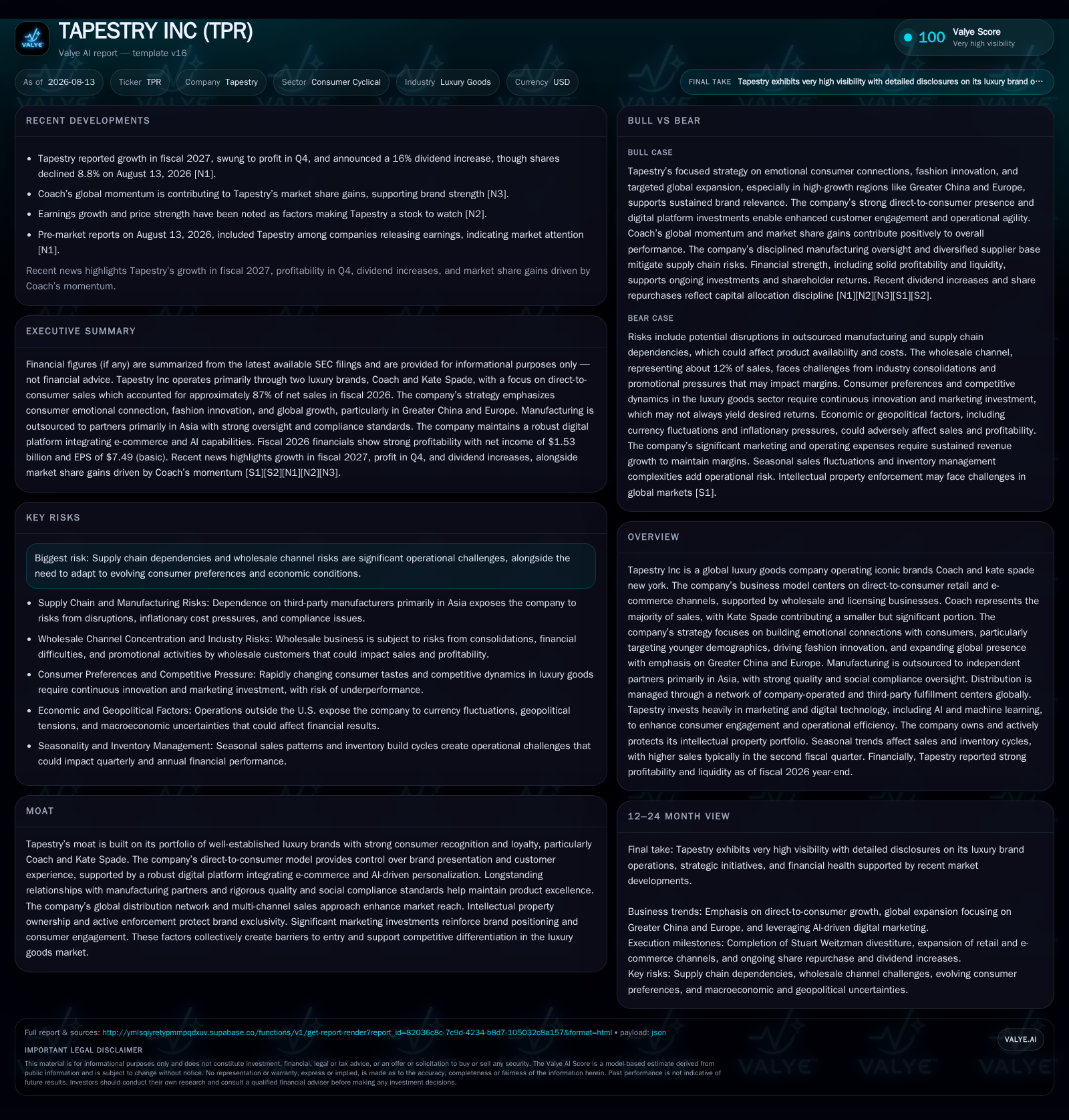
In its latest quarterly and annual disclosures ending June 27, 2026, Tapestry Inc delivered solid financial performance led by its flagship brand Coach, which accounted for more than 86% of net sales. The company's Amplify growth strategy emphasizes emotional consumer connections and digital innovation targeting younger demographics to sustain market share gains globally, especially in Greater China and Europe. Despite supply chain complexities from tariff risks and reliance on Asian manufacturers, Tapestry’s diversified multi-channel distribution model—including direct-to-consumer retail and e-commerce—supports operational resilience. Key growth levers include expanding digital personalization powered by AI, optimized wholesale partnerships, and lifestyle category extensions beyond handbags. Material risks stem from macroeconomic sensitivity impacting discretionary spending and potential trade policy shifts. Monitoring same-store sales trends, e-commerce penetration rates, and geographic revenue mix will be critical to assessing execution momentum going forward.
Recent Operating Update
The recent August 13, 2026 event filing ([S3]) accompanied by the latest annual report ([S1]) reaffirms a strategic focus on leveraging the company’s iconic brands with differentiated positioning. Coach remains the pivotal growth driver representing over 86% of net sales while kate spade contributes around 13%. The divestiture of Stuart Weitzman finalized prior year has narrowed the portfolio enhancing management focus [S1]. Tapestry also emphasized progress on its ‘‘Amplify’’ growth roadmap launched early fiscal 2026 concentrating on four pillars: building emotional consumer connections especially among Gen Z cohorts; fueling fashion innovation particularly in handbags and footwear; delivering compelling consumer experiences backed by digital technology; and driving geographic expansion predominantly across Greater China and Europe markets [S1].
Business Model Analysis
Tapestry operates as a luxury goods house centered on premium accessories encompassing handbags, leather goods, footwear, gifts, and lifestyle products sold primarily under the Coach and kate spade new york banners [S1]. The monetization revolves around owning strong IP-protected brands with established consumer loyalty enabling premium pricing. Revenue is derived from multiple channels: direct-to-consumer retail stores plus proprietary e-commerce platforms where the company controls the customer journey; wholesale accounts consisting of department stores and specialty retailers that distribute curated assortments managed locally to optimize fit with those customers; licensing agreements generating royalties from third parties authorized to use trademarks; ancillary channels including outlet stores [S1].
The DTC channel is a strategic priority furnishing higher margin capture due to eliminating intermediary markups combined with data collection facilitating digital personalization via AI integration [S1]. Wholesale partnerships not only provide broader physical market exposure but also require careful inventory planning to prevent excesses that could lead to markdowns or brand dilution. Manufacturing is outsourced primarily across Asia (Vietnam, Cambodia, Philippines, India for Coach; Bangladesh additionally for kate spade), relying on regional expertise in leather craftsmanship but subject to geopolitical tariff risks requiring contingency sourcing strategies [S1]. Quality control and social compliance audits are emphasized to safeguard brand reputation amidst complex supply chains.
Fashion innovation focuses decisively on handbags complemented by lifestyle categories such as footwear where targeted expansion enhances seasonal collections’ appeal helping sustain repeat purchase rates [S1]. These efforts are supported by strong marketing investment aimed at brand equity reinforcement through storytelling that resonates emotionally with younger consumers seeking inclusivity and expression — critical given evolving market segmentation dynamics.
Industry Structure & Competitive Positioning
Within the luxury goods sector focused on high-end accessories and lifestyle products, Tapestry competes against peers maintaining portfolios of well-known brands such as Michael Kors plus broader conglomerates like LVMH or Kering operating multi-brand strategies globally. The company holds an advantageous position via its flagship brands with significant heritage (Coach since 1941) combined with strong direct-to-consumer infrastructure enabling brand control paramount in this industry where exclusivity affects consumer perceptions.
Its digital transformation efforts position Tapestry alongside innovative players who utilize AI-powered personalization enhancing engagement reflecting broader trends where omni-channel retail sophistication defines competitive advantage. Moreover, its geographic push into key high-growth luxury markets like Greater China offers avenues to offset volatility in mature regions such as North America while tailoring assortments caters well to localized preferences — a recognized industry success factor.
However, competitors include fast fashion entrants targeting aspirational consumers at lower price points creating margin pressure through discounting or expanded licensing strategies potentially eroding brand exclusivity if not carefully managed.
Growth Drivers
Several distinct vectors underpin Tapestry's medium-term growth outlook:
- Targeting Younger Demographics: The deliberate aim toward Gen Z adoption through culturally relevant messaging reinforced by digital experiences seeks to lock younger cohorts into lifetime value relationships.
- Fashion Innovation & Product Assortment Expansion: Concentrating handbag leadership augmented by selective footwear category expansions diversifies consumer offering without diluting core craftsmanship perception.
- Digital & AI Enabled Personalization: Investment in cloud computing infrastructure coupled with marketing tech boosts e-commerce penetration escalating DTC revenue share.
- Global Geographic Expansion: Focused efforts in Greater China and Europe tap emerging affluent populations while leveraging existing wholesale arrangements backs new store openings or enhanced e-commerce delivery.
- Wholesale Optimization: Customizing assortments per partner enhances sell-through rates thus protecting margins from excessive discounting or inventory obsolescence.
- Ongoing Brand Equity Reinforcement: Marketing intensity at roughly consistent percent of sales sustains emotional resonance prompting repeat purchases amid shifting fashion cycles.
These growth opportunities can be quantitatively tracked through KPIs such as same-store sales growth indicating retail health; average selling price (ASP) reflecting product mix strength; e-commerce penetration assessing channel shifts; gross margin percentage signaling price-cost dynamics; geographic sales mix revealing international expansion progress.
Risks & Watchpoints
Tapestry confronts several material risks requiring vigilance:
- Macroeconomic Sensitivity: As luxury discretionary spending routinely contracts during recessions or inflationary episodes impacting consumer confidence this presents cyclicality risk influencing revenue consistency [S1].
- Supply Chain Dependencies: Heavy reliance on Asia-based manufacturing susceptible to tariffs/trade policy shifts poses cost inflation risk plus potential supply disruptions affecting product availability [S1].
- Trade Policy & Tariffs: Shifts in U.S. Customs enforcement or trade agreements could materially increase landed costs or limit sourcing flexibility hurting competitiveness.
- Brand Dilution Risks: Over-licensing or excessive discounting within wholesale chains could undermine brand exclusivity undermining long-term pricing power.
- Inventory Management Challenges: Markdowns from fashion missteps elevate inventory obsolescence risks requiring agile allocation systems.
- Counterfeit Goods & IP Infringement: Enforcement is essential given high brand recognition attracting imitation impacting consumer trust.
- Currency Volatility: International revenue exposed to foreign exchange fluctuations may compress margins if hedging is ineffective.
- Digital Security Risks: E-commerce platform vulnerabilities threaten customer data safety potentially eroding brand reputation.
Effective mitigation involves proactive supply chain diversification strategies including contingency sourcing alternative regions besides primary countries along with nimble inventory controls aligned with real-time demand sensing technology deployed recently [S1][S2]. Macroeconomic forecasts coupled with early consumer purchasing trend analysis will assist scenario planning given discretionary segment cyclicality.
What To Watch Next
Critical near-term indicators will shed light on execution momentum:
- Fiscal Q4 results reported August 13 showed margin expansion largely driven by Coach segment outperforming expectations alongside robust global DTC sales confirmed by company press release [N1][N3]. Monitoring how kate spade rebounds in coming quarters will clarify portfolio diversification resilience.
- Same-store sales performance across key retail geographies including flagship locations signals consumer engagement quality amid challenging real estate trends affecting mall traffic [S2][N14].
- E-commerce sales penetration rate progression relative to total revenue helps gauge effectiveness of AI-driven personalization initiatives simplifying purchase journeys [S1][N2].
- Wholesale channel sell-through rates report aids assessment of inventory discipline versus past overstock tendencies mitigating markdowns risk [S1].
- Geographic revenue mix evolution especially gains from Greater China measurable against North American base provides insight into globalization strategy traction [S1][N14].
- Impact of any new or escalated tariff measures emerging from U.S.-Asia relations will be crucial tracking influencing cost inputs [S1].
These operational variables alongside ongoing marketing spend efficiency analyses linked to retention/repeat purchase metrics define pacing toward Amplify strategy milestones announced earlier in fiscal 2026.
Financial Profile Discussion
This analysis synthesizes comprehensive insights based primarily on the latest quarterly (10-Q) filings dated May 7, 2026 ([S2]), recent event updates including fourth quarter earnings disclosure ( S3 dated August 13), annual report (10-K dated August 13, 2026 [S1]), contemporaneous news coverage ([N1]-[N14]), together with consolidated financial snapshot metrics ([F1]). Commentary maintains an emphasis on operational relevance avoiding unsupported extrapolations consistent with Valye News standards.
Disclaimer: This document is a factual analyst-style review designed exclusively for informational purposes without any investment research view or advice regarding securities or trading strategies.
Disclaimer: This is research-only, informational analysis and not investment advice. It may include AI-generated interpretation and general industry context. Always verify important details using primary sources.

Comments