
Ohio Valley Banc Faces Earnings Pressure from Credit Costs Amid Regional Banking Challenges
Second-quarter 2026 results reflect credit risk headwinds and highlight the importance of portfolio diversification and local market knowledge in competitive community banking.
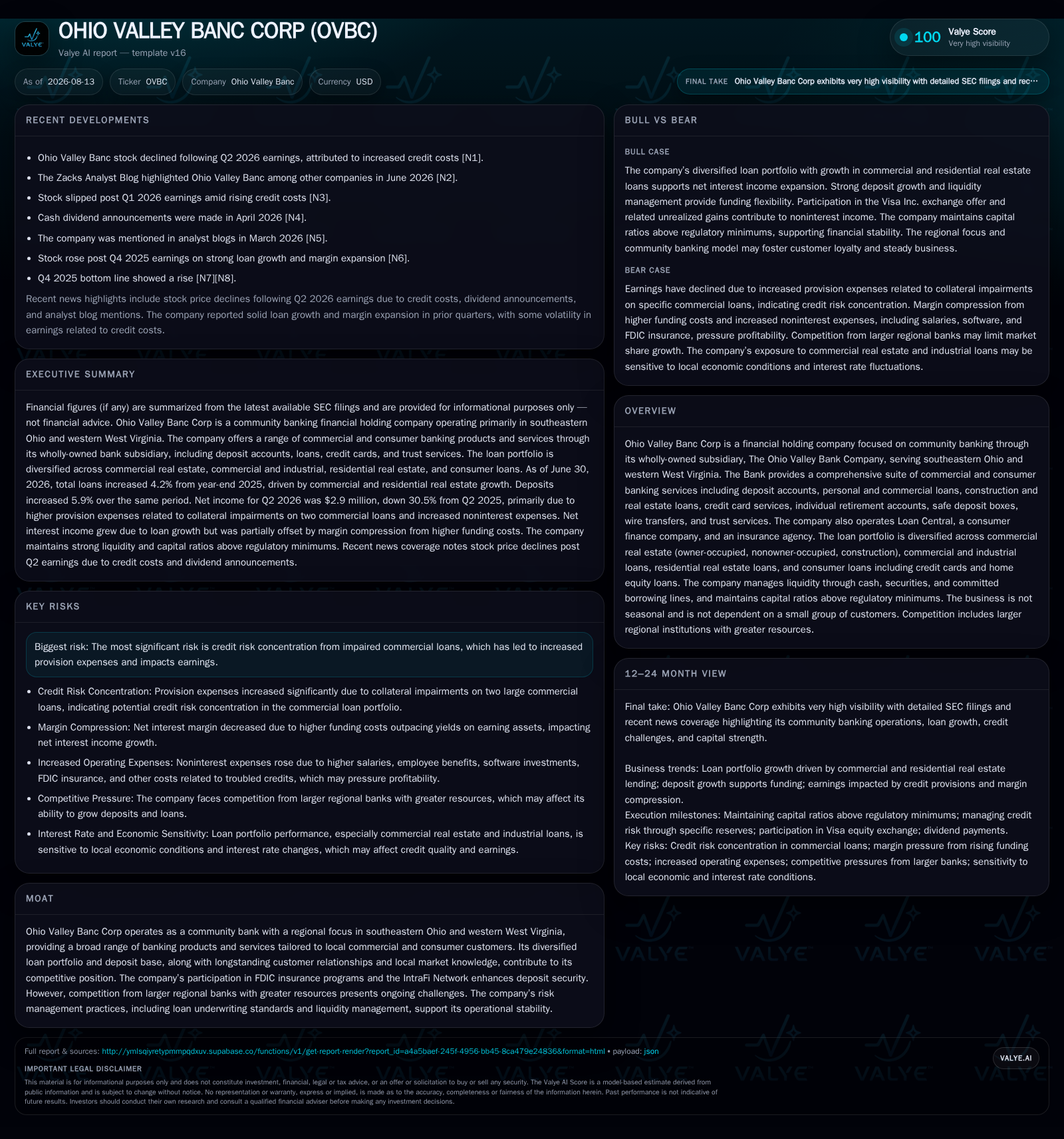
Ohio Valley Banc Corp reported a significant 30.5% drop in net income for Q2 2026 compared to the prior year, primarily due to increased provisions for loan losses driven by impaired commercial loans. The company remains focused on community banking in southeastern Ohio and western West Virginia with a diversified loan portfolio and ancillary financial services. However, profitability metrics such as return on assets and equity declined, underscoring challenges from credit risk concentration and competition from larger banks. Managing liquidity, underwriting standards, and non-interest income streams will be key to stabilizing earnings going forward.
Recent Operating Update Highlights
Ohio Valley Banc Corp’s second quarter of 2026 reported consolidated net income of approximately $2.93 million, down sharply by 30.5% compared to the same period in the previous year when earnings were about $4.21 million [S3]. Correspondingly, earnings per share declined from $0.89 to $0.62. These results were primarily impacted by higher provision expenses tied to deteriorating credit quality in certain commercial loan segments [S3][S2]. This elevated provision burden dampened profitability ratios, with the annualized return on assets (ROA) falling by 42 basis points to 0.70% for Q2 and return on equity (ROE) contracting nearly 400 basis points to just under 7% during the quarter [S2].
This near-term pressure highlights an ongoing challenge faced by Ohio Valley Banc that stems from credit risk concentration, particularly within impaired commercial real estate loans—a typical vulnerability in regional community banks that focus heavily on local commercial borrowers susceptible to economic fluctuations [N1][S2]. The increased provisions suggest cautious loan loss reserving aligned with deteriorating asset quality but also signal cost pressures that constrain earnings growth.
Business Model Overview
Ohio Valley Banc is structured as a financial holding company centered around its wholly owned subsidiary The Ohio Valley Bank Company, which serves Southeastern Ohio and Western West Virginia through community banking operations focused on localized commercial and consumer lending products [S1]. The bank attracts deposits primarily through retail checking, savings, money market accounts, and time deposits within its region’s small towns and cities.
Its loan portfolio is diversified across several key segments: commercial real estate (both owner-occupied and non-owner-occupied properties), construction loans, commercial and industrial loans (C&I), residential real estate mortgages, major consumer loans including credit cards and home equity lines of credit [S1]. This mix reflects a typical regional community bank approach aiming to mitigate portfolio concentration risks by spreading exposure over various customer types while tailoring underwriting standards closely monitored for local economic conditions.
Beyond core banking services, Ohio Valley Banc operates Loan Central, Inc., a consumer finance business offering products such as tax refund advance loans (TALs) often bundled with tax preparation services—a strategy enhancing fee income alongside interest margins [S1]. Additionally, it runs an insurance agency providing another channel for non-interest revenues which can partially offset interest rate volatility or provision surges.
Revenue generation relies heavily on net interest margin (NIM), which is the spread between interest earned on loans/investments versus interest paid on deposits/borrowings. Ancillary fees contribute additional steady revenue but are generally smaller than core interest income streams in overall scale. Operating leverage depends on efficient branch operations balanced against investment in digital platforms aimed at improving customer retention amidst evolving banking preferences.
Industry Structure and Competitive Position
Ohio Valley Banc competes primarily within the regional community banking niche characterized by intense competition from both similarly sized local banks and larger regional institutions capable of offering broader products or more technological innovation [S1]. Larger peers like Regions Financial Corporation or United Bankshares operate with scale advantages permitting investment in digital platforms or expanded lending capacity absent for smaller players.
However, Ohio Valley Banc’s strength lies in deep local market knowledge fortified through long-standing relationships with local businesses and consumers—a valuable competitive moat granting insight into borrower creditworthiness often unavailable to distant lenders [S1]. This relationship banking fosters customer loyalty but also concentrates exposure geographically.
Deposit gathering benefits from FDIC insurance participation supplemented by involvement in programs like the IntraFi Network that enhance deposit security—vital for maintaining stable funding costs in fluctuating markets [S1]. Liquidity management is generally conservative; at June 30, 2026 cash and equivalents stood near $78 million exceeding total debt outstanding (~$23 million) by roughly $55 million indicating a strong liquidity position able to support loan growth or absorb shocks [F1].
Growth Drivers
Key growth drivers include expanding lending within small-to-medium enterprises benefitting from localized economic development efforts across Southeast Ohio and Western West Virginia regions where bank branches are concentrated [S1]. Loan demand growth could be supported by infrastructure investments or governmental incentives enhancing business activity locally.
Deposit growth is likely sustained through effective relationship management combined with ancillary service cross-selling—insurance products and consumer finance lending provide additional revenue streams that dilute dependence solely on interest margin fluctuations [S1]. Increasing adoption of digital banking capabilities tailored specifically for community demographics offers potential for improved operational efficiency and customer engagement moving forward.
Maintaining strong underwriting standards while selectively expanding loan portfolio segments less prone to volatile impairments could help moderate future provision spikes—a vital lever given recent credit experience [S2][N1]. Strategic partnerships or selective acquisitions of niche financial service providers might further accelerate growth in fee-based income areas without disproportionate capital requirements.
Risks and Growth Constraints
Credit risk concentration remains the most pressing challenge facing Ohio Valley Banc as evidenced by higher loan loss provisioning impacting recent earnings performance [S3][N1]. Commercial real estate loans tied to impaired borrowers create vulnerability especially if local economic conditions weaken further impacting borrower repayment ability.
Interest rate volatility also threatens net interest margin stability since margins can compress if deposit costs rise faster than loan yields or reinvestment yields fall adversely affecting new originations or securities held for investment purposes [S2]. Competition from larger regional banks creates pricing pressures on both deposit rates and loan spreads while limiting scale economies required for technological upgrades.
Regulatory compliance burdens pose ongoing constraints requiring capital reserves calibration potentially limiting aggressive balance sheet growth relative to capital adequacy thresholds enforced by regulators focused on systemic safety.[S1]
Liquidity risk remains low currently given cash surplus versus debt; however sudden depositor withdrawals triggered by regional economic shocks remain possible requiring close monitoring of loan-to-deposit ratios and funding sources stability [F1][S2]. Operational risks including cybersecurity threats require continued investment limiting discretionary margins.
What To Watch Next
Investors should track quarterly credit metrics closely including non-performing loans ratio (NPL), net charge-offs levels, provision expense trends, alongside new loan originations segmented by portfolio type—as deterioration or improvement here will drive results volatility given concentrated exposures [S2][N1]. Changes in deposit base size and composition will indicate funding cost trajectories affecting net interest margin sustainability.
Management commentary regarding underwriting adjustments or stress testing outcomes during upcoming quarterly calls will illuminate risk management effectiveness while announcements around expanded ancillary service offerings may signal revenue diversification strategies advancing beyond core lending dependence.
Monitoring regulatory updates that could alter capital rules or reporting requirements will affect capital allocations potentially influencing growth strategies.[S1]
Digital platform enhancements announced could boost customer retention mitigating competitive threats from larger banks deploying robust multi-channel capabilities [N2]
Financial Profile Discussion
As of June 30, 2026, Ohio Valley Banc reported cash & equivalents totaling approximately $78.08 million against total debt of $23.13 million reflecting a net cash position near $54.95 million reinforcing strong liquidity reserves crucial for managing unexpected outflows or supporting incremental lending activities without immediate reliance on external borrowings [F1]
Profitability challenges persist given Q2 net income contraction reflective mainly of elevated provision expenses—an inherent tension within community banks managing cyclical credit cycles but challenged further here by specific sectoral credit stress concentrated in commercial real estate portfolios [S3][S2].[N1] Declines in ROA (to roughly 0.7%) and ROE (to ~6.8%) emphasize pressure on capital returns necessitating careful cost management balanced with prudent growth investments going forward.
Maintaining adequate capital buffers remains imperative amid regulatory scrutiny focused more intensely post financial crises ensuring stakeholder confidence despite earnings volatility inherent to regional community banking models reliant predominantly on net interest income coupled with measured fee-based diversification strategies.
Disclaimer: This is research-only, informational analysis and not investment advice. It may include AI-generated interpretation and general industry context. Always verify important details using primary sources.

Comments